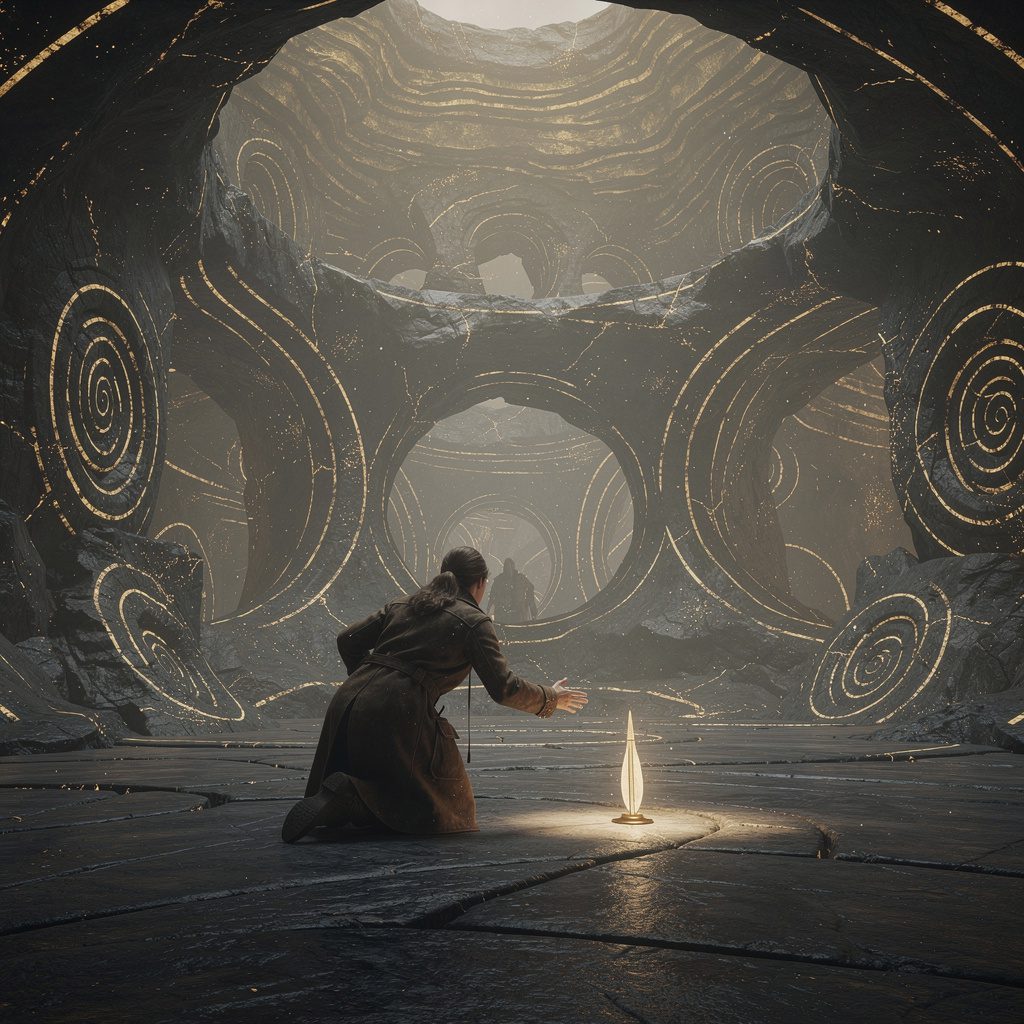
It moves across the smooth stone floor in a clean, unhurried arc, three inches, six, and then it comes to rest against her palm with a weight that is nothing like what she expected — not the cold weight of metal or the fragile lightness of glass, but something in between, something that has warmth in it, that settles into her hand with the specific, settled quality of a thing arriving where it intended to arrive. The filament’s rotation does not stop. It shifts direction. It spins now in a spiral that winds up along her wrist, not touching her skin, hovering perhaps a quarter-inch above it, tracing the path of her veins with an attention that is, despite everything, not frightening. It is, she thinks, the most precise calibration she has ever witnessed. Better than anything she built at school. Better than the clockwork wick-adjuster on her lantern, which she is genuinely proud of. The amber light in the chamber reaches its full brightness and then holds there, steady and warm and complete, and the vibration through the floor rises to something she can almost hear, a note just below the threshold of sound, resonant and enormous, the mountain’s version of a door clicking open.
She closes her fingers gently around the Spindle.
The urgency arrives then, not as fear but as clarity — a sudden, absolute certainty that she needs to move, that the mountain’s welcome is genuine but not indefinite, that there is a difference between being chosen and being given unlimited time to act on it. She is on her feet before she has fully decided to stand, her field journal tucked under one arm, the Spindle warm and steady in her right hand, the filament still spiraling along her wrist in its quiet, continuous assessment. She moves toward the cleft entrance at a pace that is not quite a run but is not a walk either, the pace of someone who trusts the decision that has been made and is now simply implementing it efficiently, which is the pace Miriam Lockhart moves at whenever she knows exactly what she is doing. The amber light in the veins dims behind her as she passes, not going out but quieting, the way a machine quiets when the work cycle is complete. By the time she steps through the cleft into the grey morning air of the Greyfen Marshes, the chamber behind her is exactly as dark as it was before any of this began.
She stands in the mist for a moment, breathing.
The Spindle’s filament has slowed again, back to its original unhurried rotation, and the warmth of it in her hand is steady and undemanding, the warmth of a thing that has made its choice and is at peace with it. The marsh is exactly as it was: reeds, still water, small dark birds moving through the silver morning like quiet thoughts. Miriam looks at the Spindle for a long moment, and then she opens her field journal to a clean page and begins, in her precise, slightly cramped handwriting, to write down what she knows. Not what she felt. Not what she imagined. What she knows. The Spindle came to her. It measured her first. It found her — her patience, her discipline, her willingness to wait and observe rather than grab — sufficient. She records this without pride and without wonder, because pride and wonder are not useful in the field, and because she suspects the Spindle would find them slightly embarrassing on her behalf. She is probably right. The filament turns, and turns, and turns. Somewhere in the reeds, a bird calls once, low and clear, and the marsh absorbs the sound without an echo.

 WhatsApp
 Telegram
 Email







Categories
- AI & Technology
- Contemporary
- Corporate Control
- Creepypasta
- Crime Thriller
- Cyberpunk
- Dark Fantasy
- Enemies to Lovers
- Fairy Tale Retelling
- Fantasy
- First Contact
- Forbidden
- Genetic/Body Horror
- High Fantasy
- Monster Hunter
- Mythic/Folklore
- Paranormal
- Portal/Otherworld
- Post-Apo
- Post-Collapse Society
- Psychological Thriller
- Romances
- SCI-FI
- Second Chance
- Slow Burn
- Space Combat
- Spacepunk
- Surveillance State
- Survival Thriller
- Thrillers
- Time Travel
- Treasure Hunter
- Urban Fantasy
- Witchcraft/Curses
Tags
10min stories atmospheric atmospheric fantasy atmospheric fiction contemporary romance Creepy creepypasta crime thriller dark fantasy debt dystopia emotional fiction enemies to lovers ensemble cast epistolary fantasy first person forbidden romance found text framed narrative high fantasy love story magic Memory mystery Paranormal psychological horror psychological thriller romance sci-fi second chance second chance romance short fiction short story slow burn space station speculative fiction supernatural Survival survival thriller suspense thriller travel romance witchcraft workplace romance
Leave a Reply