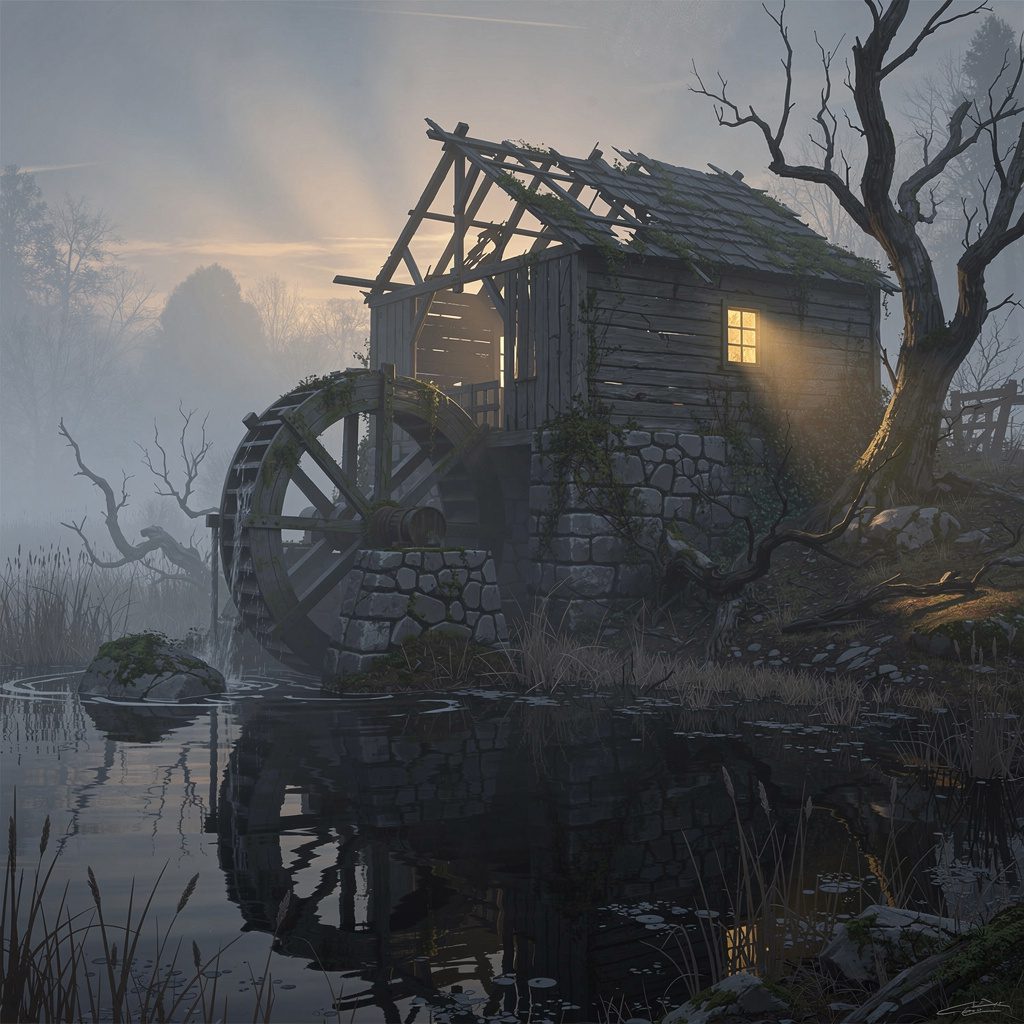
“You’ve come about the debt,” the woman said, before Radhika had even pushed through the door of the mill.
Radhika stopped. The door swung behind her on a hinge that creaked like a poorly fitted gear tooth — the kind of sound that meant something had been opening and closing far longer than iron ought to allow. “I’ve come about my grandmother,” she said carefully. “She’s stopped breathing right. Stopped sleeping. Stopped being herself.”
“Same thing.” The woman didn’t turn from the loom. Her fingers moved across the threads with the practiced rhythm of a master craftsperson — the kind Borin Gearhammer would have called someone who understood the mechanism of things, the way tension and release work together like cogs in a well-oiled press. “The debt is why she breathes wrong. Sit down, girl. You’re letting in the fen.”
Radhika sat.
The mill was not what she had expected. From outside, it was a ruin — walls bowed outward like a barrel stave under pressure, the waterwheel motionless in the black water of Thistlewick Fen. But inside, it was warm and enormous, impossibly so, the ceiling lost somewhere in amber shadow. The loom itself occupied the center of the room: a construction of dark wood and pale bone and something that might have been copper wire, stretched so tightly that Radhika could hear it hum when the woman touched it. The threads running through it were not wool or silk. They were colors she didn’t have names for — a red that felt like embarrassment, a grey that smelled like old rain, a gold that made her teeth ache when she looked at it too long.
“My grandmother made a bargain,” Radhika said. “Thirty years ago.”
“Thirty-one.” The woman’s fingers didn’t pause. “She wanted her harvest saved. The blight was coming, and she had three daughters to feed, and she came to me at the edge of this very fen and asked for help. I gave it.”
“And what did you take?”
Now the woman turned. Her face was long and narrow, with eyes the color of still water over dark stone — not quite green, not quite grey, not quite anything Radhika could hold in her mind for more than a moment. Her ears tapered to a soft point, almost hidden in hair the color of tarnished silver. Her hands, Radhika now saw, had one too many joints in each finger, the extra knuckle bending inward like a latch folding closed.
“I took a thread,” she said. “From the loom of her life. She agreed. One thread, freely given. She thought it meant a year. Maybe a decade.” A smile, thin and patient as a crack in old stone. “It meant the last year. The thread at the end of the weave.”
Radhika’s chest went tight. “You’re taking her death.”
“I’m holding it. There’s a difference. The machine still runs — she breathes, she wakes, she speaks. But the mechanism is incomplete. A gear with a missing tooth doesn’t grind to a halt immediately. It stutters. It skips. And eventually —”
“I know what eventually means,” Radhika said. Her voice was flat and controlled, the way her grandmother had taught her to speak to anyone who thought they had the upper hand. “I want to make a trade.”
The fae woman turned back to the loom.
For a long moment, the only sound was the hum of those nameless-colored threads and the distant, wet breath of the fen outside.
“Everyone who comes here wants to make a trade,” the woman said. “It’s the most human thing there is. You can’t simply accept a mechanism once it’s been set. You always want to reach inside and rearrange the gears.” She didn’t say it unkindly. She said it the way an engineer might describe a recurring flaw in a design — not with contempt, but with a kind of tired familiarity. “What could you possibly offer me, Radhika Kapoor?”
Radhika had thought about this for six weeks. She had walked the fen twice, mapped its edges, traced the mill’s reflection in the black water every morning before dawn. She had brought three things in the satchel now resting against her knee: a jar of honey from her grandmother’s last hive, a lock of her own hair tied with red thread, and a small iron mechanism she had built herself — a clockwork puzzle box, seventeen moving parts, no solution yet found by anyone who had tried it.
She put the puzzle box on the floor between them.
The fae woman looked at it. Something shifted in those still-water eyes.
“I’ll solve it,” Radhika said. “Right now. In front of you. If I can, you return the thread. If I can’t, you take a thread from my loom instead, and my grandmother goes free.”
Silence.
“You built that yourself,” the woman said.
“Yes.”
“And you know the solution.”
“Yes.”
The woman was quiet for a long time. Then: “That’s not a gamble. You can’t lose.”
“No,” Radhika agreed. “I can’t.”
Another silence. Longer this time.
“Why,” the fae woman said slowly, “would I accept a wager with no risk to you?”
“Because you’re bored,” Radhika said. “Because everyone who comes to you is desperate and frightened and they make messy, panicked bargains and you hold all the threads and you know exactly how every loom ends. And I’m offering you something you haven’t seen in thirty-one years.” She met those water-grey eyes and held them. “Someone who came prepared.”
The fae woman looked at her for a very long time.
Then she laughed — a sound like a latch releasing, like pressure equalizing in a sealed chamber, like something old and tightly wound finally letting go. “Solve it, then.”
Radhika picked up the box. Her fingers moved through the sequence — press, rotate, slide, compress, turn — seventeen steps, practiced until they lived in her hands rather than her head. The box opened with a soft, definitive click.
Inside was nothing. An empty chamber.
The fae woman leaned forward. A flicker of something crossed her face — not quite surprise, but its close mechanical cousin.
“That’s the trick, isn’t it,” Radhika said quietly. “Everyone assumes there has to be something inside. That a locked thing must be hiding something worth keeping. But the box was never about the contents. It was about the opening.”
She looked up.
“Return the thread.”
The loom made a sound. A single note, clear and final, like a tuning fork struck against good iron. One of the nameless-colored threads — a warm amber, almost the color of old honey — loosened from the weave and drifted upward, dissolving before it reached the ceiling.
Radhika walked home through the fen as the sun came up behind the sedge grass, turning the black water amber.
Her grandmother was sitting up in bed when she arrived. Color in her cheeks. Breathing even and deep, like a bellows working in proper rhythm. She looked at Radhika with clear eyes and said, “I had the strangest dream. I dreamed someone gave me back something I didn’t know I’d lost.”
“Rest,” Radhika said. “I’ll make tea.”
She put the kettle on and stood at the window while it heated, looking out at nothing in particular.
It was only later — much later, when she was washing the puzzle box before putting it away — that she noticed it.
The box had seventeen moving parts. She had built it herself. She knew every piece.
But the interior chamber, which had always been empty by design, now held a single thread — amber-gold, faintly warm to the touch, coiled neatly at the center.
The fae woman had not returned the thread to her grandmother’s loom.
She had put it somewhere safe.
Radhika closed the box. Set it on the highest shelf. Stood very still for a moment, running through the implications the way you run a hand along a gear train, feeling for the catch, the skip, the place where the mechanism had been quietly, precisely rerouted.
Then she went and made the tea.

 WhatsApp
 Telegram
 Email
Email





Leave a Reply