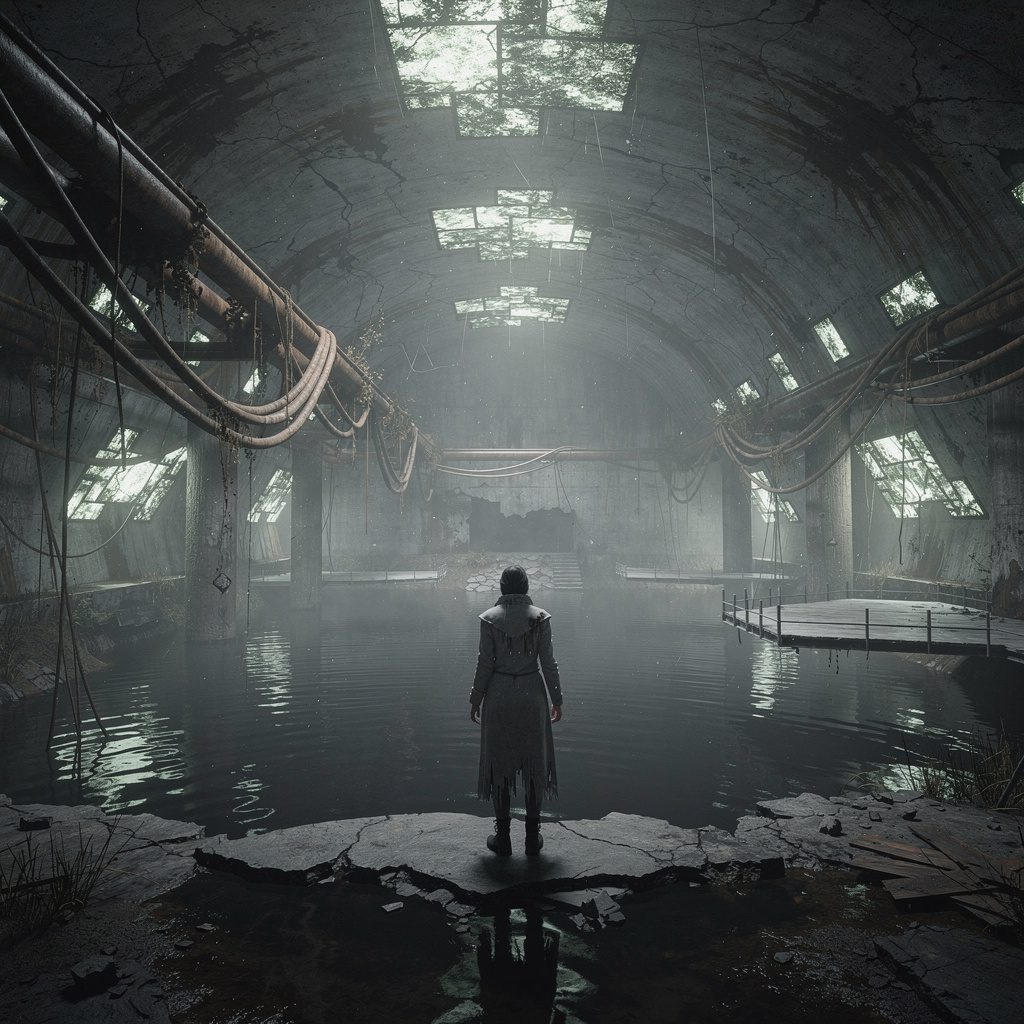
RECOVERED DATA FRAGMENT — DESIGNATION: AASEN, NANNA K.
IMPLANT SERIAL: VX-7 / CORTEX-BIND MODEL 4
LOG DATE: [CORRUPTED] — APPROX. CYCLE 1,847 POST-COLLAPSE
STATUS: UNAUTHORIZED ACTIVATION
— Fragment begins —
Flash again tonight. Third one this week. Saw the eastern water tower collapse before the structural bolts even started to rust. Saw Petrov’s dog dead in the courtyard two days before it happened. I don’t talk about it. Nobody here talks about implants anymore. They find one on you, they take it. They take everything attached to it. I’m keeping this log because I need to know if I’m losing my mind or if the VX-7 is actually doing what the Cortex-Bind documentation said it could do. The documentation I’m not supposed to have. The documentation that cost me three months of water rations to obtain.
If someone finds this log and I’m already gone — the implant is real. The flashes are real. And the big one hasn’t happened yet.
— Fragment ends —
—
Nanna moves through the ruin district before dawn, when the scavenger patrols are thinnest.
Her boots are wrapped in salvaged insulation foam to muffle sound on the cracked concrete. Her coat is the color of ash and old brick — deliberate. She has worn nothing bright in four years.
The city used to have a name. Now people just call it the Shelf, because the collapse hit unevenly: some districts dropped six meters when the underground aquifers gave out, leaving whole neighborhoods on raised platforms of intact road, looking down at flooded rubble below. Nanna lives on the low side. Everyone useful lives on the low side.
She carries a short-range signal jammer clipped to her belt, a water filter slung across her back, and a thermal blade tucked into her boot. Not for fighting. For cutting wire. For prying open sealed access hatches. For the kind of work that keeps a person alive in a place where no government, no corporation, no organized force has held territory in over a decade.
The implant sits behind her left ear, beneath the skin. A hard ridge, barely visible. She’s had it for fourteen months.
She didn’t choose it. She found it.
—
The VX-7 was a military prototype. Pre-collapse, maybe ten years before the aquifer failures started, before the food chain fractured, before the Shelf became what it is. The documentation she paid for describes it as a “cognitive anticipation module” — designed to give frontline soldiers fractional-second threat prediction by reading micro-signals in the environment and projecting probable outcomes directly into the visual cortex.
But the version she found had been modified. Upgraded, maybe. Or broken in a specific way that changed what it did.
It doesn’t show her fractions of a second ahead.
It shows her days.
—
The first flash came three weeks after she installed it herself, using a mirror, a field-surgery kit, and a detailed diagram she had memorized rather than printed. It lasted two seconds. She saw the old market bridge — the one connecting the Shelf’s high side to the processing district — cracking down the center, people scrambling, crates of trade goods sliding into the dark water below.
Four days later, the bridge cracked. Nobody died. But four families lost everything they owned.
She had not warned them. She hadn’t known what she was seeing.
She knows now.
—
Today’s flash came at 0400, jolting her out of sleep.
She sat up on her cot in the dark, breathing hard, the implant humming faintly behind her ear — a sensation like a tuning fork pressed against bone.
What she saw: the Shelf’s main cistern. The one that serves eight hundred people on the low side. A figure in a gray work jacket crouching beside the primary intake valve. A small device being attached to the pipe junction. Then water running dark. Then people sick. Then people not moving.
She sat with it for a long time.
Then she got up, wrapped her boots, and went out into the pre-dawn dark.
—
The cistern is a four-kilometer walk northeast, through two collapsed transit corridors and across the open plaza that used to be a university campus. The plaza is exposed. She doesn’t like crossing it. The scavenger gangs that control the north quarter use elevated positions — old faculty towers — to watch for movement.
She crosses low and fast, using the remains of a decorative wall as cover, moving in short bursts between standing sections.
Her breath fogs in the cold air.
The implant is quiet now. It’s always quiet after a flash. Like it spent something to show her, and needs time to rebuild.
She doesn’t know what it’s spending. She doesn’t let herself think about that too hard.
—
The cistern facility is a squat, reinforced structure that predates the collapse by fifty years. Solid construction. The kind of building that survives because someone, long ago, built it to last rather than to impress.
Its walls are poured concrete, stained dark with years of moisture and algae bloom. Ventilation grates run along the base, each one sealed with a welded mesh. The main door — heavy steel, manual bolt — faces west. A secondary access hatch sits on the north face, lower to the ground, used by maintenance crews back when maintenance crews existed.
Nanna knows this building. She helped repair its secondary filtration unit eight months ago, trading three days of skilled labor for a month’s water credit.
She knows the north hatch doesn’t lock properly.
—
She eases through the hatch on her belly, pulling herself into the narrow service corridor beyond.
The air inside is thick with mineral damp. The smell of still water and old metal. Emergency lighting — a strip of bioluminescent panels someone installed after the grid failed — casts everything in a faint green-white glow.
She moves to the end of the corridor and looks through the grate into the main chamber.
The cistern itself is enormous. A vast, vaulted space with a central pool of dark water, the surface perfectly still, reflecting the glow of the panels. Pipes run along the ceiling in dense bundles, dropping down to valve clusters at intervals. The sound is constant: a low, resonant hum of water under pressure, moving through the system, feeding out to the distribution points across the low side.
Nanna watches. Waits.
For a long time, there is nothing.
She begins to wonder if the flash was wrong. If the timing is off. If she misread it.
The implant has never been wrong.
But it has been early.
—
The figure arrives forty minutes later.
Gray work jacket. Exactly as she saw it.
Nanna doesn’t move.
The figure is slight, deliberate, carrying a compact kit bag. They move to the primary intake valve on the east wall — the largest junction in the facility, the one that feeds the main distribution trunk — and crouch beside it. They work quietly. Practiced. This is not their first time in this building.
From the kit bag: a device the size of a flattened fist, matte black, with a short nozzle on one end.
Nanna’s jaw tightens.
She knows what it is. She’s seen the type before — an injector unit, used for chemical treatment of water systems. Legitimate purpose: mineral balancing, algae suppression. Illegitimate purpose: everything else.
She has no idea who sent this person. She has no idea what is in the injector. She does not need to know either thing to understand what she has to do.
—
She removes the grate slowly, setting it aside without a sound.
The chamber amplifies everything. The hum of the water. Her own breathing. The small metallic sounds of the figure working at the valve.
She drops into the main chamber.
The figure spins.
For a moment, they simply look at each other across ten meters of green-lit concrete.
Nanna holds up the thermal blade — not raised to threaten, just visible. Present. A statement of fact.
“Step back from the valve,” she says. Her voice is level. She has practiced keeping it level for years.
The figure doesn’t run. That surprises her. They stand, slowly, and she sees their face clearly for the first time: young, tired, a deep scar running from the left jaw to the collarbone. Someone who has been through their own version of what the Shelf does to people.
“You don’t know what’s in it,” the figure says.
“I know it’s going in that pipe,” Nanna says. “That’s enough.”
A long silence. The water hums beneath them both.
The figure sets the injector on the ground and steps back.
—
Nanna crosses the chamber. Keeps her eyes on the figure. Crouches and picks up the injector without looking away.
The figure watches her with an expression she can’t fully read. Not anger. Something closer to exhaustion.
“They said no one would know,” the figure says quietly. “They said the timing was perfect.”
Nanna doesn’t ask who “they” are. That’s a problem for another day. A problem for people with more resources than she has.
“Get out of the building,” she says. “Don’t come back.”
The figure goes.
—
Nanna stands alone in the cistern chamber for a long time.
The water hums. The bioluminescent panels glow their cold green-white across the surface of the pool. Eight hundred people on the low side will wake up today and fill their cups and cook their food and never know this room existed, or what almost happened in it before dawn.
She looks at the injector in her hand.
Matte black. Dense. Heavier than it looks.
She carries it to the secondary corridor, seals it inside an empty junction box she finds in the maintenance alcove, and marks the box with a scratch pattern she’ll recognize. Evidence, if she ever finds someone worth giving it to.
Then she sits on the floor of the corridor, back against the damp concrete wall, and lets herself breathe.
—
The cost announces itself twenty minutes later.
The implant flares — not a flash this time, not a vision of future events, but a sustained, burning pressure behind her left ear. Like something overloading. Like a circuit held past its tolerance.
She presses her hand against the spot. The humming she’s grown used to over fourteen months is gone. Replaced by silence.
Complete silence.
She has read enough of the documentation to understand what that means. The VX-7 was not designed for sustained operation. It was not designed to be carried by one person for over a year, running continuous low-level anticipation cycles, firing full predictive flashes multiple times per week. It was designed for short deployments. Controlled conditions. Technicians on standby.
She has none of those things.
She sits in the maintenance corridor beneath the cistern and understands, with a clarity that does not feel like grief yet, that the implant is done. Whatever it spent to show her this morning’s vision was the last of what it had.
No more flashes.
No more warnings.
Just Nanna, and the Shelf, and whatever comes next — arriving in real time, without preview, the way it arrives for everyone else.
—
She pulls herself upright.
Her boots are still wrapped in insulation foam. Her coat is still the color of ash and old brick. The water filter is still slung across her back.
She goes out through the north hatch into the pale gray light of early morning.
The Shelf is waking up. She can hear it — distant voices, the clank of trade goods being moved, somewhere a generator cycling on. The low-side sounds she knows as well as her own breathing.
She walks home.
The implant behind her ear is silent and still, like a stone that used to hold heat.
She doesn’t know what today will bring. She doesn’t know what tomorrow holds. She will have to watch for things the way everyone else does — carefully, with her own two eyes, reading the world as it happens rather than before it does.
For the eight hundred people who will drink clean water today, that is a fair price.
She decides, somewhere between the collapsed transit corridor and the university plaza, that she believes that.
She walks on.

 WhatsApp
 Telegram
 Email
Email





Leave a Reply