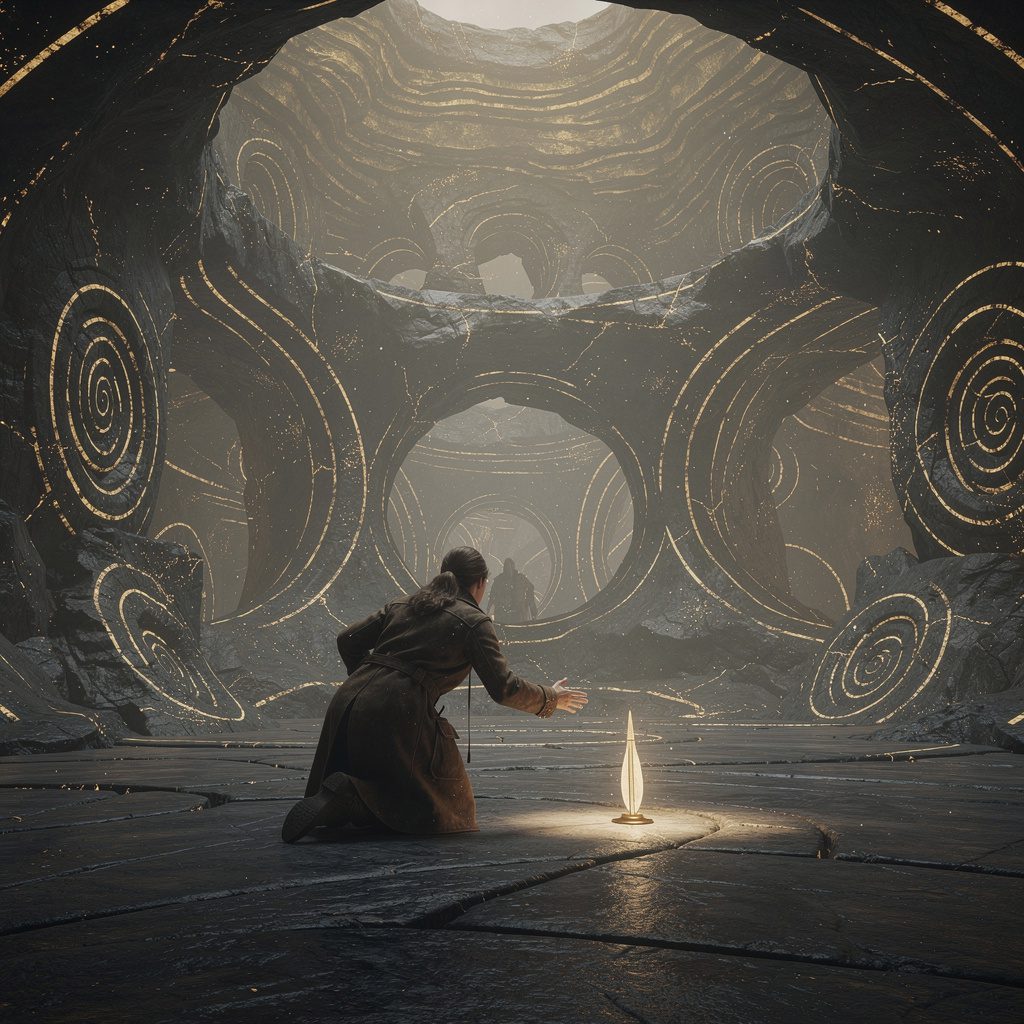
This is the discipline that the Gearhammer School of Applied Acquisition instills above all others: you do not touch the object until you understand the object, or until you understand, at minimum, why you cannot understand it. Miriam circles the Spindle at a distance of roughly four feet, studying it from every angle, noting in her journal the way the ambient light in the chamber seems slightly brighter near it, the way the warmth of the floor is more pronounced in the area immediately surrounding it, the way the filament’s rotation does not vary by so much as a degree per minute regardless of her position or movement. She sketches it. She sketches the floor around it. She notes the absence of any marks on the floor, any wear pattern, any indication that the three previous expeditions touched the Spindle or even approached it closely. She wonders, not for the first time, what exactly happened to those expeditions inside this chamber. The reports do not say. The reports say only that the teams returned, and that they declined to discuss the interior in any detail, and that the Consortium closed the file. She circles the Spindle a second time, and a third, and on the fourth circuit she becomes aware that the filament’s rotation has changed. It is faster now. Only slightly. But measurably.
She stops.
The filament is rotating faster because she is here, or because she has been here long enough, or because of something specific about her presence that the Spindle has been measuring with the patience of a machine that has been running for four thousand years and has no particular objection to running for four thousand more. Miriam understands, in this moment, something that the Consortium’s closed file was trying and failing to articulate: the Spindle is not waiting to be taken. It is waiting to decide. And it has been deciding, this whole time, with the same quiet mechanical thoroughness that she herself applies to any acquisition: studying her, noting her, measuring the particular quality of her attention, the way she circles rather than lunges, the way she observes rather than assumes, the way she has been, for the past forty minutes, simply present with the thing rather than grasping at it. It is, she thinks, the most rigorous job interview she has ever undergone. She almost laughs. She does not laugh.
She kneels on the warm stone floor, close enough now to see the individual grooves of the carved marks on the Spindle’s surface, close enough to feel the air around it slightly warmer than the air a foot away, close enough to hear — or perhaps only to feel through her knees — the deep sub-audible vibration that the filament’s rotation generates, the same vibration she felt in the entrance marks, the same vibration that is, she now understands, the mountain’s way of being awake. The filament spins faster still. The amber light in the chamber intensifies, not dramatically, not with any fanfare, but steadily and with total confidence, the way a furnace brightens when you give it the right fuel. Miriam opens her hand, palm up, and holds it still. She does not move toward the Spindle. She simply makes space. She waits.
The Spindle rolls.

 WhatsApp
 Telegram
 Email







Categories
- AI & Technology
- Contemporary
- Corporate Control
- Creepypasta
- Crime Thriller
- Cyberpunk
- Dark Fantasy
- Enemies to Lovers
- Fairy Tale Retelling
- Fantasy
- First Contact
- Forbidden
- Genetic/Body Horror
- High Fantasy
- Monster Hunter
- Mythic/Folklore
- Paranormal
- Portal/Otherworld
- Post-Apo
- Post-Collapse Society
- Psychological Thriller
- Romances
- SCI-FI
- Second Chance
- Slow Burn
- Space Combat
- Spacepunk
- Surveillance State
- Survival Thriller
- Thrillers
- Time Travel
- Treasure Hunter
- Urban Fantasy
- Witchcraft/Curses
Tags
10min stories atmospheric atmospheric fantasy atmospheric fiction contemporary romance Creepy creepypasta crime thriller dark fantasy debt dystopia emotional fiction enemies to lovers ensemble cast epistolary fantasy first contact first person forbidden romance framed narrative high fantasy love story magic Memory mystery Paranormal psychological horror psychological thriller romance sci-fi second chance second chance romance short fiction short story slow burn space station speculative fiction supernatural Survival survival thriller suspense thriller travel romance witchcraft workplace romance
Leave a Reply