The entrance is not hidden, which is the first thing that strikes her as significant. In Miriam’s experience, genuinely dangerous places rarely bother with concealment. It is only moderately dangerous places — the kind that rely on your not knowing what’s inside — that hide their doors. The Hollow Mountain’s entrance is a tall, narrow cleft in the basalt, perhaps eight feet high and barely wide enough for a person to pass through sideways, and its edges are worn smooth by what must be centuries of hands brushing against them. Not the hands of the three Consortium expeditions. Older hands. Many of them. The stone around the cleft is incised with marks that are not quite letters and not quite pictures and not quite diagrams, but carry the unsettling suggestion of all three simultaneously, as though they were made by a mind that had not yet decided to separate language from image from instruction. Miriam runs her fingers along one of the marks — a spiral that becomes a gear that becomes an eye — and feels, very faintly, the way you feel when you press your palm to a machine that is running: a deep, sub-audible vibration, more sensation than sound, more knowledge than sensation. She pulls her hand back. She notes it in her field journal. She goes inside.
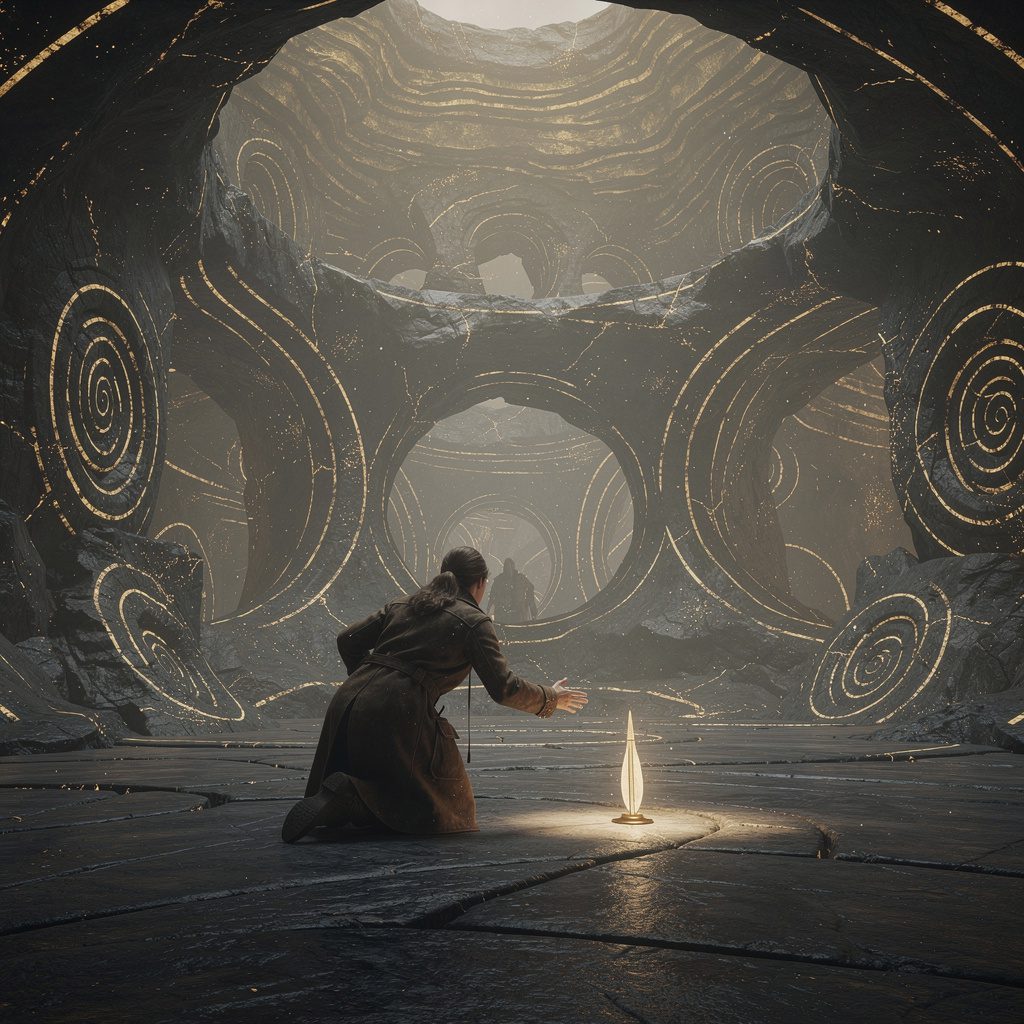
The interior of the Hollow Mountain is lit, and this is the second thing that strikes her as significant, because she has brought a lantern and has not yet needed it. The light comes from the basalt itself, or rather from the mineral deposits within it: long veins of something crystalline and faintly amber, running through the dark rock like the circulatory system of a sleeping animal, pulsing with a light that is not quite steady, that shifts and breathes almost imperceptibly, so that the shadows in the chamber never fully settle. The chamber is enormous. Miriam’s structural cartography training makes her estimate it at roughly ninety feet in diameter and perhaps sixty feet to the apex of the natural dome above, and she knows these numbers are approximately correct, and she also knows, standing inside the chamber, that numbers are entirely the wrong tool for describing what it feels like. It feels like the inside of a thought that something very old is still thinking. The floor is smooth and slightly warm underfoot, and at its center — not on a plinth, not in a vault, just resting on the bare stone as though it had been set down for a moment and then forgotten — is the Spindle of Orun Dask.
Miriam stops walking.
She has read descriptions of the Spindle, of course, gathered from the three expedition reports before they devolved into the kind of handwriting that suggests the writer was no longer entirely calm. It is approximately fourteen inches long. It is made of a material that no one has successfully identified, something between bone and metal and glass, pale gold in color, carved along its length with the same not-quite-letters not-quite-gears not-quite-eyes as the entrance. It tapers at both ends, and at its center it widens into a slight bulge, like a spindle of thread with the thread still on it, except the “thread” is a single hair-thin filament of the same amber light as the veins in the rock, wrapped around and around the center in a spiral so fine it is nearly invisible, and it rotates. Very slowly. Continuously. Without any visible mechanism, without any source of power that Miriam can identify, without any reason whatsoever that her training can supply. She looks at it for a long time. She is, she realizes, holding her breath. She lets it out.
She does not reach for it.

 WhatsApp
 Telegram
 Email







Categories
- AI & Technology
- Contemporary
- Corporate Control
- Creepypasta
- Crime Thriller
- Cyberpunk
- Dark Fantasy
- Enemies to Lovers
- Fairy Tale Retelling
- Fantasy
- First Contact
- Forbidden
- Genetic/Body Horror
- High Fantasy
- Monster Hunter
- Mythic/Folklore
- Paranormal
- Portal/Otherworld
- Post-Apo
- Post-Collapse Society
- Psychological Thriller
- Romances
- SCI-FI
- Second Chance
- Slow Burn
- Space Combat
- Spacepunk
- Surveillance State
- Survival Thriller
- Thrillers
- Time Travel
- Treasure Hunter
- Urban Fantasy
- Witchcraft/Curses
Tags
10min stories atmospheric atmospheric fantasy atmospheric fiction contemporary romance Creepy creepypasta crime thriller dark fantasy debt dystopia emotional fiction enemies to lovers ensemble cast epistolary fantasy female protagonist first person forbidden romance framed narrative high fantasy love story magic Memory mystery Paranormal psychological horror psychological thriller romance sci-fi second chance second chance romance short fiction short story slow burn space station speculative fiction supernatural Survival survival thriller suspense thriller travel romance witchcraft workplace romance
Leave a Reply