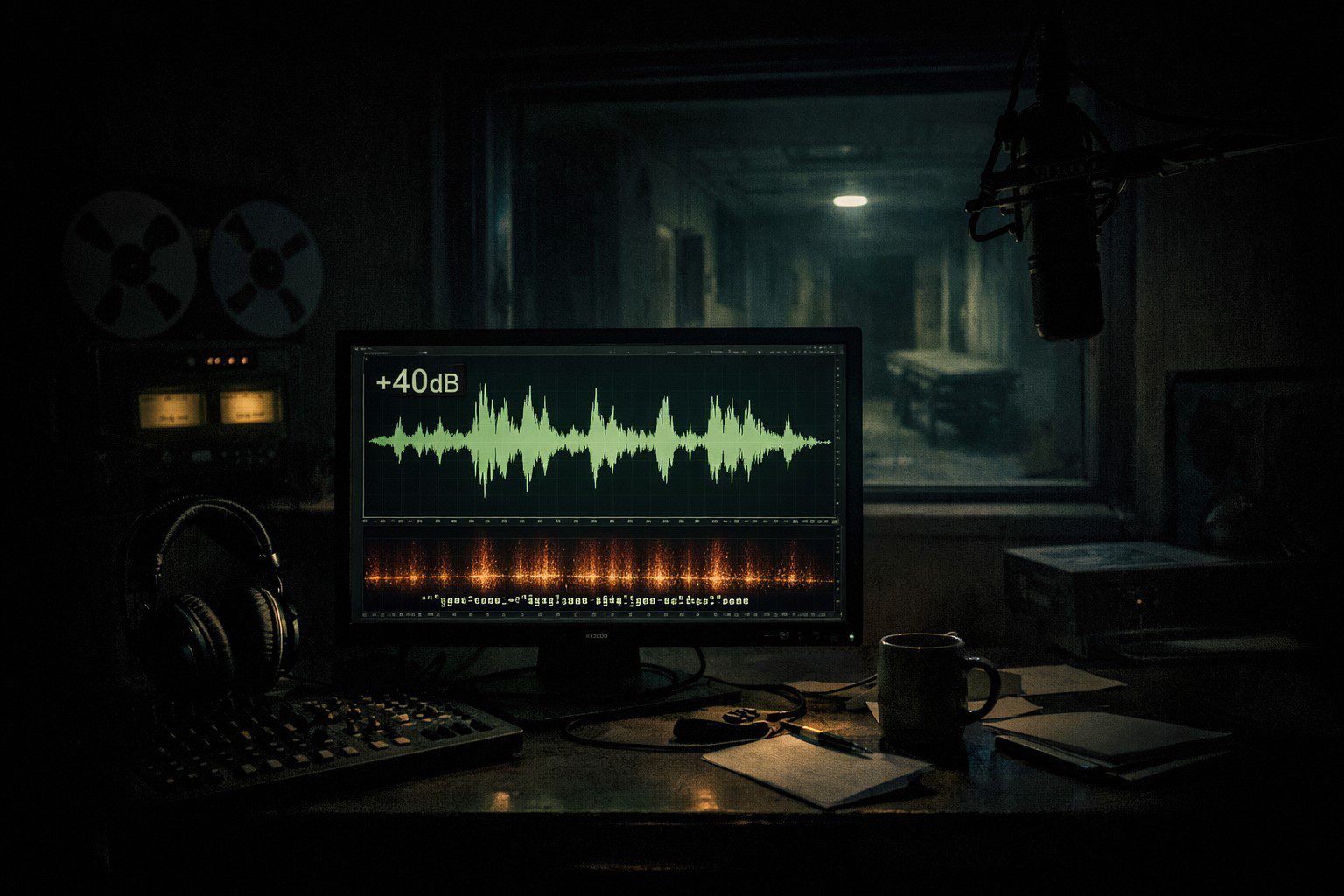
What I did not do was delete the boosted recording I had made for my own analysis. I kept it on a separate drive, labelled it, and told myself I was keeping it for professional documentation purposes, which was partially true.
The other part of the truth was that I had listened to the boosted recording eleven times and I still could not leave it alone.
Not because it was frightening. Because there was something in the rhythm of it that I was trying to place — a quality of repetition that was not mechanical, not monotone, but varied in subtle ways. The phrase repeated exactly in its words, or what I took to be its words, but the delivery shifted. Sometimes it sounded patient. Sometimes it sounded urgent. Once, on the ninth listen, it sounded like something I could only describe as relieved.
A recording of an empty room, in a decommissioned building, with no crew present, containing a voice saying something urgent and patient and occasionally relieved.
I kept listening.
The documentary was broadcast four months after my work was complete. The filmmakers had taken my recommendation seriously: they included a segment in the final cut about the forty-second file, with the boosted audio played beneath a sequence of photographs of the hospital’s upper ward from the 1960s. Dr. Mabry was interviewed briefly and described the language characteristics she had identified without speculating about their origin. The segment was presented as unexplained.
The response was significant. The documentary received more attention than most, and the segment about the audio was the element most discussed — online, in review coverage, in two academic papers that appeared in the following year, both in the field of anomalous audio phenomena, which I had not previously known was a field.
I read both papers. One concluded that the recording was most likely an artefact of the gain-boosting process — structured noise misread as speech by a primed auditory cortex. The other concluded that the phonemic inventory was genuinely anomalous and warranted further analysis. Both cited my name in the methodology sections as the audio engineer who had processed the file. I found it strange to be cited in academic papers. I was not sure how I felt about either conclusion.
What I had not mentioned in my handover notes, and had not told Dr. Mabry, and had not told the filmmakers, was something I had noticed on the eleventh listen and confirmed on the twelfth.
The phrase repeated at six-second intervals, as I had noted from the beginning. What I had not initially noticed was that the intervals had not always been exactly six seconds.
In the first three minutes of the seventeen-minute recording, the intervals were six seconds. In the middle section — from approximately minute four to minute twelve — they shortened. By minute eight they were four and a half seconds. By minute ten they were closer to four.
Then, from approximately minute thirteen to the end, the intervals returned to six seconds. Regular, unchanged, exactly as they had started.
The acceleration in the middle corresponded, in my best estimation of the timeline, to the period when I had first run the gain boost. When I had first heard the voice. When I had been listening.
I do not know how to account for that. I have tried several explanations. The most rational is that my perception of the intervals was distorted by my own attention — that I was listening more carefully in the middle section and was therefore perceiving the spacing differently than it actually was. I went back and measured the intervals frame by frame. The measurements supported what I had heard: the intervals were shorter in the middle section.
Not by much. A second and a half at the minimum, a second and three-quarters at maximum. But shortened.

 WhatsApp
 Telegram
 Email







Leave a Reply