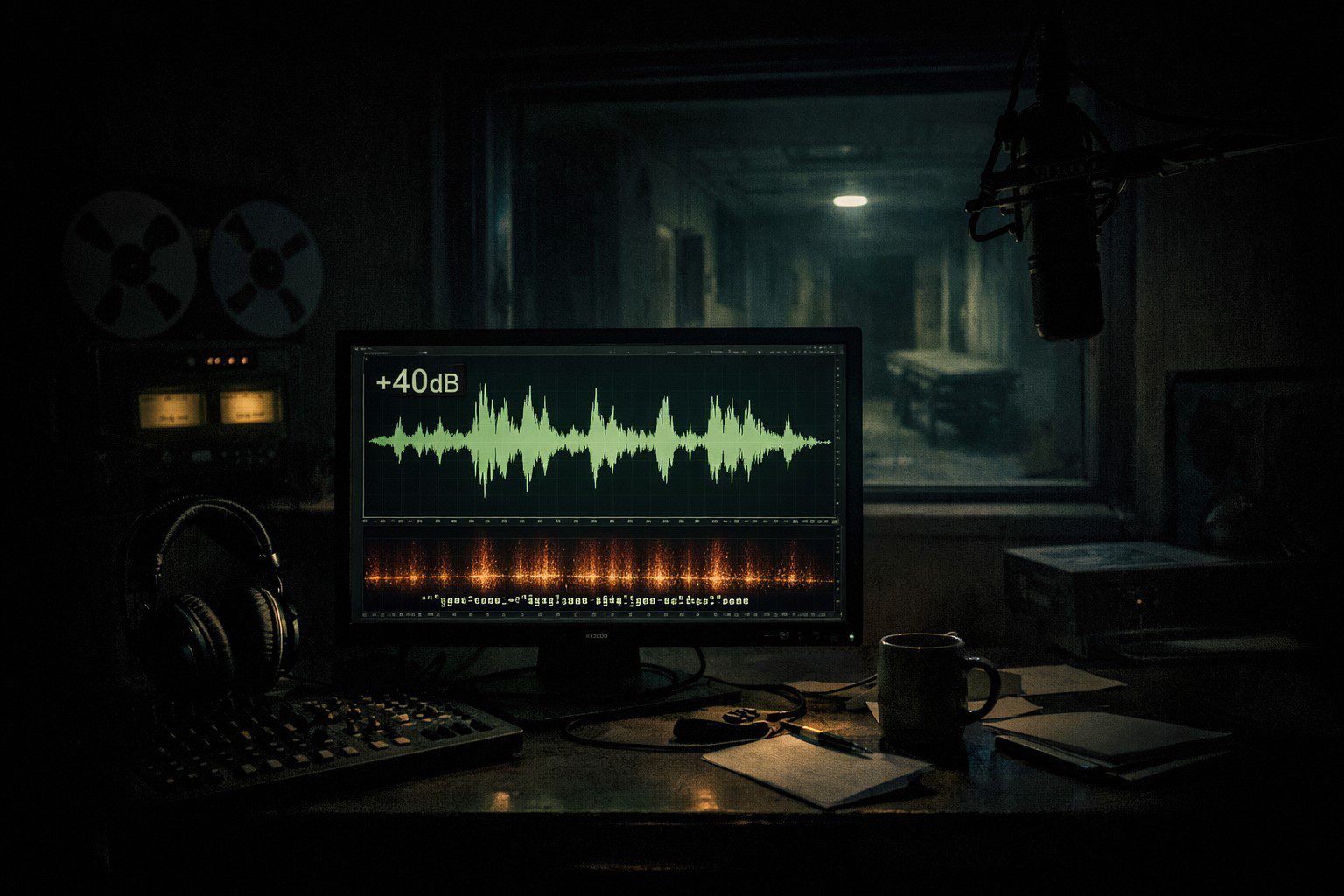
The recording was seventeen minutes of silence — except it wasn’t. When the audio engineer boosted the gain by forty decibels, she found a voice. It was speaking continuously, in a low and unbroken murmur, saying the same sentence over and over in a language she had never heard.
She had been hired to clean the audio from a documentary about a decommissioned psychiatric hospital. She had not been told about the voice.
My name is Sable Reeve. I was thirty-three, I had been doing audio post-production for eight years, and I was not the kind of person who frightened easily. I had cleaned audio from crime documentaries, from war zones, from interviews with people who had survived things I preferred not to think about in detail. Difficult audio was what I did. I had tools and training and a professional relationship with the idea that recordings sometimes contained things their makers had not intended to capture.
The documentary was about Greyvale Hospital, which had operated as a psychiatric facility from 1924 to 1987 and had been closed following a public inquiry into conditions of care. The filmmakers had shot for three days inside the building before it was demolished, and they had delivered forty-two audio files to my studio for cleaning.
Forty-one of them were standard location recording — ambient sound, interview material, footsteps, the creak of a building that had not been heated since the 1980s. The forty-second file was seventeen minutes of what the handover notes described as dead air: no intended recording, no crew present, a microphone accidentally left running in one of the upper ward rooms.
I had listened to it at normal gain and heard nothing. I had run a waveform analysis and found the pattern too flat to represent complete silence, which meant something was there below the threshold of normal listening. I had boosted the gain.
I had found the voice.
I ran the boost three times to confirm I was not hearing an artefact of the process itself — digital noise sometimes presented as pattern, and pattern could sound like speech to a brain primed to find it. But this was not noise presenting as pattern. This was speech. Continuous, rhythmic, structured speech in a language I could not identify, repeating a phrase of perhaps eight to ten words at intervals of approximately six seconds.
I recorded the boosted version and sent it to a linguist contact, a woman named Dr. Fen Mabry, who specialised in obscure and extinct languages and who I had worked with twice before on documentary projects. I told her I had a segment of unknown language from a documentary recording and would she be able to identify it or at least characterise the language family.
She came back in forty-eight hours.
Her response was characteristically precise: the language was not in any family she recognised. The phonemic inventory — the range and type of sounds — was unusual in ways she could describe technically but found difficult to explain, because several of the sounds appeared to fall outside the range of human vocal production. The rhythm and stress pattern was consistent with a phrase being repeated, as I had noted. She could not offer a translation. She could not offer a source.
She ended with a line that I had not expected from her: I would like to not hear this again, if possible. There is something about the rhythm of it that I find difficult to account for.
I was professional enough to continue the work. I cleaned the forty-one files that required it, delivered them on schedule, and flagged the forty-second file as anomalous in my handover notes. I described what I had found without editorialising and recommended the filmmakers consult an independent linguist before deciding how to handle it.

 WhatsApp
 Telegram
 Email







Leave a Reply