We met for coffee. She was the same Ruth, nine years older as I was nine years older, and the first minute was strange in the way that reunions after long silences were always strange. Then she put a folder on the table between us and opened it.
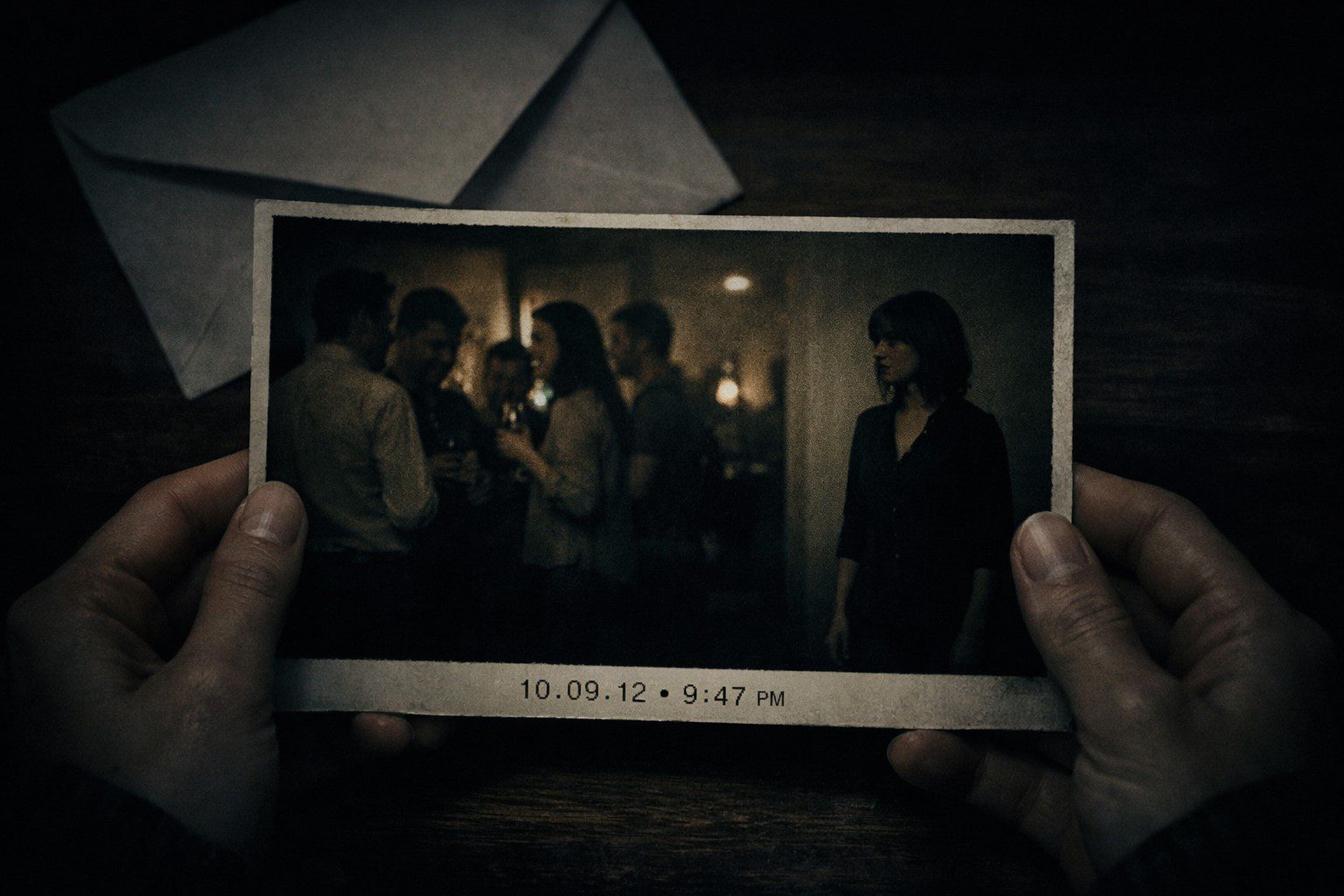
Inside: six photographs. All from her house. All at different times — different seasons, different gatherings, different configurations of people. In every single one, at the edge of the group, slightly apart, watching something outside the frame, was me.
I had no memory of any of them.
“I knew you were there each time,” Ruth said. “I found the photographs when I was going through old files last year. I didn’t know what to do with them. I didn’t know if you knew.”
“I didn’t know,” I said.
She looked at me carefully. “Cora. You came to my house six times over four years. Not to events you were invited to — events you attended and apparently didn’t register. I have your face on six separate nights. Security footage has you at the door on two of those occasions. You rang the bell. I wasn’t home on those two nights.”
I looked at the six photographs. Different nights, different clothes, the same expression — that stillness around the eyes. The same body angle: slightly apart, watching.
“I don’t remember any of it,” I said.
“I know you don’t,” she said. “That’s why I sent the first photograph. I needed you to know before you could decide what to do.” She paused. “Our disagreement, all those years ago — I think you need to talk to someone about what it was actually about. Because I don’t think you’ve ever let yourself know.”
I am in therapy now. I have been for seven months. I will not go into the details of what the disagreement with Ruth was about, because the details belong to the part of my life I am still making sense of. What I will say is that Dr. Yama — my therapist, a methodical and patient woman — uses a phrase I had not encountered before: dissociative repetition. The compulsion, in an altered or dissociated state, to return to an unresolved origin point. To the place where something was left unfinished.
I returned to Ruth’s house six times over four years with no conscious knowledge that I was doing it. I stood at the edges of her gatherings and watched something outside the frame.
I was watching for the thing I could not let myself see directly.
Dr. Yama says this is not unusual. She says the self finds its way back to what it needs to resolve, through whatever door is available. She says the photographs are, in a sense, a record of a part of me that was already trying to do the work I have now started doing deliberately.
I find this both comforting and deeply strange. A version of me, moving through nights I cannot account for, attending a house I had told myself I was finished with, leaving no trace in any digital record, appearing only in photographs at the edges of other people’s gatherings.
Watching. Waiting. Not smiling.
Knowing, perhaps, that I would eventually have to look directly at whatever it was I could not bring myself to face.
I am looking at it now.
It is not comfortable. But it is mine.

 WhatsApp
 Telegram
 Email







Leave a Reply