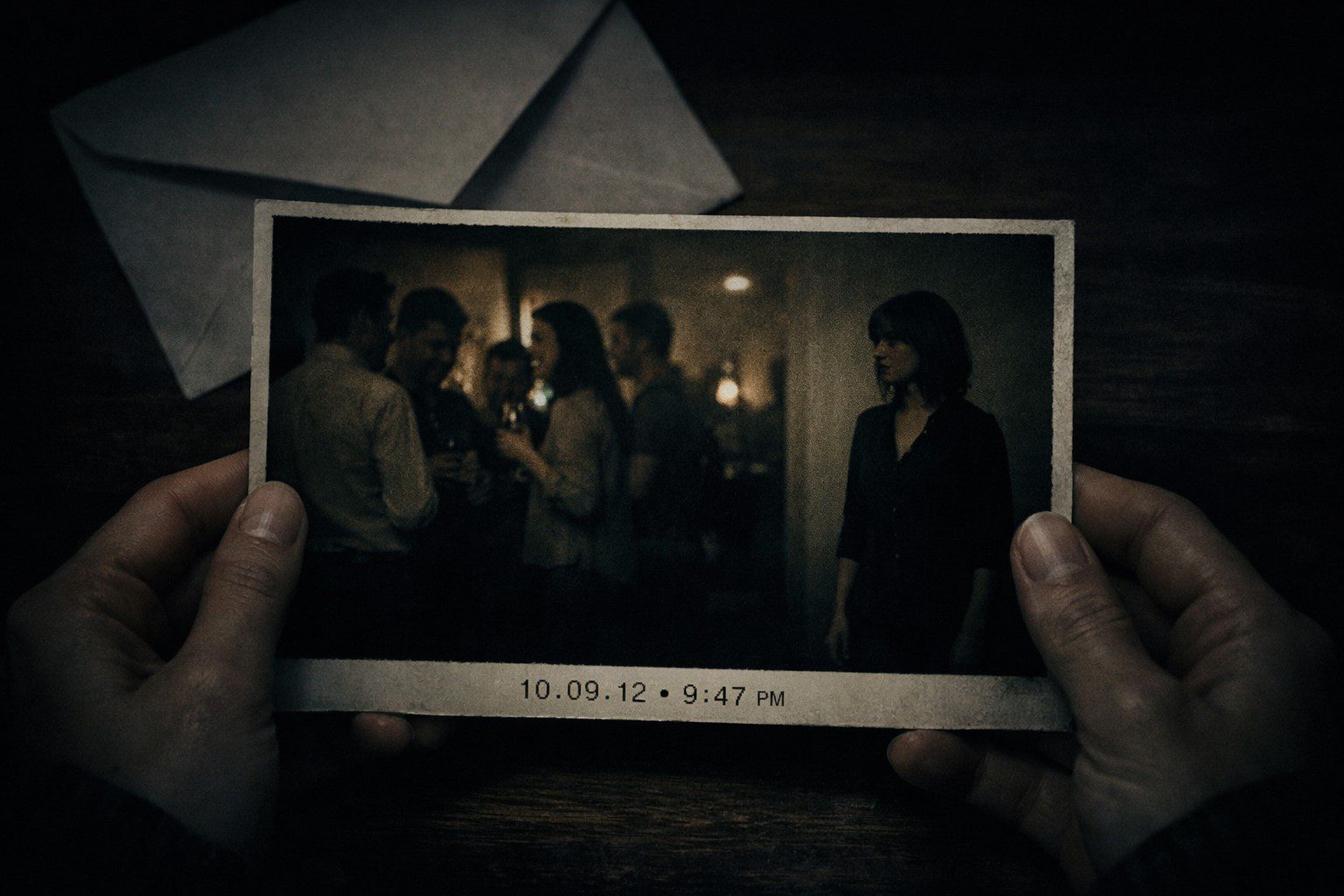
The photograph was taken nine years ago, and every person in it was smiling except me. I had no memory of that party. I had no memory of those people. And yet there I was — same face, same haircut I had at thirty-one — standing at the edge of a group of strangers and not smiling, as if I already knew how it was going to end.
The photograph arrived in an envelope with no return address, and nothing else inside.
My name is Cora Vane. I was forty years old, I worked as a contracts manager for a mid-size construction firm, and I led the kind of ordered, forward-facing life that did not typically involve receiving anonymous photographs of myself at events I had no memory of attending. I kept a diary. I had kept one every year since I was twenty-two. I went back through the one from nine years ago — a Monday evening in October, the date printed in the corner of the photograph — and found the entry for that day.
Monday. Quiet day at work. Home by six. Finished the Marsh contract notes. Early night.
I had been home by six on that Monday. The photograph was timestamped at the bottom: nine forty-seven p.m.
I told myself the timestamp was wrong. Cameras were misconfigured, dates were set incorrectly, photographs were misdated all the time. The fact that I was in the picture did not mean the picture was from that night. It could have been any gathering. My memory of October nine years ago was not perfect. People forgot evenings. People forgot parties, especially if those parties had not been memorable.
I spent three days on that explanation. Then I looked at the photograph again.
I was standing slightly apart from the group, turned at a three-quarter angle, and I was looking at something outside the frame. My expression was not blank, not neutral — it was the expression I recognised from old photographs of myself in difficult situations. A particular stillness around the eyes that I associated with concentration, or calculation, or knowing something I had not yet decided what to do with.
Whatever I was looking at outside the frame, I had been paying very close attention to it.
I showed the photograph to my oldest friend, Bea, who had known me for twenty-two years and who I trusted with the things I did not want to take to anyone else. She looked at it for a long time without saying anything, which was not like Bea, who usually had something to say within thirty seconds of being shown anything.
“Do you recognise anyone else in it?” I asked.
She pointed at a woman near the centre of the group — dark-haired, laughing at something, the only person in the photograph whose laugh seemed connected to her eyes. “I don’t know her,” Bea said. “But she looks —” She stopped.
“She looks what?”
“She looks like she knows you’re watching her.”
I looked at the dark-haired woman again. Her laughter was directed at someone to her left. But her body was angled, subtly, toward the edge of the frame. Toward where I was standing.
I hired someone. Not a private investigator — I did not want whatever this was to move into legal or professional territory before I understood it. What I hired was a photograph analyst: a woman named Drew who worked for an insurance firm tracing document fraud and who, as a secondary skill, specialised in image verification and metadata extraction. I sent her the photograph digitally and asked her to tell me everything the file could tell me.
She came back in four days.

 WhatsApp
 Telegram
 Email







Leave a Reply