He looked at me. “Yes.”
“The anomaly is localised to the valley and the immediate ridge area,” I said. “If you’re navigating by instrument while moving through the strongest part of the field, the disorientation compounds. You correct based on bad data, overcorrect, and the terrain loops you back to the depression because it’s the lowest point and the natural end of a circular correction pattern.” I showed him my paper map. “I adjusted for eleven degrees of drift before I came down the ridge. I had a fixed bearing on a terrain feature above the anomaly that I kept in sight the whole way.” I handed him the map. “We walk out together. I hold the bearing. You follow my line, not your instruments.”
He looked at the map for a long time.
“Eleven days,” he said quietly. “Twelve attempts.”
“You were navigating by instrument through an anomaly that was feeding you corrected data that was wrong,” I said. “You weren’t trapped. You were in a feedback loop.”
We walked out in two hours and forty minutes. I held the bearing on the rock formation I had identified above the ridge, kept us on a consistent line, and called out corrections when Martin drifted. His compass did what mine had done — drifted east, steadily, reasserting itself. We ignored it. We kept our eyes on the rock and moved toward it.
At the ridge line the drift ceased. Below us, the track I had come in on was visible in the afternoon light, leading back through the treeline to where I had left the vehicle.
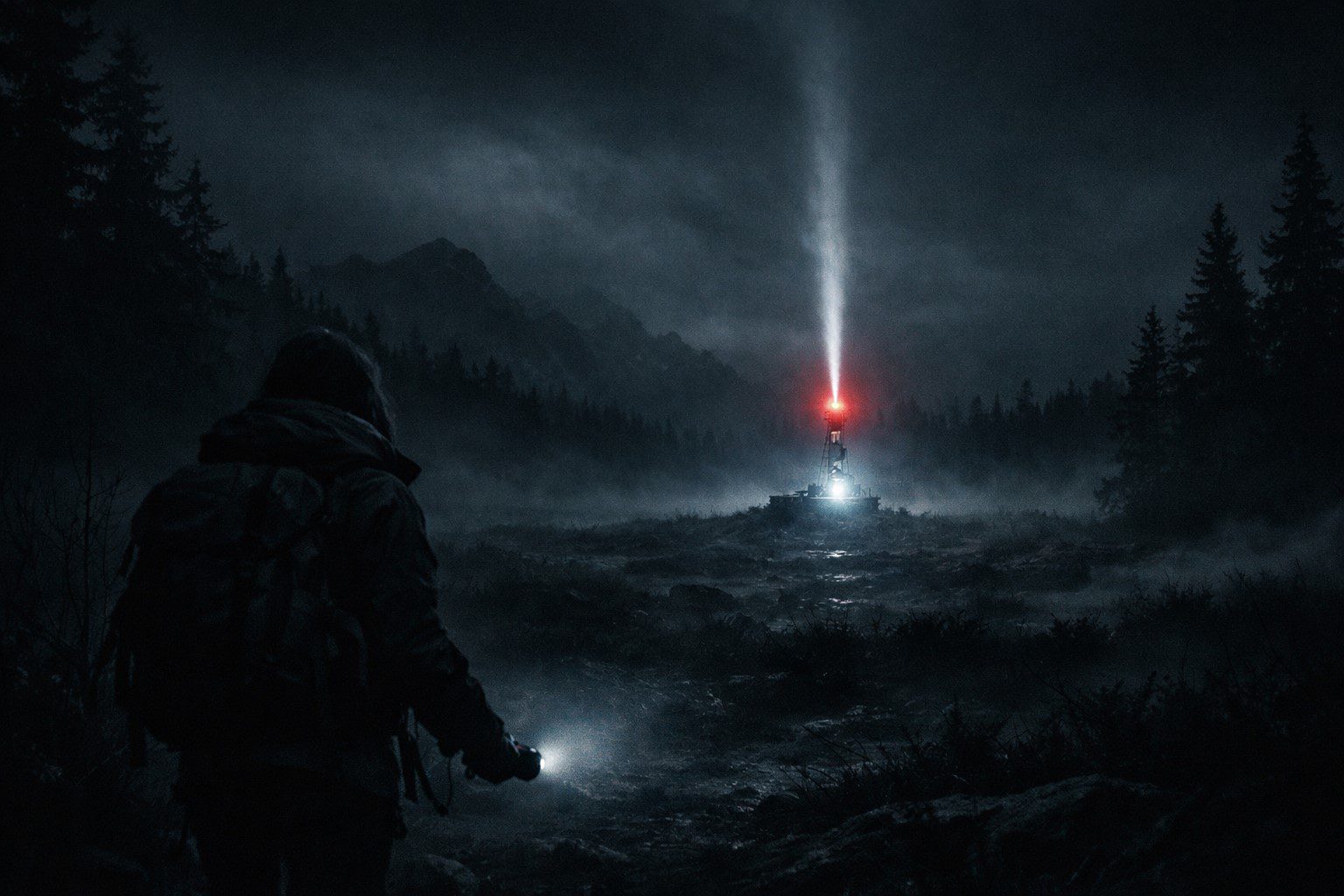
Martin stood at the rim and looked back down at the valley. The orange tent was visible in the centre, the PLB still pulsing its signal to a sky that no longer needed to hear it.
“I kept telling myself there was something wrong with the location,” he said. “That it was holding me.”
“The location was affecting your instruments,” I said. “But you were the one making the decisions based on bad data.”
He was quiet for a moment. “How do you know the data’s bad when it’s all you have?”
It was a better question than he knew. I had been in this work long enough to understand that it didn’t have a single answer, and that the people who thought it did were the ones who got into trouble.
“You get a second opinion,” I said. “And when you can’t, you fix on something outside the field that’s disrupting you. Something that isn’t affected by the same interference.”
He looked back at the valley one more time. Then he turned and followed me down.
I wrote the incident report that evening. I noted the magnetic anomaly, the degree of navigational drift, the mechanism by which the previous teams had been turned back and Martin Voss had been unable to exit. I included my navigational adjustments and the terrain-feature method I had used to maintain bearing. It was a thorough report. I was satisfied with it.
But I sat for a long time before I filed it, thinking about what Martin had said at the rim.
How do you know the data’s bad when it’s all you have?
Three experienced teams had turned back. Not because the terrain was impassable. Not because they lacked skill. Because they had trusted their instruments in a field that was corrupting the instruments, and the instruments had told them to go back, and they had gone. Protocol said: when navigation fails, return to base. Protocol was right, almost always. But protocol had also kept a man in a valley for eleven days.
I was not sure what the lesson was, exactly. I was not sure there was one lesson.
What I was sure of was this: Martin Voss had been in that valley for eleven days and he had kept the beacon running and he had kept trying and he had stayed alive. Twelve attempts to leave and he had not given up after the first, or the fifth, or the eleventh.
The valley had not been holding him. But something had kept him going back to it.
I filed the report. I drove home. I thought about feedback loops all the way, and about the difference between being held by a place and choosing, without knowing you’re choosing, to return to it.
I still think about it.
I’m not sure I’ve answered it yet.

 WhatsApp
 Telegram
 Email







Leave a Reply