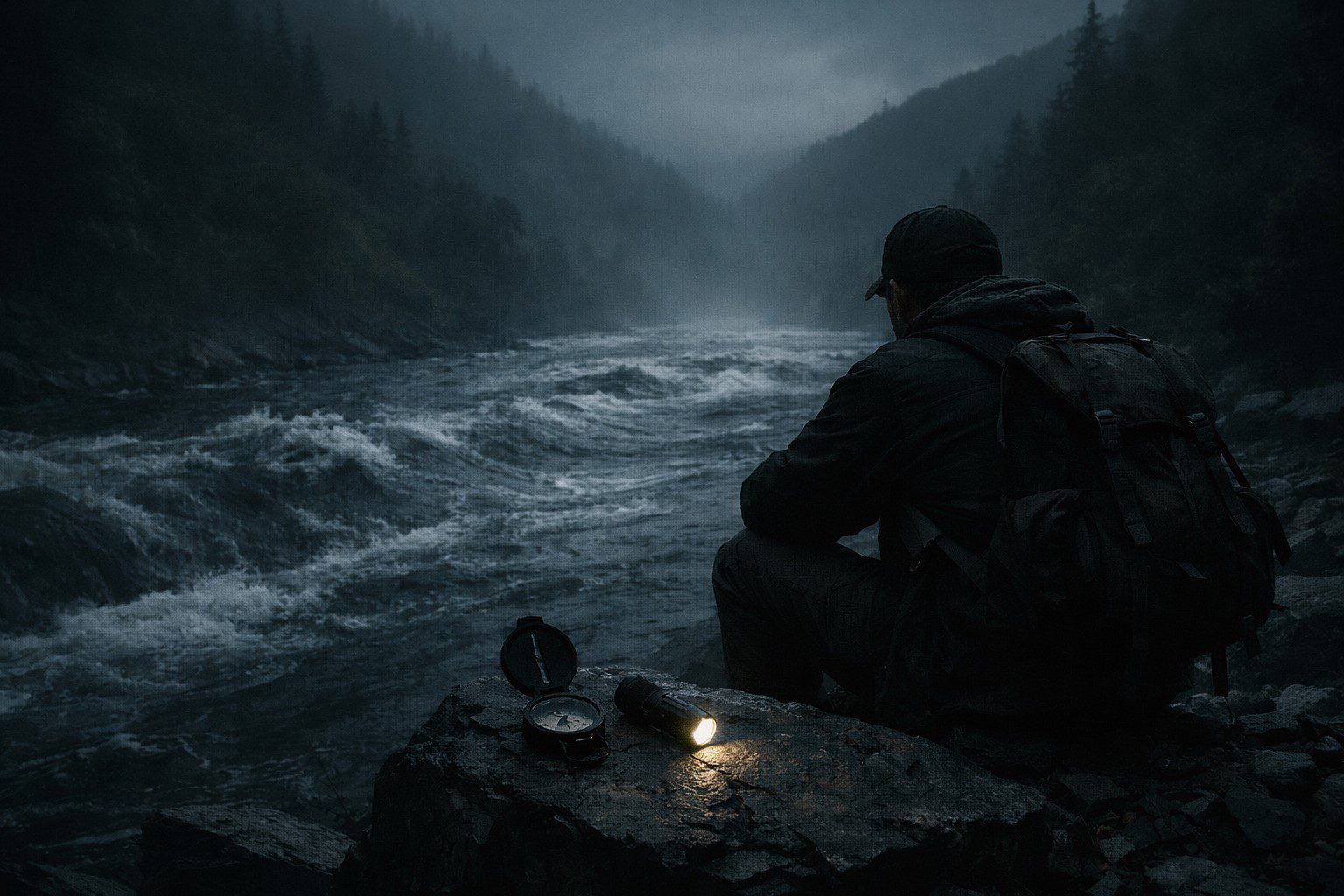
I picked up my pack, walked to the bank, turned to face the direction the water was coming from, and started walking.
Three hours and forty minutes later I found the entrance. The valley narrowed to a steep-sided gorge and then opened onto the slope I had descended three days earlier, and beyond it the tree line and the track and the ordinary world operating by ordinary rules. I stood at the entrance for a moment and felt the specific relief of a person who has been outside the rules and has just stepped back inside them.
I made camp at the entrance and slept for nine hours. In the morning I wrote up my notes and sent a full report to the expedition coordinator, recommending the route be altered to avoid the valley entirely until the anomaly could be properly surveyed. The expedition was rerouted. No one went back in.
I have thought many times about the person who left the note in November 1987. Eleven days before they understood. Eleven days of a compass pulling the wrong direction, a river running backward, a valley that grew each time you tried to measure it. They had worked out the iron ore vein. They had not worked out the river.
Neither have I. Magnetic anomalies affect compasses and, in certain geological conditions, can disrupt electronic signals and produce perceptual distortions in people who have been exposed to strong fields for extended periods. That accounts for the compass and possibly the communicator and at a stretch some of my navigational errors on days two and three.
It does not account for the river. Rivers do not reverse. Water flows downhill because gravity requires it, and no magnetic anomaly in any documented case has been shown to affect gravity. The river was flowing uphill for reasons that the geology cannot explain, that I cannot explain, and that the person who spent eleven days working it out could not explain either.
They left the note anyway. Took the time to write it down, seal it, weight it under a stone in the fire circle, and leave it for whoever came next. They had no way of knowing anyone would come. They left it because it seemed like the right thing to do — because they had learned something at significant cost and the information was worth preserving.
I think about that decision. The note was thirty-six years old when I found it. It worked. It got me out in four hours instead of eleven days.
Someone I will never know made a decision I will never be able to thank them for. They walked out of a valley that had spent eleven days trying to keep them in, and their first act was to leave something behind for a stranger.
I filed my report. I recommended against the route. I kept the note.
But I have also been wondering, for the months since, about the river. About what moves water uphill. About whether the person in 1987 went back — whether they ever found the answer they couldn’t find in eleven days — and whether the answer was something you could put in a waterproof sleeve under a flat stone in a fire circle, or whether it was the kind of thing that could only be understood from inside the valley.
I have not gone back. I do not plan to go back.
But I keep the note in my kit. Just in case the plan changes.
And just in case, if it does, there is someone after me who will need to know what I learn.

 WhatsApp
 Telegram
 Email







Leave a Reply