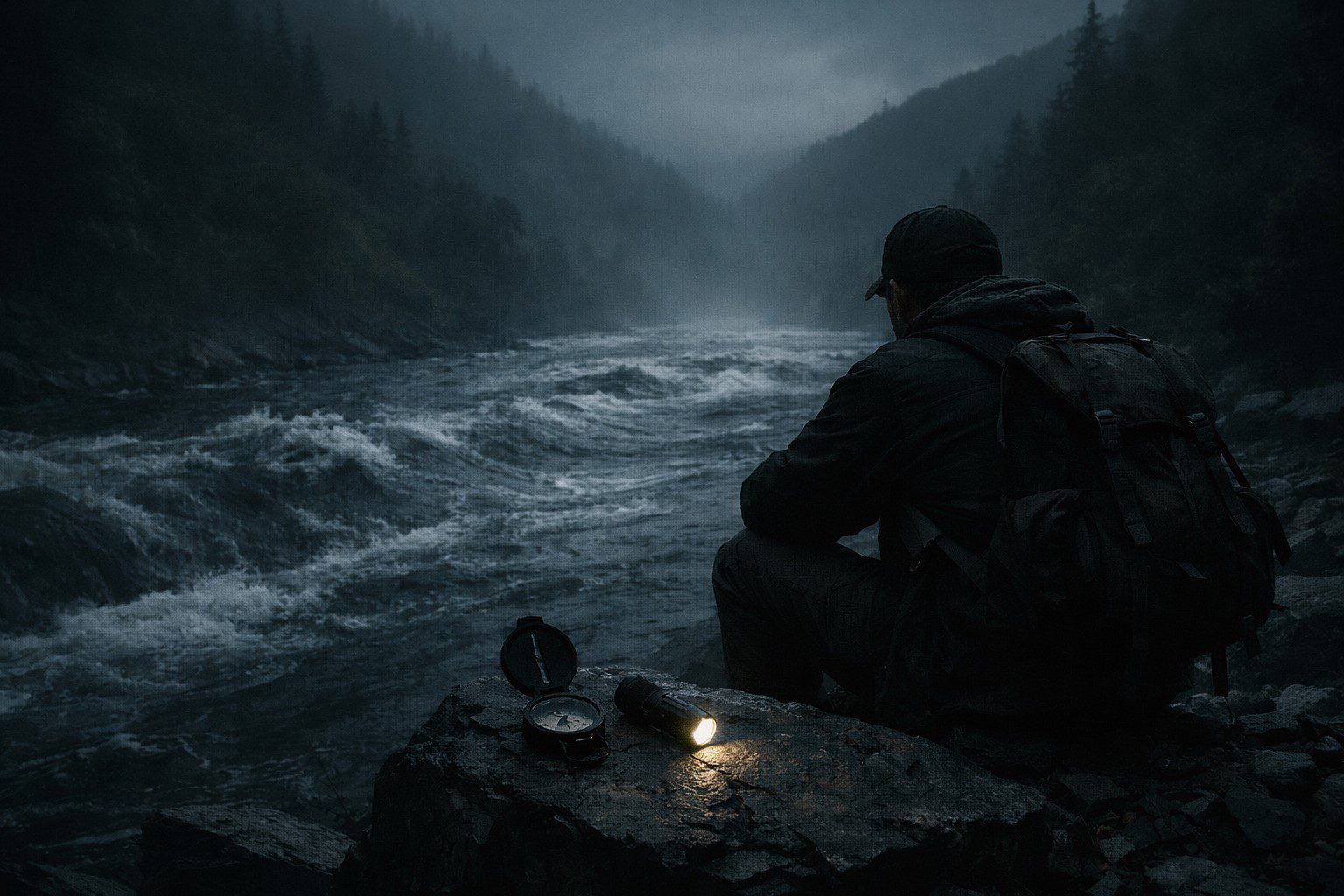
The river was flowing the wrong way, and I had been following it for six hours before I understood what that meant. Not a gentle reversal, not a trick of the light on moving water — upstream, visibly, unmistakably, against every slope the terrain suggested and every principle of hydrology I had learned in thirty years of wilderness guiding.
I stopped on the bank and watched the water move away from the valley. Then I looked at my compass. Then I sat down on a rock and thought very carefully about what kind of trouble I was in.
My name is Bram Feld. I was fifty-one years old, I had guided wilderness expeditions on four continents, and I had been alone in remote terrain more times than I could count. I did not panic in difficult situations. What I did instead was assess, prioritise, and act in small reliable steps. That approach had kept me out of serious difficulty for three decades.
It had not kept me out of this. I had come into the valley three days earlier as the advance scout for an expedition group due to arrive in four days’ time. My job was to assess conditions, confirm the route, and establish a base camp at the lake at the valley’s head. Standard pre-expedition work. I had done it dozens of times.
On the first day I had noted that the terrain matched the map, the weather was holding, and the river — the one I was now watching flow the wrong direction — had been running correctly downhill toward the valley floor. I had camped at the six-kilometre mark and slept well.
On the second day I had reached the seven-kilometre mark and found that the river was no longer running downhill. I had checked the map. I had checked the compass. I had walked upstream — which the map said was south — for two hours and found myself, by all measurements, moving north. By evening I was back where I had started, which should have been impossible, and the light was going, and I made camp and did not sleep well.
On the third day — today — I had tried a different approach. Instead of following the river, I had climbed. I found a ridge above the tree line that gave me a view of the valley, and what I saw from the ridge did not match what I expected to see from the ridge. The valley was longer than the map showed. The lake at its head was visible, but it was further than it should have been by at least three kilometres, which meant the valley had grown, or my map was wrong, or something about the way I was moving through it was not working the way movement was supposed to work.
I am not a mystical person. I have spent thirty years in wild places and I have a professional’s respect for the fact that wilderness does not care about human plans. I have been lost before, genuinely lost, and I know the particular quality of that experience — the way certainty erodes, the way familiar skills become unreliable, the way the terrain stops making sense. This was like that, but it had an additional quality I had not encountered before. The valley was not just difficult to navigate. It was actively inconsistent. The same stretch of river, walked twice, produced different results. The same ridge, reached by the same route, showed a different view.
My satellite communicator was in my pack. It had shown a signal on the first day. On the second day it had shown no signal for the first time in four years of use. I checked it each morning. No signal.

 WhatsApp
 Telegram
 Email







Leave a Reply