She walked back.
Peet looked at her when she sat down. His expression had not changed. It never changed. She was beginning to understand that this was not pleasantness — it was the absence of anything that pleasantness could cover.
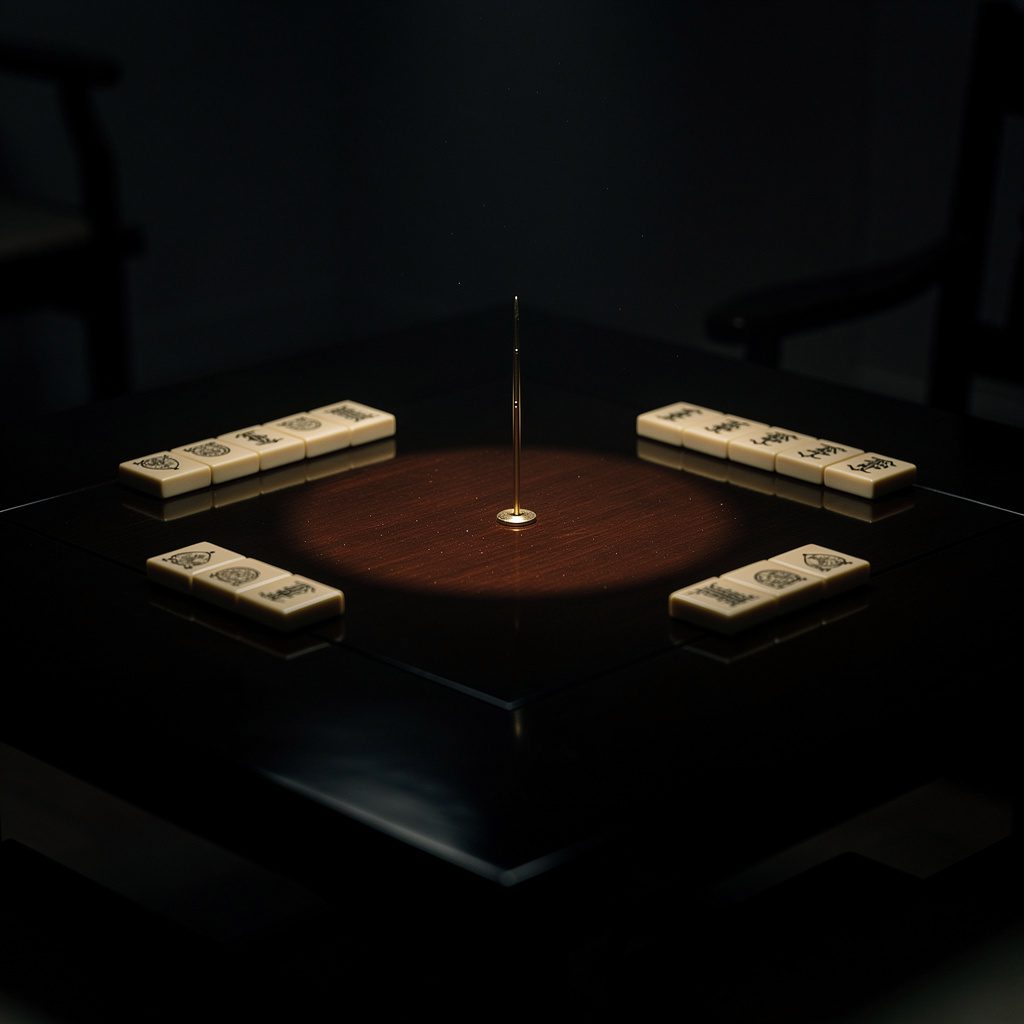
She looked at her marker, three tiles from the center.
She drew a card.
The card was a blank — white on both sides, no symbol. She held it up. “Blank,” she said.
“Skip your turn,” Peet said.
She set it down. “Fine.”
She caught Ishaan’s eye and gave him a look — a very small look, the kind that means wait and trust me simultaneously. He was sharp enough to receive it. He drew his next card and announced, without expression, that it sent him backward.
Rowan drew. His card moved him sideways, onto a parallel track, which the rules specified required three additional moves to exit.
The timer ticked.
Peet watched.
Sable drew the blank card next — there were evidently several in the deck — and skipped her turn with a shrug that cost her something, Dulce could see it in her throat. Tomasz drew a reversal. The needle at the center of the board trembled continuously now, and Dulce had the irrational sense that it was nervous, that the game itself was nervous.
The timer had perhaps eight minutes left.
Peet leaned forward slightly. It was the first time he had moved in over an hour. “Someone needs to advance,” he said. His voice was still level, but something in it had shifted — a frequency beneath the words, barely perceptible.
“The cards say what the cards say,” Dulce replied.
Four minutes.
Two.
She watched the timer the way she had never watched anything in her life. The brass face of it, the small hand moving. The way each second seemed to compress and then release, compress and release, like breathing.
Peet stood up.
One minute.
He moved toward the board, and Dulce thought he was going to do something to it — stop the timer, reset it, overturn it — but he stopped just short of the table and stood there, and for the first time his face was not pleasant. It was simply empty. The smile had gone somewhere it didn’t bother to hide.
Thirty seconds.
The timer made a sound like a small bell, and then it stopped.
The silence lasted one breath, two.
From across the room, the lock panel on the main door made a soft mechanical sound, and the light shifted from red to green.
Nobody moved for a moment. Then Rowan crossed the room in four steps and pushed the door open and the night air came in — cold and real and smelling of wet leaves — and they went through it, all of them, one after another, out onto the deck and into the dark.
Dulce was the last one out. She stopped in the doorway and looked back at Peet, who had not moved from his place beside the table. The board sat between them, its center needle still trembling, the markers still arranged in their unfinished positions.
Peet looked at her. Just looked.
She walked out.
They found the access road in the dark and followed it down the mountain, six people moving in a loose, silent cluster, none of them speaking about what had happened, not yet, not until there was enough distance between them and the lodge to make words feel safe again.
Dulce was the only one who looked back.
The lodge sat at the top of the rise, its windows lit warm amber against the mist, looking from this distance exactly as it had looked when she arrived — welcoming, solid, the kind of place that promises a few uncomplicated days in the mountains.
In one of the windows, a shape stood watching.
And beside it, very faintly, she could see the outline of another shape. Smaller. Still.

 WhatsApp
 Telegram
 Email







Categories
- AI & Technology
- Contemporary
- Corporate Control
- Creepypasta
- Crime Thriller
- Cyberpunk
- Dark Fantasy
- Enemies to Lovers
- Fairy Tale Retelling
- Fantasy
- First Contact
- Forbidden
- Genetic/Body Horror
- High Fantasy
- Monster Hunter
- Mythic/Folklore
- Paranormal
- Portal/Otherworld
- Post-Apo
- Post-Collapse Society
- Psychological Thriller
- Romances
- SCI-FI
- Second Chance
- Slow Burn
- Space Combat
- Spacepunk
- Surveillance State
- Survival Thriller
- Thrillers
- Time Travel
- Treasure Hunter
- Urban Fantasy
- Witchcraft/Curses
Tags
10min stories atmospheric atmospheric fantasy atmospheric fiction contemporary romance Creepy creepypasta crime thriller dark fantasy debt dystopia emotional fiction enemies to lovers ensemble cast epistolary fantasy female protagonist first person forbidden romance framed narrative high fantasy love story magic Memory mystery Paranormal psychological horror psychological thriller romance sci-fi second chance second chance romance short fiction short story slow burn space station speculative fiction supernatural Survival survival thriller suspense thriller travel romance witchcraft workplace romance
Leave a Reply