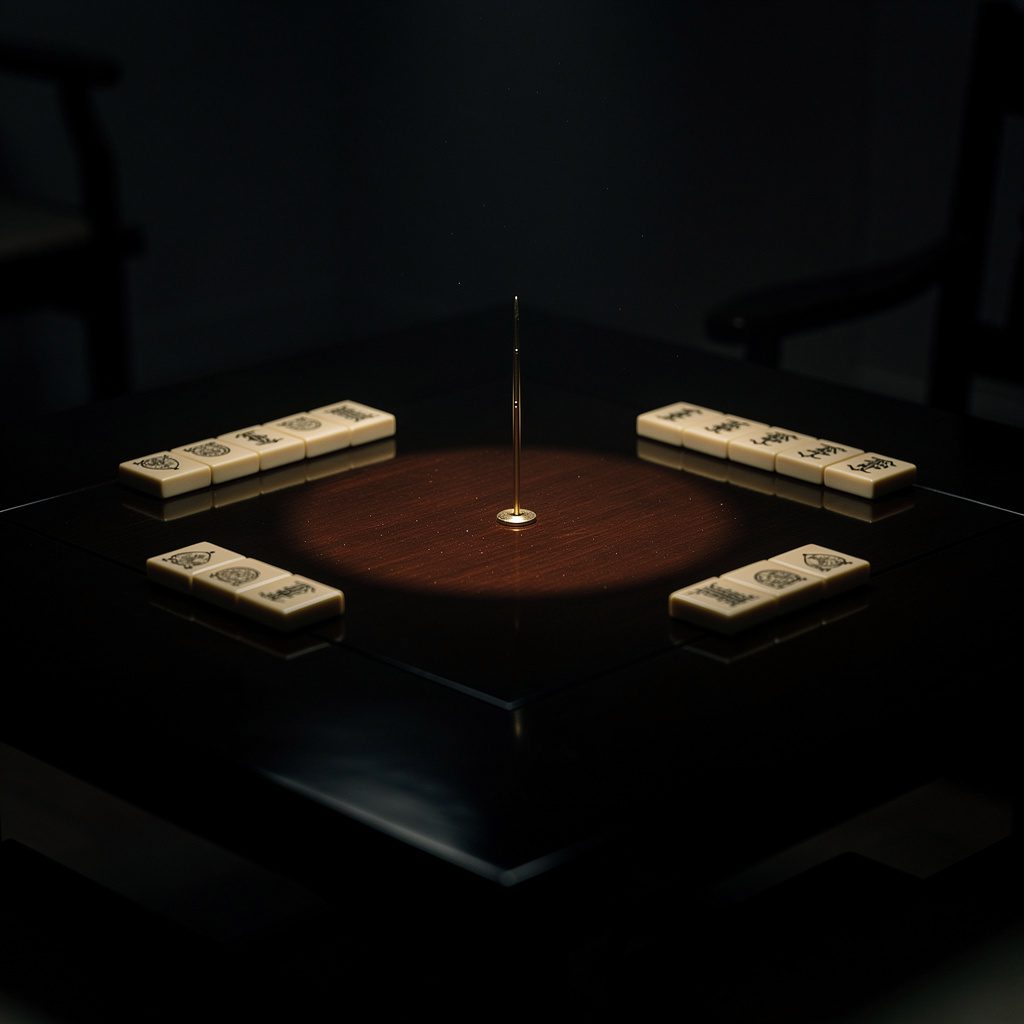
“Because the game has started,” Peet said. “The door unlocks when the game ends.”
The silence that followed was the kind that changes a room. Dulce felt it move through the group like a current — saw it in the way her colleague Ishaan Banerjee set down his card very slowly, in the way the woman across from her, a travel writer named Sable, pressed both palms flat against the table as if steadying herself against a wave.
Dulce stood up.
“I’d like to leave now,” she said.
“You can’t,” Peet said. Not unkindly. That was the worst part — not unkindly. “Not until someone reaches the center. The game has its own rules. I’m just here to facilitate.”
She crossed to the door. She tried the handle. It didn’t move. She tried it again, harder, and then she looked at the lock panel and saw it was the kind that required a code from both sides — there was no manual override, no thumb-turn, no emergency release. Just the panel, and the red light, and the soft continued ticking of the timer back at the table.
Rowan was already at the windows. The lodge windows were large and beautifully framed, but they had been built for views, not ventilation — fixed panes, single-piece, no latches. He pressed his hand against the glass. The mist pressed back.
Dulce turned around and looked at the room the way she had never looked at it before: as a container.
The six of them moved quickly through the phases that groups always move through — the disbelief, the negotiation, the anger directed at Peet, who absorbed it all with that steady, impenetrable calm. Ishaan demanded to know who Peet worked for. Sable took out her phone and found, as they all found, that there was no signal. One of the other guests, a young man named Tomasz who had barely spoken all weekend, went methodically along the walls looking for another exit. He found a utility corridor behind the kitchen but it ended in a second locked door, this one steel, no panel at all, just a keyhole with no key.
Dulce went back to the table.
She sat down. She looked at the board.
The timer had perhaps forty minutes left on it. Her marker was close — three tiles from the center, closer than anyone else. She understood, with the cold clarity that comes when the body stops arguing with the situation and starts working inside it, that the fastest way out of the room was to win the game.
She picked up the deck and drew.
The others drifted back, one by one, because there was nothing else to do. Even Rowan came back, moving his obsidian marker with stiff, angry precision. Even Tomasz. The game resumed, and the great room of the mountain lodge, which had smelled of pine resin and woodsmoke an hour ago, now smelled of something sharper — adrenaline, maybe, or fear metabolized into focus.
Dulce played.
She was four moves from the center when she heard the sound.
It came from the utility corridor — a single, quiet knock. Not from the steel door. From the wall beside it.
She went alone. She didn’t know why she went alone except that the others were watching the board and she couldn’t stop herself. The corridor was narrow and unlit and she used her phone’s flashlight, which threw pale shadows against the exposed timber framing.
The knock came again. Lower this time, as if from a person crouching.
“Hello?” she said.
A voice came back — a woman’s voice, low and very controlled. “Don’t play to win,” it said.
Dulce put her hand on the wall. The timber was cold. “What?”
“Don’t play to win. Play to stall. If the timer runs out before anyone reaches the center, the door opens automatically. That’s the rule he doesn’t tell you.” A pause. “I know because I played last time.”
Last time.
Dulce pressed her back against the corridor wall and closed her eyes for three seconds, which was all she allowed herself. Last time meant there had been a last time. Last time meant Peet had done this before, in this room or one like it, with other people who had come to the mountains to feel uncomplicated.
“Who are you?” she asked.
But the voice was gone. There was only the cold wall and the faint ticking, carried down the corridor from the great room.

 WhatsApp
 Telegram
 Email







Categories
- AI & Technology
- Contemporary
- Corporate Control
- Creepypasta
- Crime Thriller
- Cyberpunk
- Dark Fantasy
- Enemies to Lovers
- Fairy Tale Retelling
- Fantasy
- First Contact
- Forbidden
- Genetic/Body Horror
- High Fantasy
- Monster Hunter
- Mythic/Folklore
- Paranormal
- Portal/Otherworld
- Post-Apo
- Post-Collapse Society
- Psychological Thriller
- Romances
- SCI-FI
- Second Chance
- Slow Burn
- Space Combat
- Spacepunk
- Surveillance State
- Survival Thriller
- Thrillers
- Time Travel
- Treasure Hunter
- Urban Fantasy
- Witchcraft/Curses
Tags
10min stories atmospheric atmospheric fantasy atmospheric fiction contemporary romance Creepy creepypasta crime thriller dark fantasy debt dystopia emotional fiction enemies to lovers ensemble cast epistolary fantasy first person folklore forbidden romance framed narrative high fantasy love story magic Memory mystery Paranormal psychological horror psychological thriller romance sci-fi second chance second chance romance short fiction short story slow burn space station speculative fiction supernatural Survival survival thriller suspense thriller travel romance witchcraft workplace romance
Leave a Reply