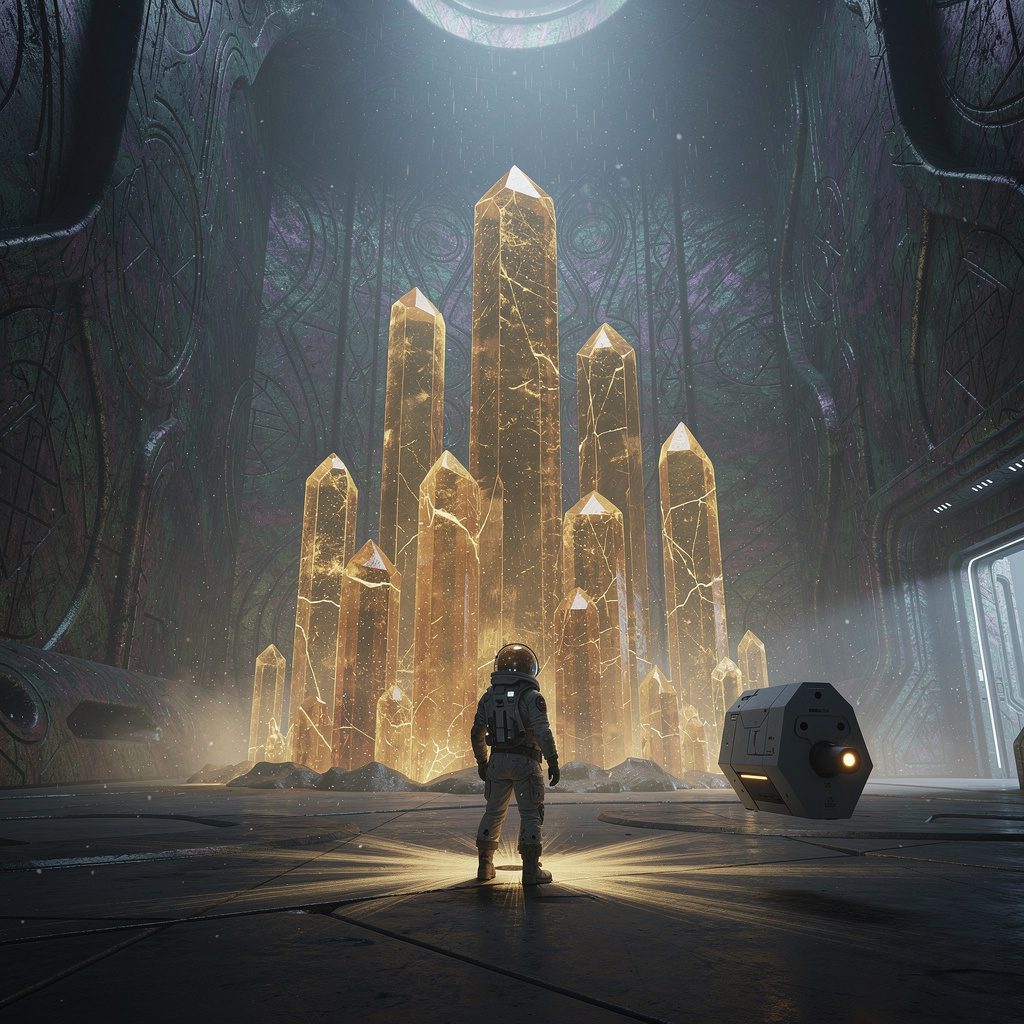
For a moment, the calm of the chamber settles over me like something physical. I stand in the pulsing gold light and I breathe and I look at the crystals and I think about the beings who made this room. They are gone—completely, irretrievably gone, in the way that civilizations sometimes go, leaving only geometry and light. They built something that lasted long enough for a corporation to try to own it, and they have no voice to object. I think about that.
I begin the transmission sequence.
The data package is large—scan maps, resonance readings, the video recording I’ve been making since I entered the corridor, spectral analysis, everything my modified scanner can pull. It will take eight minutes to compress and nine minutes to transmit in full, which means I will not make it before the drone arrives. I knew this going in. I have a contingency.
I set the scanner to transmit in segments, highest-priority data first: the video, the structural maps, the spectral signature of the crystal material. If the drone cuts the transmission early, at least the core evidence will be out. At least the academic community will know this place exists. Cordata can threaten me with every clause in my contract—and they will, and the debt they will cite is not just the loan, not just the administrative fees, but the accumulated penalties for unauthorized access to a sealed site, for use of unsanctioned recording equipment, for breach of the Proprietary Discovery Clause itself. By the time their legal systems finish with me, I will owe them the next twelve years of my life in labor credits.
I knew that before I came down here.
Seven minutes. The transmission is running. The crystals pulse around me, slow and patient and indifferent to the countdown in my helmet display.
I sit down on the floor of the chamber—the warm, iridescent floor—and I do something I have not done in a long time. I stop moving. I stop calculating. I just look.
The light from the crystals shifts as I watch, the pulse rhythm changing slightly, the wave pattern growing more complex, as if the chamber is responding to my presence, or to the electromagnetic signature of my scanner’s transmission, or to something I cannot measure. The geometric patterning on the crystal surfaces seems to rearrange itself at the edges of my vision, though when I look directly, it is always still. There is a sound, too—I realize this only now, sitting quietly. A subsonic hum, felt more in the chest than heard, steady as a held note, old as the rock around it.
Three minutes.
The drone’s arrival announcement chimes in my helmet. It is two minutes out. It is polite about this.
I stand up. The transmission is sixty-two percent complete. The critical data—the video, the maps—is already through. What remains is supplementary: my spectral readings, my personal field notes, the seventeen pages of analysis I wrote in my bunk over eight months of stolen time. Useful, but not essential. The essential thing is out.
The drone enters the chamber from the corridor behind me. It is a standard Cordata Compliance Unit—a rounded hexagonal body about the size of a large backpack, matte gray, with six articulated limbs that let it navigate any terrain and a sensor array that can read biometrics, equipment signatures, and network activity simultaneously. It hovers at chest height. Its indicator light is amber. Not red. Amber means it is in assessment mode, not enforcement mode. Not yet.
“Employee Wu, Rin. Tier-Three Survey Specialist. You are currently in a restricted zone without authorization. You are operating unsanctioned recording equipment. You are transmitting data via an unsanctioned channel.”
The drone’s voice is the same calm, helpful tone as the station network. Cordata is very consistent.
“Yes,” I say.
“Transmission has been logged. Cordata legal review will assess applicable penalties under your employment agreement. You are advised to cease transmission immediately to limit further liability.”
Seventy-nine percent. The supplementary data is going through.
“I’ll keep that in mind,” I say.
The drone’s indicator shifts. Still amber.
Ninety-one percent. Ninety-four.
One hundred.
I close the transmission manually, clearly, so the drone’s logs show a voluntary termination. I hold up my personal scanner and power it down. “Done,” I say.
The drone scans me for another long moment. Then: “Please proceed to the surface compliance office. An escort will accompany you.”

 WhatsApp
 Telegram
 Email







Categories
- AI & Technology
- Contemporary
- Corporate Control
- Creepypasta
- Crime Thriller
- Cyberpunk
- Dark Fantasy
- Enemies to Lovers
- Fairy Tale Retelling
- Fantasy
- First Contact
- Forbidden
- Genetic/Body Horror
- High Fantasy
- Monster Hunter
- Mythic/Folklore
- Paranormal
- Portal/Otherworld
- Post-Apo
- Post-Collapse Society
- Psychological Thriller
- Romances
- SCI-FI
- Second Chance
- Slow Burn
- Space Combat
- Spacepunk
- Surveillance State
- Survival Thriller
- Thrillers
- Time Travel
- Treasure Hunter
- Urban Fantasy
- Witchcraft/Curses
Tags
10min stories atmospheric atmospheric fantasy atmospheric fiction contemporary romance Creepy creepypasta crime thriller dark fantasy debt dystopia emotional fiction enemies to lovers ensemble cast epistolary fantasy first person forbidden romance found text framed narrative high fantasy love story magic Memory mystery Paranormal psychological horror psychological thriller romance sci-fi second chance second chance romance short fiction short story slow burn space station speculative fiction supernatural Survival survival thriller suspense thriller travel romance witchcraft workplace romance
Leave a Reply