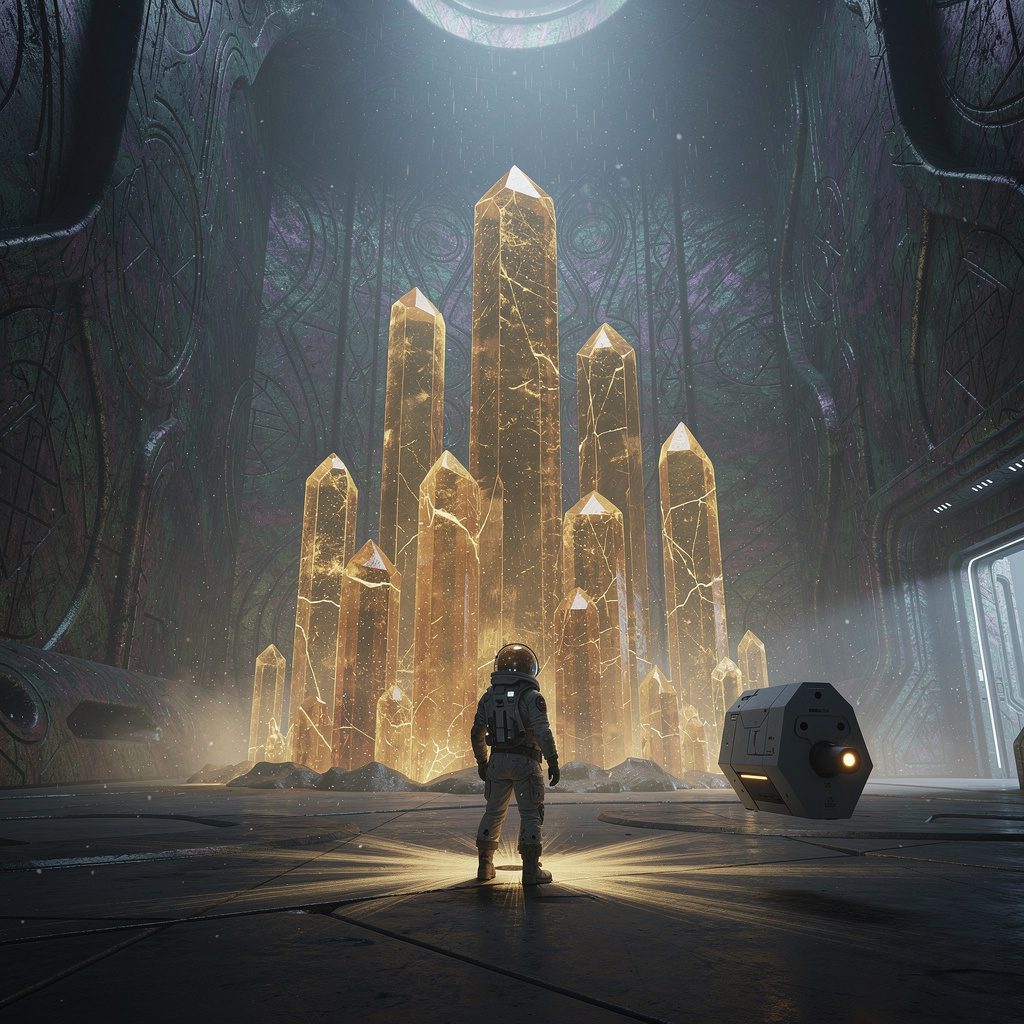
The corridor I am walking through now is not on any station schematic I was ever given access to. I found my way here using the resonance data and a maintenance access shaft that has not been opened in what the dust tells me is a very long time. The walls are not Cordata construction. I can tell by the texture—Cordata uses a poured composite that cures smooth and uniform, the color of old bone. These walls are something else entirely. They are dark, almost black, and they have a faint iridescence when my helmet light catches them at an angle, a shimmer like oil on still water. The material is neither stone nor metal nor any polymer I can identify. It is warm to the touch even through my suit gloves, which should be impossible given the ambient temperature down here is just above freezing. The geometry of the corridor itself is subtly wrong in a way that took me several minutes to identify: the walls angle very slightly inward as they rise, so the ceiling is perhaps ten centimeters narrower than the floor, and the curve of the passage bends not left or right but in a gentle corkscrew, so that I am always, imperceptibly, turning. Whatever built this did not think in straight lines.
Twenty-two minutes.
I stop.
The corridor opens into a chamber, and the chamber is the reason I am here.
I saw it once in the scan data—a void roughly fifteen meters across and eight meters high, with a dense concentration of what the scanner labeled as “anomalous crystalline structures” at its center. The scan couldn’t tell me more than that. The actual thing is more than the scan could hold. The chamber is full of light that has no visible source, a soft, diffuse luminescence that seems to come from the walls themselves, or perhaps from the air, blue-white and steady, like the light at the bottom of a very clear ocean. The crystalline structures at the center are a cluster of columns, each one between one and three meters tall, growing from the floor in formations that look organic—like coral, or like the branching of a river delta seen from above—and they are not static. They pulse. Slowly, rhythmically, each pulse sending a wave of slightly brighter light moving outward from the cluster to the walls and back, like a heartbeat, like a breath. The crystals are translucent, pale gold at their cores shading to deep amber at the tips, and the surfaces are covered in a fine geometric patterning—not random, not natural in the way mineral facets are natural, but deliberate, repeating, structured. I have walked a hundred unmapped sites on a dozen worlds. I have never seen anything like this.
I pull out my personal scanner—not the company-issue one, which logs everything to Cordata’s servers in real time, but my own, a secondhand field unit I bought in a transit market three years ago and have been quietly modifying ever since. I start recording.
Fifteen minutes.
This is the part that matters. This is the part that changes everything, if I can get it out.
Cordata sealed my original report because they knew what this was. I understand that now, standing in the light of it. The Proprietary Discovery Clause in my contract—buried in the same appendix as the loan interest rate—gives Cordata ownership of any discovery made by an employee during the term of their employment, using company equipment, on company-chartered territory. My suit is company equipment. The scanner I used for the original survey is company equipment. Pellucid-4 is company-chartered territory. By the terms of my contract, the ruins of whatever civilization built this chamber belong entirely to Cordata Extraction Solutions. They would seal it, study it privately, extract whatever value they could from it, and file it away as a proprietary asset. No scientific community would ever know it existed. No record would survive outside Cordata’s internal archive.
But my personal scanner is not company equipment. And the data on it, if I can transmit it to the open academic relay that passes within range of Pellucid-4 every nineteen days—the next pass is in eleven minutes—cannot be retroactively claimed under the Proprietary Discovery Clause, because the clause requires company equipment. I checked. I checked seventeen times.
The transmission window is eleven minutes away. The drone is fifteen minutes away.

 WhatsApp
 Telegram
 Email







Categories
- AI & Technology
- Contemporary
- Corporate Control
- Creepypasta
- Crime Thriller
- Cyberpunk
- Dark Fantasy
- Enemies to Lovers
- Fairy Tale Retelling
- Fantasy
- First Contact
- Forbidden
- Genetic/Body Horror
- High Fantasy
- Monster Hunter
- Mythic/Folklore
- Paranormal
- Portal/Otherworld
- Post-Apo
- Post-Collapse Society
- Psychological Thriller
- Romances
- SCI-FI
- Second Chance
- Slow Burn
- Space Combat
- Spacepunk
- Surveillance State
- Survival Thriller
- Thrillers
- Time Travel
- Treasure Hunter
- Urban Fantasy
- Witchcraft/Curses
Tags
10min stories atmospheric atmospheric fantasy atmospheric fiction contemporary romance Creepy creepypasta crime thriller dark fantasy debt dystopia emotional fiction enemies to lovers ensemble cast epistolary fantasy female protagonist first person forbidden romance framed narrative high fantasy love story magic Memory mystery Paranormal psychological horror psychological thriller romance sci-fi second chance second chance romance short fiction short story slow burn space station speculative fiction supernatural Survival survival thriller suspense thriller travel romance witchcraft workplace romance
Leave a Reply