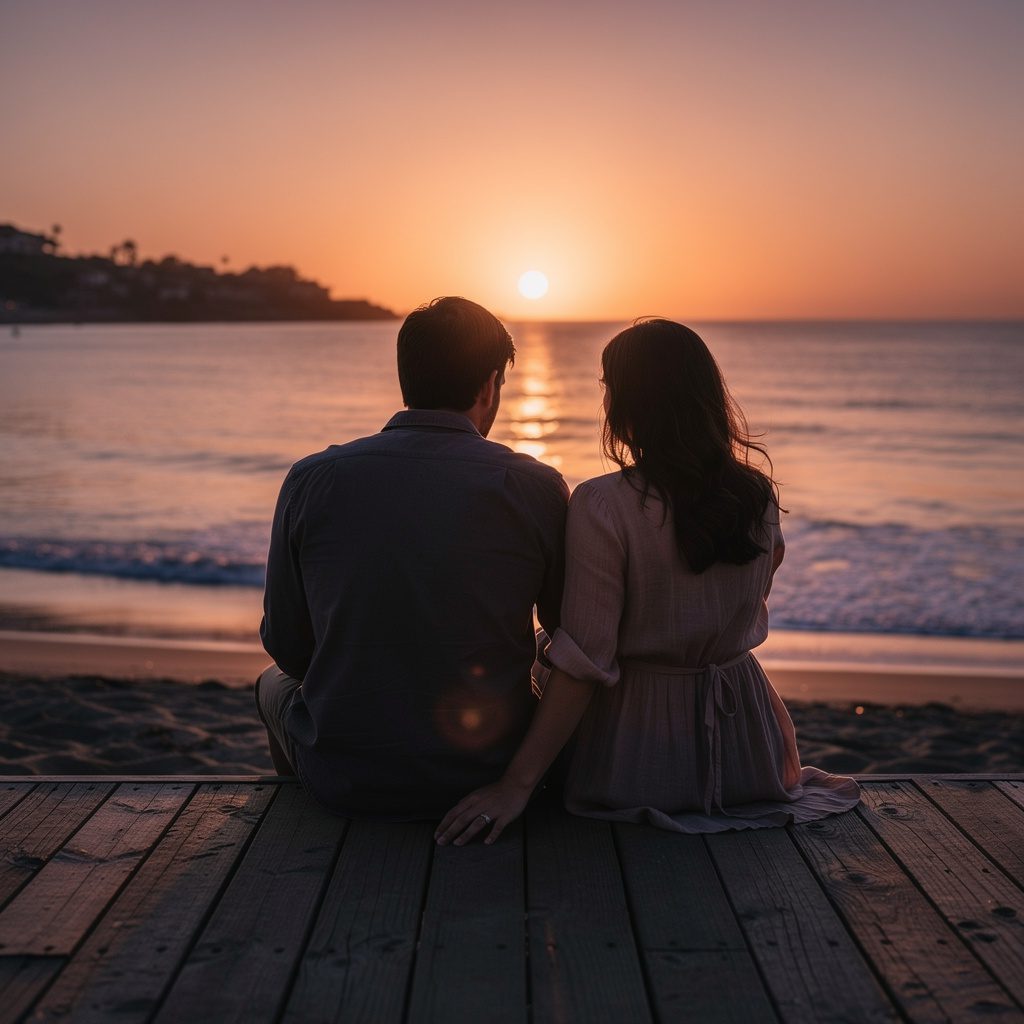
Lina always said the summer she spent working at the Santa Barbara beach house was the best and worst three months of her life. She said it with a laugh, the kind that came from somewhere deep and settled, the kind that meant she had already lived through the hard part and found herself grateful on the other side. She told the story the same way every time — starting with the morning Karim arrived and the way her stomach had done something complicated and unwelcome the moment he set his laptop down on the desk beside hers.
It had been her desk first. Or rather, her corner of the shared workspace that occupied the sunlit back room of the rented beach house, where the production company had set up a small writers’ retreat for the summer. The room faced the ocean through a wide bank of windows, and in the mornings the light came in sideways and gold, and the sound of the waves was just loud enough to hear if the house was quiet. Lina had claimed the right-hand desk on her first day in June, arranged her things with deliberate care — her notebooks stacked in order of use, her succulents lined along the windowsill, her spare cardigan draped over the chair back like a flag of occupation — and felt, for the first time in a long time, like she had a place that was entirely hers. The other desk had sat empty for three weeks. She had stopped noticing it. She had started to think of the whole room as hers.
Then Karim walked in on a Tuesday morning in late June with a duffel bag over one shoulder and a coffee in each hand, and he put one of the coffees down on her desk without asking and said, “You look like you’ve been here since five.” He wasn’t wrong. She had been there since five-fifteen. She looked at the coffee, then at him, then back at the coffee, and said nothing for a moment that stretched just slightly too long.
“I brought oat milk,” he added. “If that helps.”
It did not help. It helped enormously. She picked up the coffee and told herself it meant nothing.
Karim was a composer. She was a screenwriter. They were both working on projects for the same streaming platform, which was how they had ended up in the same rented house on the same stretch of beach, sharing the same workspace for reasons that had seemed purely logistical until they weren’t. He had a reputation — she knew that much from the platform’s internal newsletter, which she had read and then pretended not to have read. He was good. Critically celebrated, annoyingly prolific, the kind of person whose name appeared in sentences that also contained the word “genius,” which she found both impressive and faintly irritating in the way that only truly threatening things are irritating. She had her own reputation, smaller and harder-won, and she had built it by working in near-total silence, by being the person in the room who needed the least and delivered the most, and she had no intention of being rattled by a man who brought oat milk and had a good jawline and apparently composed entire film scores in his head while staring at the ocean.
The first week was fine. They were polite. They worked in parallel, each absorbed in their own project, the only sounds between them the soft percussion of keyboards and the occasional exhale that meant something wasn’t going the way it should. He played piano in the evenings in the living room — the house had a battered upright that had probably been there since the seventies — and she told herself she wasn’t listening, even when she found herself sitting on the stairs with her notebook in her lap, not writing anything, just sitting.
The second week was harder.

 WhatsApp
 Telegram
 Email







Categories
- AI & Technology
- Contemporary
- Corporate Control
- Creepypasta
- Crime Thriller
- Cyberpunk
- Dark Fantasy
- Enemies to Lovers
- Fairy Tale Retelling
- Fantasy
- First Contact
- Forbidden
- Genetic/Body Horror
- High Fantasy
- Monster Hunter
- Mythic/Folklore
- Paranormal
- Portal/Otherworld
- Post-Apo
- Post-Collapse Society
- Psychological Thriller
- Romances
- SCI-FI
- Second Chance
- Slow Burn
- Space Combat
- Spacepunk
- Surveillance State
- Survival Thriller
- Thrillers
- Time Travel
- Treasure Hunter
- Urban Fantasy
- Witchcraft/Curses
Tags
10min stories atmospheric atmospheric fantasy atmospheric fiction contemporary romance Creepy creepypasta crime thriller dark fantasy debt dystopia emotional fiction enemies to lovers ensemble cast epistolary fantasy female protagonist first person forbidden romance framed narrative high fantasy love story magic Memory mystery Paranormal psychological horror psychological thriller romance sci-fi second chance second chance romance short fiction short story slow burn space station speculative fiction supernatural Survival survival thriller suspense thriller travel romance witchcraft workplace romance
Leave a Reply