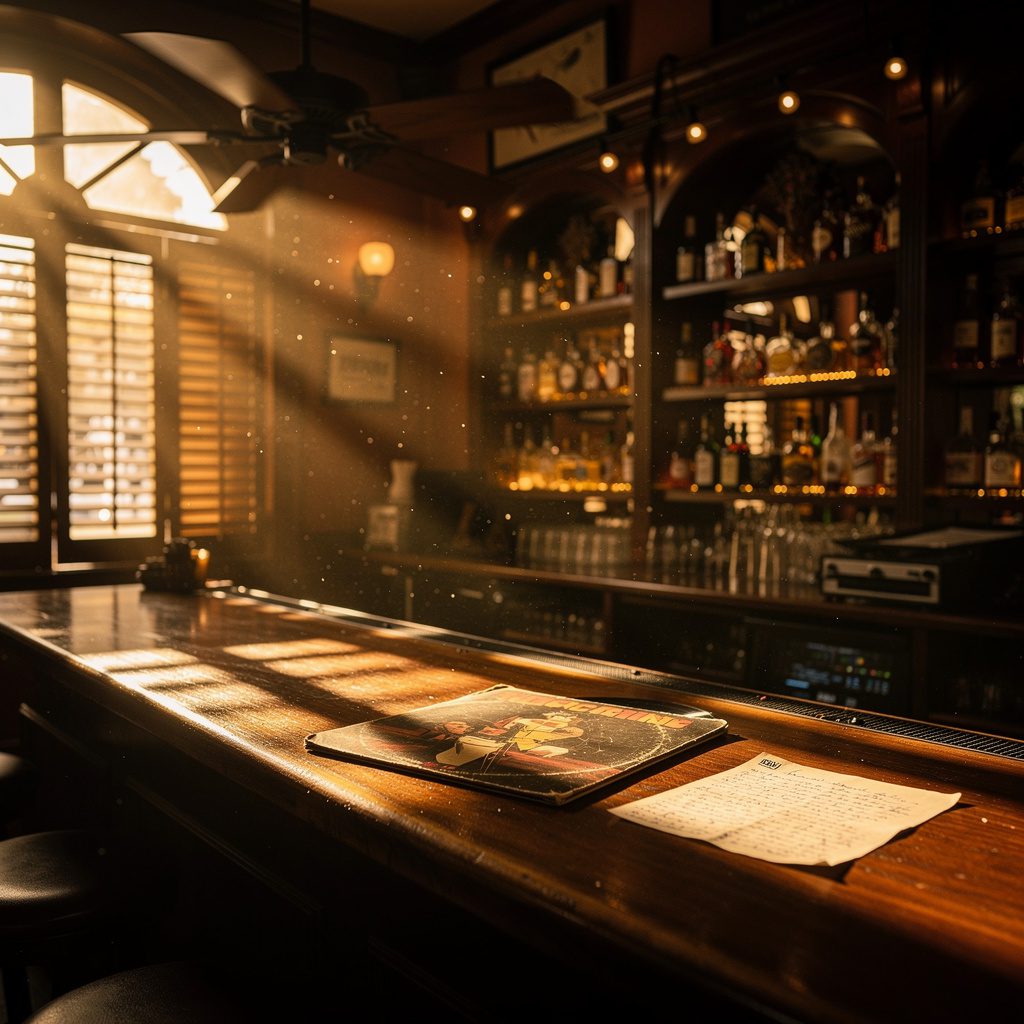
Nandini set the letter on the bar between them.
She was not angry. That surprised her. She had expected to feel something sharp when she imagined this conversation, in the abstract, in the version of it she had quietly constructed over the last ten minutes of standing alone with words that were not meant for her. But what she felt was closer to ache. Something old and adjacent to grief.
Because the letter was beautiful. Not in a performed way, not in the way Ambrose’s compliments were beautiful — precise and well-timed and somehow always aware of their own effect. Marcus had written about the way she moved through the bar during a full house, like she was part of the music. He had written about the Tuesday she had stayed an extra hour because a regular named Earl was having a bad night and needed someone to sit with him. He had written, near the end, that he was not telling her any of this because some things were better kept where they couldn’t do damage.
She had read that line four times.
“Marcus,” she said.
“I know.”
“You should have told me.”
He looked at the letter on the bar. “You were happy.”
“I was—” She stopped. Looked at the window. Looked back. “Ambrose and I are done. We ended it last week.”
The ceiling fan turned.
Marcus said nothing for a moment. Then: “I didn’t know that.”
“I know you didn’t.”
—
The wedding — Nandini’s cousin Priya, marrying a good man in a ceremony in the Garden District — was in four hours, and Nandini was supposed to leave by two. She was supposed to go home, change into the gold silk she had hung on the back of her closet door, and be present and joyful and uncomplicated.
She had come in early to cover a short shift for a colleague. She had been looking for a pen.
Now she was standing in a bar that smelled of cedar and old wood and the ghost of a thousand late nights, with a letter that had been written for her and hidden from her and found by accident, and Marcus Radcliffe was looking at her with an expression she did not have a clean word for.
—
From Marcus’s perspective, the worst part was not being seen. The worst part was that he had known, somewhere beneath the managing, that the letter existed because the feeling was real and stubborn and refused to be filed away. And now it was out, and Nandini’s eyes were doing the thing they did when she was working something out — a small, careful focus, like she was listening for a note she hadn’t caught the first time.
He had spent six months watching her with Ambrose and telling himself he was fine with it. He had been polite to Ambrose, who was not a bad person, just a person whose ease in the world came from never having had to fight for any of it. He had watched Ambrose bring her flowers once, a Tuesday, pink peonies left on the bar with a card, and he had gone into the stockroom and stood there for ninety seconds before coming back out.
He was not proud of the ninety seconds. But he had come back out.
“Why did you end it?” he asked. He did not mean it to sound like it mattered. It came out like it mattered.
Nandini was quiet for a moment. “Because he was wonderful on paper,” she said. “And I kept waiting to feel something that matched the paper. And I didn’t.”
Marcus looked at her.
“And I was tired of waiting,” she added.
—
The trumpet outside had found its shape now. Someone was playing something slow and deliberate — not sad, exactly, but searching. The kind of melody that doesn’t resolve where you expect it to.
Nandini picked up the letter. She folded it once, carefully, along the original crease.
“I have to go to a wedding,” she said.
“I know.”
“I have to leave in—” she checked the clock on the wall, the one shaped like a saxophone that had been there since before either of them, “—about ninety minutes.”
“Okay.”
She looked at him. He looked back. The ceiling fan, the trumpet, the gold light through the shutters.
“Marcus.”
“Yeah.”
“Say something that isn’t just agreeing with me.”
That was the moment — the sharp one, the one that cut through all the managing and the careful distance and the ninety seconds in the stockroom. He crossed the bar in four steps and stopped in front of her, close enough that she had to tilt her face up slightly to hold his gaze.
“I wrote that letter because I didn’t know what to do with how I felt about you,” he said. “And I put it in the record because I knew I wouldn’t throw it away. And I’ve spent eight months telling myself it was better left there.” He paused. “I was wrong about that.”

 WhatsApp
 Telegram
 Email







Categories
- AI & Technology
- Contemporary
- Corporate Control
- Creepypasta
- Crime Thriller
- Cyberpunk
- Dark Fantasy
- Enemies to Lovers
- Fairy Tale Retelling
- Fantasy
- First Contact
- Forbidden
- Genetic/Body Horror
- High Fantasy
- Monster Hunter
- Mythic/Folklore
- Paranormal
- Portal/Otherworld
- Post-Apo
- Post-Collapse Society
- Psychological Thriller
- Romances
- SCI-FI
- Second Chance
- Slow Burn
- Space Combat
- Spacepunk
- Surveillance State
- Survival Thriller
- Thrillers
- Time Travel
- Treasure Hunter
- Urban Fantasy
- Witchcraft/Curses
Tags
10min stories atmospheric atmospheric fantasy atmospheric fiction contemporary romance Creepy creepypasta crime thriller dark fantasy debt dystopia emotional fiction enemies to lovers ensemble cast epistolary fantasy female protagonist first person forbidden romance framed narrative high fantasy love story magic Memory mystery Paranormal psychological horror psychological thriller romance sci-fi second chance second chance romance short fiction short story slow burn space station speculative fiction supernatural Survival survival thriller suspense thriller travel romance witchcraft workplace romance
Leave a Reply