Nasser sat very still. He had handled every tile. He had spent weeks studying each one, memorizing the way the edges interlocked, the way the elevation lines continued from one fragment to the next. He had not known he was memorizing anything. He had thought he was only cataloguing.
“Sulev didn’t know me either,” Nasser said slowly.
“No,” Ewa said. “But he knew someone like you would exist. He spent thirty years building the conditions for this to happen. He hid the seventeenth tile in the archive. He ensured the archive would be sealed at his death. He ensured the other sixteen tiles would surface through the relic market in a pattern that would draw a single determined hunter to collect them.”
“He engineered us,” Amira said. Her voice was flat. She was not angry yet. She was still processing the shape of what had been done.
“He trusted you,” Ewa said quietly. “Both of you. He just didn’t have a way to tell you that while he was alive without the heritage authority seizing everything before it was ready.”
They went that night. There was no reason to wait, and several reasons not to.
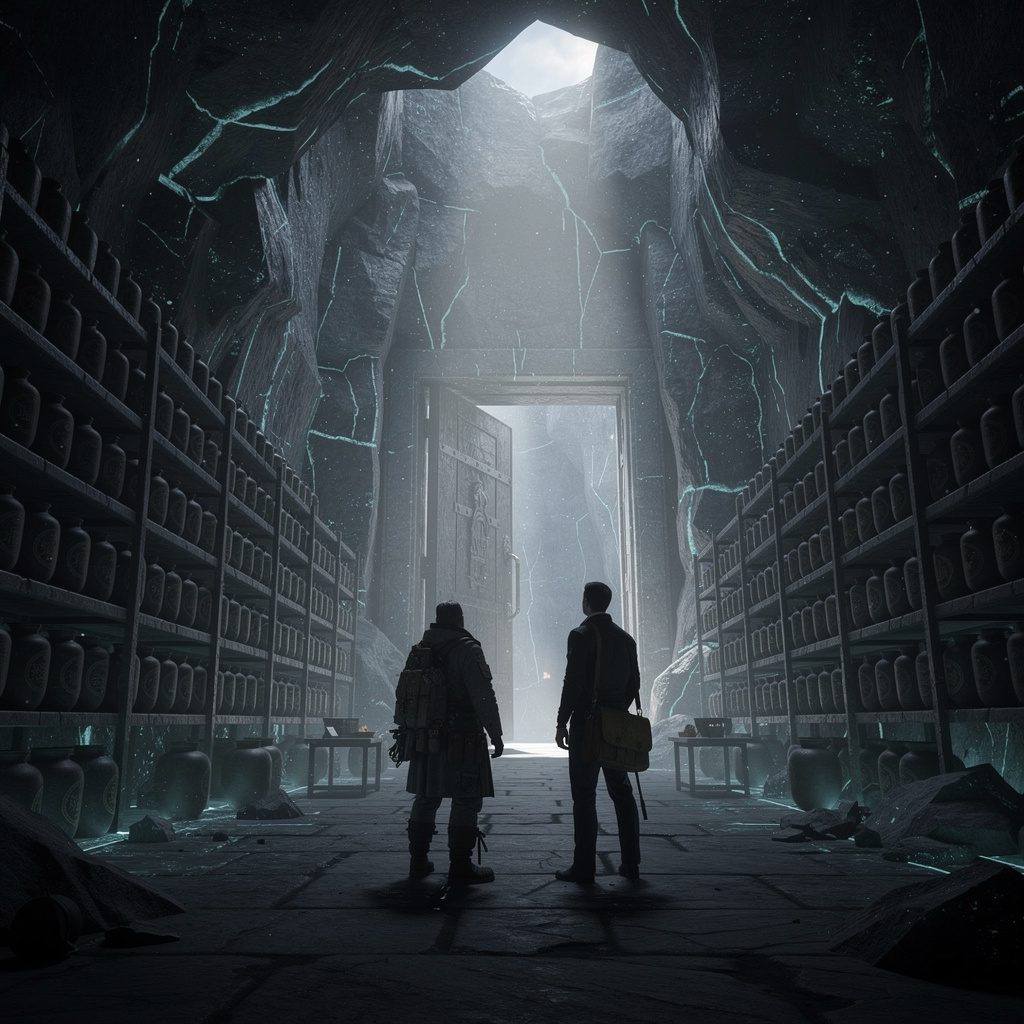
The Velthari mountain was four hours northeast of Orveen, a granite massif called Drevorn’s Spine that most people avoided because of the way the wind moved through its upper passes — in low moans that sounded, if you were the kind of person who listened too carefully, like someone breathing slowly in the dark. The treasury entrance, when they found it, was exactly where the assembled tiles said it would be: a seam in the rock face, invisible until Nasser pressed the tile fragments into the carved recesses around it and the stone exhaled, grinding back on mechanisms that had been waiting three centuries for exactly this configuration of hands.
The interior was not what Nasser had imagined. He had imagined gold. There was no gold. The Velthari treasury was a library. Shelf upon shelf of sealed ceramic cylinders, each one containing documents, plans, calculations — the complete architectural knowledge of a civilization that had carved entire cities from living rock and then disappeared before anyone could learn how. The cylinders were catalogued in the architectural script that covered the seventeenth tile. Without someone who could read that script — without Amira, who had spent three years learning it from Sulev’s decoded fragments — the treasury would have been meaningless. A room full of sealed containers with no way to know what any of them held.
Nasser stood in the middle of it and felt the particular, humbling sensation of having spent months chasing something and arriving to find that the thing was nothing like what he’d been chasing toward.
He had wanted treasure. He had found, instead, the reason Sulev Drath had spent thirty years of his life on a problem that everyone else called a myth.
Amira walked slowly along the shelves, trailing her fingers near but not quite touching the cylinders, reading the labels in a murmur too quiet to hear. Her face had changed. The careful blankness was gone. What was underneath it was something Nasser recognized from his own early years in the work, before recovery had become a profession and before he’d learned to want things for their market value rather than their weight: pure, uncomplicated wonder.
Ewa stood near the entrance, watching them both. She had not moved further into the room. She seemed to understand, with the quiet accuracy she applied to everything, that this moment did not belong to her.
“He wanted this preserved,” Amira said finally, to no one in particular. “Not sold. Not displayed. Preserved and studied. That’s why he needed an archivist.”
She turned to look at Nasser.
“And he needed someone who could find the tiles without being told to look for them. Someone who follows things because they can’t help it.”
Nasser looked at the room around him — the shelves, the cylinders, the faint luminescence of the walls where old Velthari stonework still held some long-dimmed light within the rock itself. He thought about the smell of burnt copper. He thought about the way he had memorized every tile without knowing why.
“He knew the ending,” Nasser said, “of a story neither of us had started yet.”
Ewa, from the doorway, said nothing. But she reached into her coat and set Sulev Drath’s letter on the nearest shelf — addressed, in the old cartographer’s handwriting, to both of them. The names were already there. He had written them years before either of them had come anywhere near his archive.
Amira picked it up. She did not open it yet. She held it the way she held every document she considered important: with both hands, and with the particular care of someone who understands that some things, once opened, cannot be re-sealed.
The stone door behind them remained open, breathing cool mountain air into the treasury for the first time in three hundred years.
The smell of burnt copper faded slowly, like a signal that had finally reached its destination.

 WhatsApp
 Telegram
 Email






Categories
- AI & Technology
- Contemporary
- Corporate Control
- Creepypasta
- Crime Thriller
- Cyberpunk
- Dark Fantasy
- Enemies to Lovers
- Fairy Tale Retelling
- Fantasy
- First Contact
- Forbidden
- Genetic/Body Horror
- High Fantasy
- Monster Hunter
- Mythic/Folklore
- Paranormal
- Portal/Otherworld
- Post-Apo
- Post-Collapse Society
- Psychological Thriller
- Romances
- SCI-FI
- Second Chance
- Slow Burn
- Space Combat
- Spacepunk
- Surveillance State
- Survival Thriller
- Thrillers
- Time Travel
- Treasure Hunter
- Urban Fantasy
- Witchcraft/Curses
Tags
10min stories atmospheric atmospheric fantasy atmospheric fiction contemporary romance Creepy creepypasta crime thriller dark fantasy debt dystopia emotional fiction enemies to lovers ensemble cast epistolary fantasy female protagonist first person forbidden romance framed narrative high fantasy love story magic Memory mystery Paranormal psychological horror psychological thriller romance sci-fi second chance second chance romance short fiction short story slow burn space station speculative fiction supernatural Survival survival thriller suspense thriller travel romance witchcraft workplace romance
Leave a Reply