The smell of burnt copper clung to the inside of Nasser’s satchel even when it was empty.
He hadn’t noticed it until the morning he found the first fragment of the Velthari map — a thumbnail-sized shard of fired clay pressed into the mud beneath the market stalls of Orveen’s lower quarter. He’d assumed the smell came from the clay itself. Old kilns, old earth. He thought nothing of it. He was wrong to think nothing of it.
Orveen was a city built in layers, the way old wounds are. Its lowest streets ran below the waterline of the Sereth River, held back by a wall of pale granite that sweated in the heat. Its upper districts climbed a limestone ridge and looked out over the valley with the particular arrogance of things that have always been above the flood. Between those two extremes, in the cramped and fog-prone middle tier where the map-sellers and the relic brokers and the unlicensed historians kept their shops, Nasser worked. He was not a thief. He preferred the word “recover.” He recovered things that had been lost, misplaced, or buried by people who no longer deserved to own them.
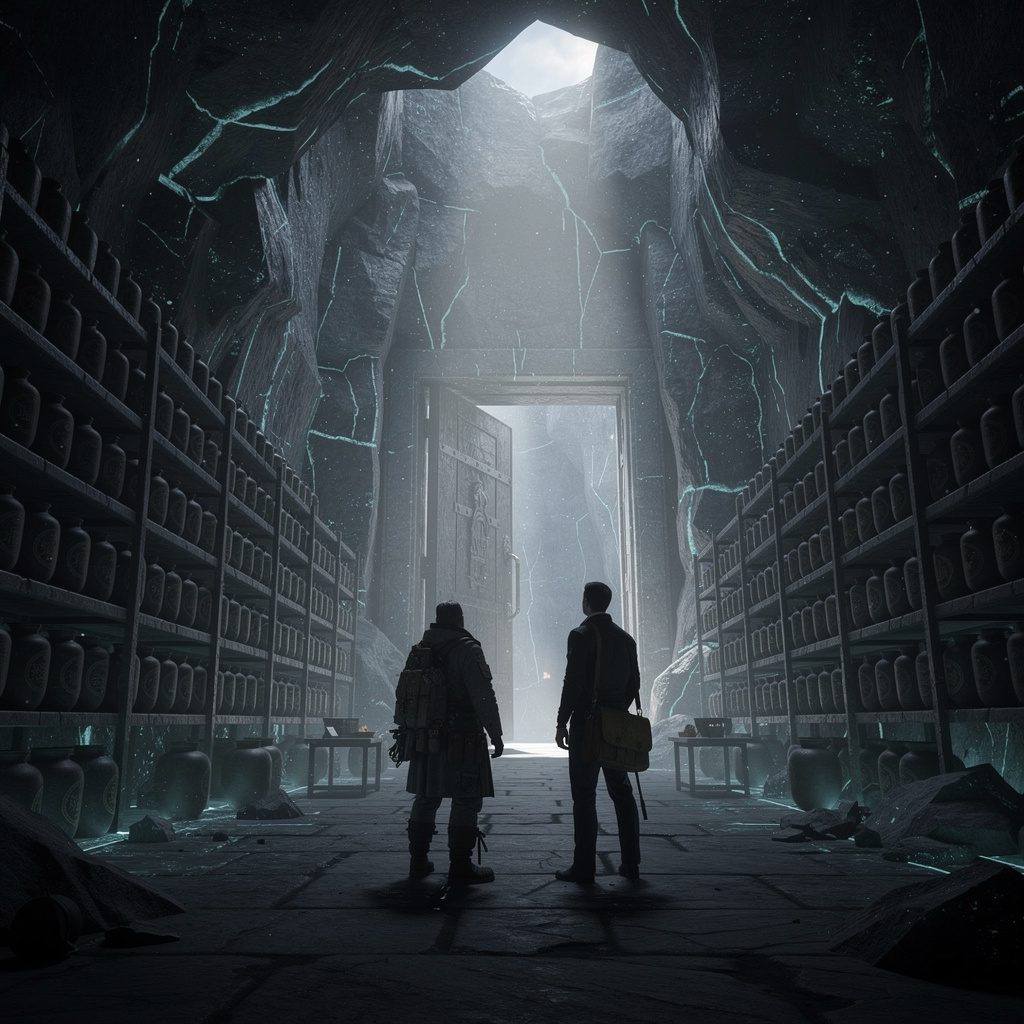
The Velthari map was supposed to be a myth. Three hundred years ago, the Velthari — a clan of deep-earth architects who had carved an entire city into the bones of a mountain — had sealed their treasury and shattered the map that led to it across seventeen ceramic tiles, scattering the pieces across the known world before they vanished. Scholars debated whether the treasury existed. Nasser did not debate. He had already found four tiles.
He was studying the fifth in the back room of a tea house when the door opened and someone sat down across from him without being invited.
She was young, or looked it, with close-cropped hair the color of river silt and eyes that caught the lamplight at an angle that made them seem briefly, wrongly gold. She wore a coat with too many pockets, all of them visibly full. She set her hands flat on the table and looked at the tile in his hands with an expression he recognized immediately: the look of someone who had been searching for exactly that object and had just stopped being surprised to find it.
“Fourth tile,” she said.
“Fifth,” he said.
She looked at him then, recalibrating. “You’re further along than I thought.”
Her name was Ewa. She told him that much and nothing else for the first several minutes, which Nasser spent deciding whether to leave. He didn’t leave. The smell of burnt copper had gotten stronger since she sat down, and he found that interesting enough to stay.
Meanwhile, in the city’s upper district, a woman named Amira was standing in front of a locked door she had been standing in front of for eleven days.
The door belonged to the estate of a dead cartographer named Sulev Drath, whose collection of pre-Velthari survey documents had been sealed by the city’s heritage authority pending an estate dispute that showed no sign of resolving. Amira was the dispute. She was Sulev’s only surviving student, and she had spent three years cataloguing his collection before his death. She knew every document in that archive by its smell and the particular way its edges had yellowed. She also knew, with a certainty she could not yet prove to a heritage tribunal, that someone had already been inside that archive and removed something.
Amira was not a treasure-hunter. She was an archivist. The distinction mattered to her the way a hairline crack matters to a bridge — invisible to most people, catastrophic in the right conditions.
What she was hunting was not the Velthari treasury. She didn’t care about the treasury. She was hunting the seventeenth tile, the anchor piece, the one that the Velthari had reportedly never scattered at all but hidden inside the survey of their own mountain, encoded in a document that Sulev Drath had spent his final years trying to decode. She had been helping him. She had been weeks away from finishing.
She turned away from the locked door, pulled her coat tighter against the evening fog, and walked down into the middle tier to think.
She walked into the same tea house because it was the only place in the middle tier that kept its lamps burning past the ninth hour.

 WhatsApp
 Telegram
 Email






Categories
- AI & Technology
- Contemporary
- Corporate Control
- Creepypasta
- Crime Thriller
- Cyberpunk
- Dark Fantasy
- Enemies to Lovers
- Fairy Tale Retelling
- Fantasy
- First Contact
- Forbidden
- Genetic/Body Horror
- High Fantasy
- Monster Hunter
- Mythic/Folklore
- Paranormal
- Portal/Otherworld
- Post-Apo
- Post-Collapse Society
- Psychological Thriller
- Romances
- SCI-FI
- Second Chance
- Slow Burn
- Space Combat
- Spacepunk
- Surveillance State
- Survival Thriller
- Thrillers
- Time Travel
- Treasure Hunter
- Urban Fantasy
- Witchcraft/Curses
Tags
10min stories atmospheric atmospheric fantasy atmospheric fiction contemporary romance Creepy creepypasta crime thriller dark fantasy debt dystopia emotional fiction enemies to lovers ensemble cast epistolary fantasy female protagonist first person forbidden romance framed narrative high fantasy love story magic Memory mystery Paranormal psychological horror psychological thriller romance sci-fi second chance second chance romance short fiction short story slow burn space station speculative fiction supernatural Survival survival thriller suspense thriller travel romance witchcraft workplace romance
Leave a Reply