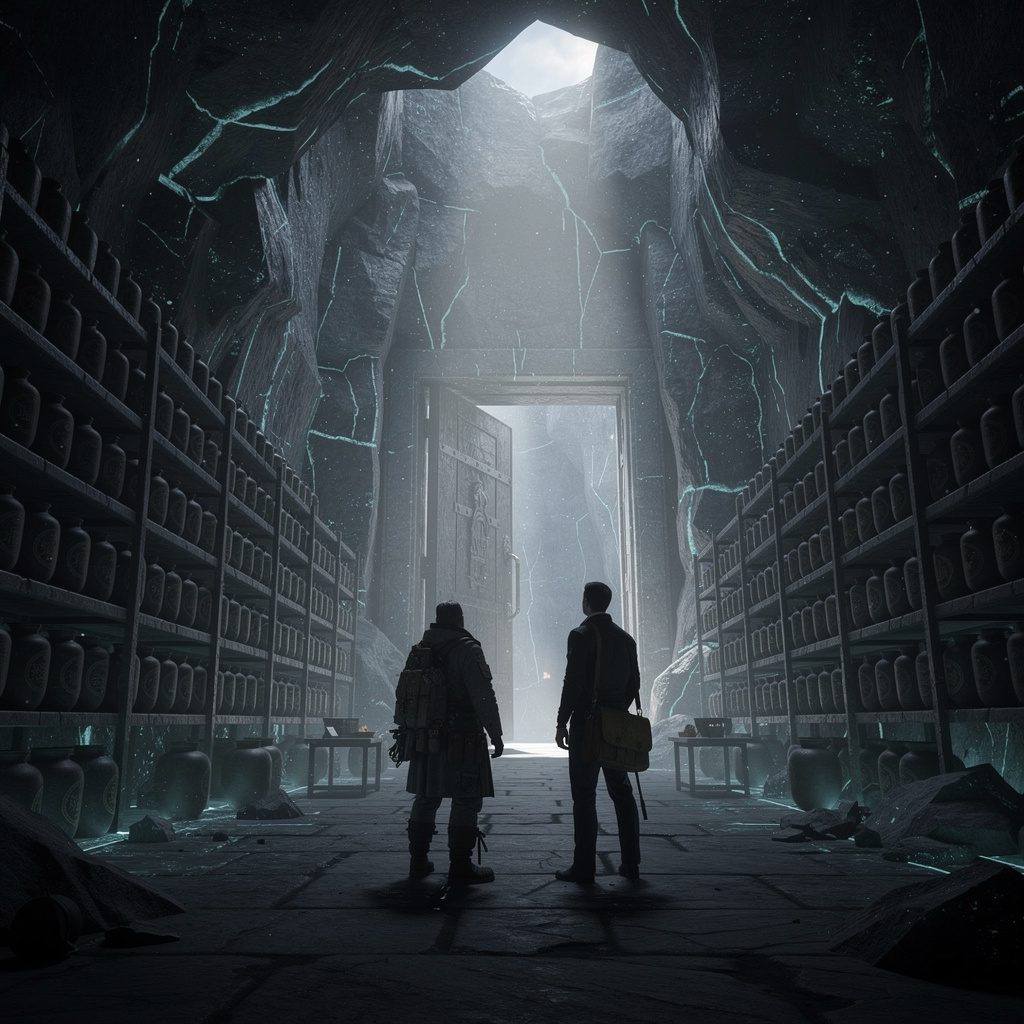
She sat down at the only open table, and then she looked up, and then she saw the tile.
Nasser watched the woman who had just entered stop moving. He watched her eyes fix on the tile still sitting on the table between him and Ewa. He watched her face go through four distinct expressions in under two seconds: recognition, calculation, fear, and then a careful blankness that was worse than all three.
Ewa turned around without being told. She had heard the stillness, apparently. Or something else had told her.
“Archivist,” Ewa said, with the tone of someone identifying a weather pattern.
“Relic broker,” Amira said, looking at Nasser.
“I prefer recover—” he started.
“I know what you prefer,” Amira said. “You’re Nasser Orvain. You found the tile in the Ferren dig in the spring. You sold the authentication report to three different buyers and kept the tile.”
He said nothing. The authentication report detail was accurate.
Amira pulled out the chair beside him and sat down because her legs had made the decision before her mind had. She looked at the tile for a long moment. Then she looked at Ewa.
“How do you know about the map?” she asked.
“I’ve been following it,” Ewa said simply.
“For how long?”
“Longer than you’ve been working on it.”
That should have been impossible. Amira had begun working on the Velthari survey documents three years ago, in a private archive, with a dead man who had told no one what they were doing. The research had never been published. She had never spoken of it outside that archive room.
“Sulev told you,” Amira said.
“No,” said Ewa. “Sulev didn’t know I existed.”
The lamp between them guttered. The smell of burnt copper spiked sharply, and Nasser finally placed it: it was coming from Ewa’s coat. From one of those many pockets. From something inside one of those pockets that had been warm since she sat down.
“What are you carrying?” he asked.
Ewa reached into her coat and set a tile on the table.
It was larger than the others he’d found, nearly the size of his palm, and the clay was darker — not fired in a common kiln but in something hotter, something that had left the surface with a faint iridescent sheen, like the inside of a shell. The markings on it were different too. Where the other tiles bore fragments of topographical lines, elevation notations, route markers, this one was covered in something that looked almost like text but wasn’t quite. It was the Velthari architectural script, which Nasser had seen in reference drawings but never on an original artifact. It was, unmistakably, the seventeenth tile.
Amira made a sound that was not a word.
“You had it,” she said. “You had it the whole time.”
“No,” Ewa said. “I had it for eleven days.”
Eleven days. The same eleven days Amira had been standing in front of a locked door.
“You were in the archive,” Amira said. Not a question. The certainty of it settled through her like cold water.
“Sulev left instructions,” Ewa said. “Not a will. Not anything a heritage tribunal would recognize. A letter, addressed to someone who would come looking after he died. I came looking.” She paused. “He described you. He said you would be the one standing at the door.”
The silence that followed had a texture to it. Nasser felt it pressing against the back of his neck the way a storm feels before the rain arrives.
Amira said, “He knew I’d be locked out.”
“He knew the heritage authority would seal the estate. He arranged it, actually. He needed time for the right people to find each other.” Ewa looked between Amira and Nasser. “Five tiles and the anchor piece don’t open the treasury alone. The tiles map the route. The anchor piece decodes the final lock. But the lock requires the architectural script to be read aloud in the correct sequence, and the correct sequence is only legible if you hold all six pieces in spatial alignment — which requires knowing which five tiles belong to the final approach and which order they assemble in.” She looked at Nasser. “That requires a recovery specialist who has handled every tile and can reconstruct the assembly sequence from physical memory.”

 WhatsApp
 Telegram
 Email






Categories
- AI & Technology
- Contemporary
- Corporate Control
- Creepypasta
- Crime Thriller
- Cyberpunk
- Dark Fantasy
- Enemies to Lovers
- Fairy Tale Retelling
- Fantasy
- First Contact
- Forbidden
- Genetic/Body Horror
- High Fantasy
- Monster Hunter
- Mythic/Folklore
- Paranormal
- Portal/Otherworld
- Post-Apo
- Post-Collapse Society
- Psychological Thriller
- Romances
- SCI-FI
- Second Chance
- Slow Burn
- Space Combat
- Spacepunk
- Surveillance State
- Survival Thriller
- Thrillers
- Time Travel
- Treasure Hunter
- Urban Fantasy
- Witchcraft/Curses
Tags
10min stories atmospheric atmospheric fantasy atmospheric fiction contemporary romance Creepy creepypasta crime thriller dark fantasy debt dystopia emotional fiction enemies to lovers ensemble cast epistolary fantasy female protagonist first person forbidden romance framed narrative high fantasy love story magic Memory mystery Paranormal psychological horror psychological thriller romance sci-fi second chance second chance romance short fiction short story slow burn space station speculative fiction supernatural Survival survival thriller suspense thriller travel romance witchcraft workplace romance
Leave a Reply