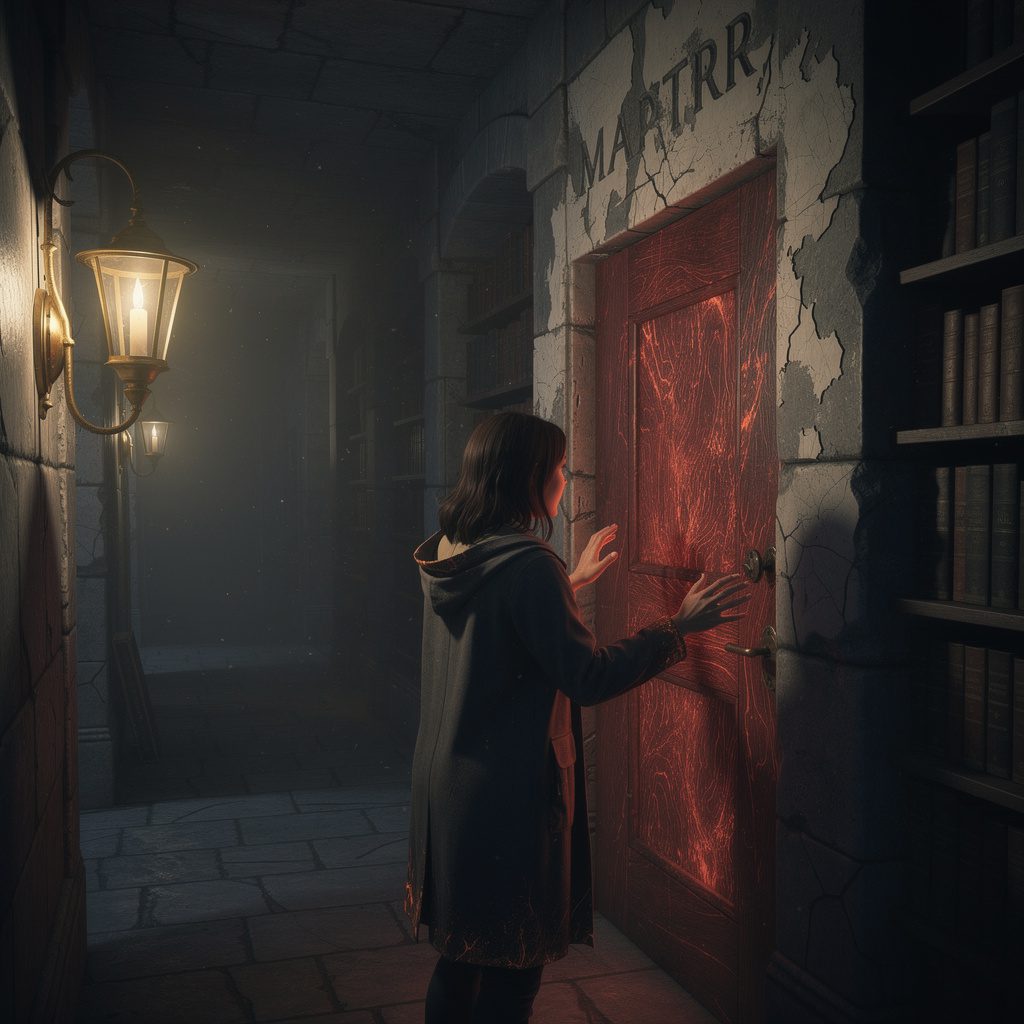
Camila stands in front of it again as the Archive’s old clock strikes six and the last of the other staff pull on their coats and call their goodnights and let themselves out into the evening. She waited. She is not sure when she decided to wait, but she did, and now the building is quiet around her in the particular way of buildings that are used to being empty at night — a settled, unsurprised quiet, the quiet of walls that have held their secrets through many long evenings before this one. The lamp buzzes. The door stands. She studies the carved letters above the frame again, and this time — perhaps because the light has shifted, perhaps because she has stopped trying — she can almost read them. Not in any language she knows. But the shape of them is familiar the way certain melodies are familiar before you recall where you heard them, and the feeling they give her is not danger exactly. It is more like the feeling of standing at the edge of something large, a cliff or a sea, where the enormity of what lies ahead is not a threat so much as a fact. She has spent eleven years in this corridor. She has spent eleven years in this city, in this life, in this carefully constructed smallness that she has called contentment and that she now, standing in front of a door made of warm not-quite-wood, understands she has called contentment because the alternative was to call it what it actually is. A retreat. A long, elaborate, comfortable retreat from the moment eleven years ago when she arrived in Halvenmoor with a fellowship and a thesis and a plan that did not survive contact with loss, and found that the Archive was a place where you could be very still and very safe and never have to go anywhere again.
She puts her hand on the door.
It opens inward.
—
Vaelith is on her feet before the instruments finish their cascade of readings, crossing to the window that faces the Seam — which is not visible to ordinary sight but which she has spent so long observing through her lens that she can feel its presence now as a change in the air, a slight thickening, the way the atmosphere before a storm is different from the atmosphere of any other afternoon. The door is open. After thirty years, the door is open. She had calculated this moment to within a margin of three days, and she had also, in the private architecture of her expectations, prepared herself for the possibility that no one would come through it. She had prepared herself carefully and thoroughly, the way she prepares for everything, and she had still not quite believed that preparation would be enough to prevent the specific grief of being wrong. Now the dial holds its position. Now the Seam holds its opening. And Vaelith allows herself, for just a moment, to feel the unfamiliar sensation of something going right after an interval so long that rightness had begun to seem like a feature of other people’s lives.
She takes the lamp from the table. She goes down the stairs of the seventh tower, through the silent ground floor where Aevorn’s last library still stands — its books long since unreadable, their pages fused by whatever passed through the city when it folded, but their spines still lined up with the diligence of people who believed in order even at the end — and out into the street, where the pewter sky presses close and the air smells of something between copper and rain. She walks toward the Seam. She walks toward the door.

 WhatsApp
 Telegram
 Email







Categories
- AI & Technology
- Contemporary
- Corporate Control
- Creepypasta
- Crime Thriller
- Cyberpunk
- Dark Fantasy
- Enemies to Lovers
- Fairy Tale Retelling
- Fantasy
- First Contact
- Forbidden
- Genetic/Body Horror
- High Fantasy
- Monster Hunter
- Mythic/Folklore
- Paranormal
- Portal/Otherworld
- Post-Apo
- Post-Collapse Society
- Psychological Thriller
- Romances
- SCI-FI
- Second Chance
- Slow Burn
- Space Combat
- Spacepunk
- Surveillance State
- Survival Thriller
- Thrillers
- Time Travel
- Treasure Hunter
- Urban Fantasy
- Witchcraft/Curses
Tags
10min stories atmospheric atmospheric fantasy atmospheric fiction contemporary romance Creepy creepypasta crime thriller dark fantasy debt dystopia emotional fiction enemies to lovers ensemble cast epistolary fantasy female protagonist first person forbidden romance framed narrative high fantasy love story magic Memory mystery Paranormal psychological horror psychological thriller romance sci-fi second chance second chance romance short fiction short story slow burn space station speculative fiction supernatural Survival survival thriller suspense thriller travel romance witchcraft workplace romance
Leave a Reply