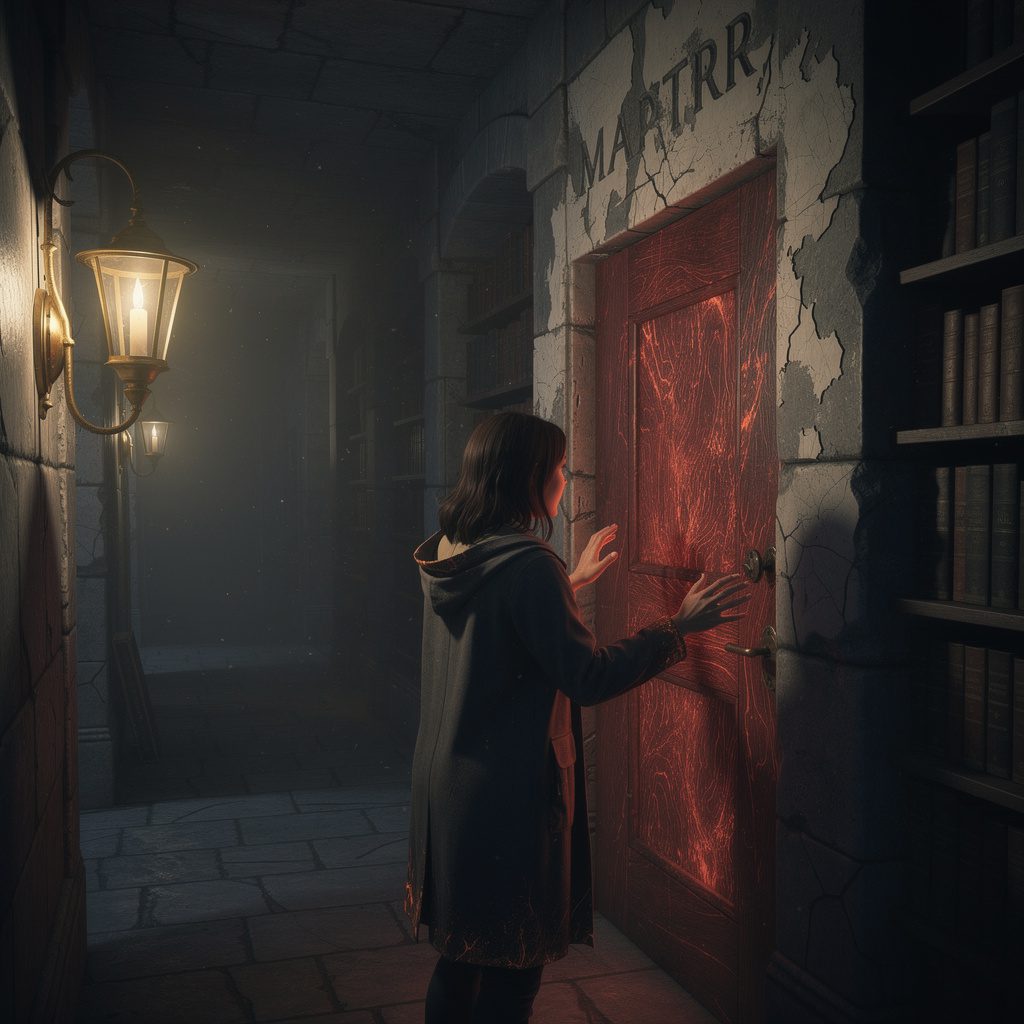
The door appears on a Tuesday, which is the least remarkable day Camila Vasquez can imagine for the world to crack open. She notices it the way you notice something wrong in a familiar painting — not all at once, but in the corner of the eye, a wrongness that takes a moment to become a fact. She has walked the corridor of Halvenmoor Archive every morning for eleven years, past the water-stained plaster and the brass lamp that never quite burns bright enough and the locked supply closet whose key went missing in the first month of her employment and was never found. She knows this hallway the way she knows the rhythm of her own breath: unremarkably, completely. And yet. There is a door where the plaster used to be. It stands between the lamp and the place where the corridor bends toward the reading room, and it is made of something that is not quite wood — a deep reddish-brown material with a grain that seems to shift when she is not looking directly at it, like the surface of still water when something moves beneath. There is no handle. There is no hinge she can see. There is only the door, and above it, carved into the frame in letters she does not recognise, a phrase that her eyes slide away from each time she tries to read it, as though the words themselves are reluctant to be known.
She stands in front of it for a long time. The lamp buzzes softly beside her. Somewhere in the reading room, a page turns. The Archive is a place of accumulated quiet, of dust and old binding glue and the particular hush of rooms where people have spent decades being careful with fragile things, and Camila has always found comfort in that hush — has built her life inside it, in fact, the way a hermit crab builds a life inside a borrowed shell. She is thirty-four years old. She has worked here since she was twenty-three, cataloguing the Archive’s collection of pre-Rending manuscripts, and in that time she has learned to love the smell of aged vellum more than the smell of rain, which she understands is an unusual preference but does not trouble her. She has a small flat three streets away. She has a cat named Vestibule who is old and imperious. She does not have much else, and she has always told herself this is a choice rather than an accident, though she has never examined that claim too closely. The door makes her want to examine it. She does not know why. She reaches out and presses her palm flat against its surface, and the wood — or the not-quite-wood — is warm. Not warm the way sun-heated stone is warm. Warm the way skin is warm.
She pulls her hand back.
She goes to her desk. She catalogs three manuscripts. She eats her lunch. She does not go back to the corridor.
She goes back to the corridor.

 WhatsApp
 Telegram
 Email







Categories
- AI & Technology
- Contemporary
- Corporate Control
- Creepypasta
- Crime Thriller
- Cyberpunk
- Dark Fantasy
- Enemies to Lovers
- Fairy Tale Retelling
- Fantasy
- First Contact
- Forbidden
- Genetic/Body Horror
- High Fantasy
- Monster Hunter
- Mythic/Folklore
- Paranormal
- Portal/Otherworld
- Post-Apo
- Post-Collapse Society
- Psychological Thriller
- Romances
- SCI-FI
- Second Chance
- Slow Burn
- Space Combat
- Spacepunk
- Surveillance State
- Survival Thriller
- Thrillers
- Time Travel
- Treasure Hunter
- Urban Fantasy
- Witchcraft/Curses
Tags
10min stories atmospheric atmospheric fantasy atmospheric fiction contemporary romance Creepy creepypasta crime thriller dark fantasy debt dystopia emotional fiction enemies to lovers ensemble cast epistolary fantasy female protagonist first person forbidden romance framed narrative high fantasy love story magic Memory mystery Paranormal psychological horror psychological thriller romance sci-fi second chance second chance romance short fiction short story slow burn space station speculative fiction supernatural Survival survival thriller suspense thriller travel romance witchcraft workplace romance
Leave a Reply