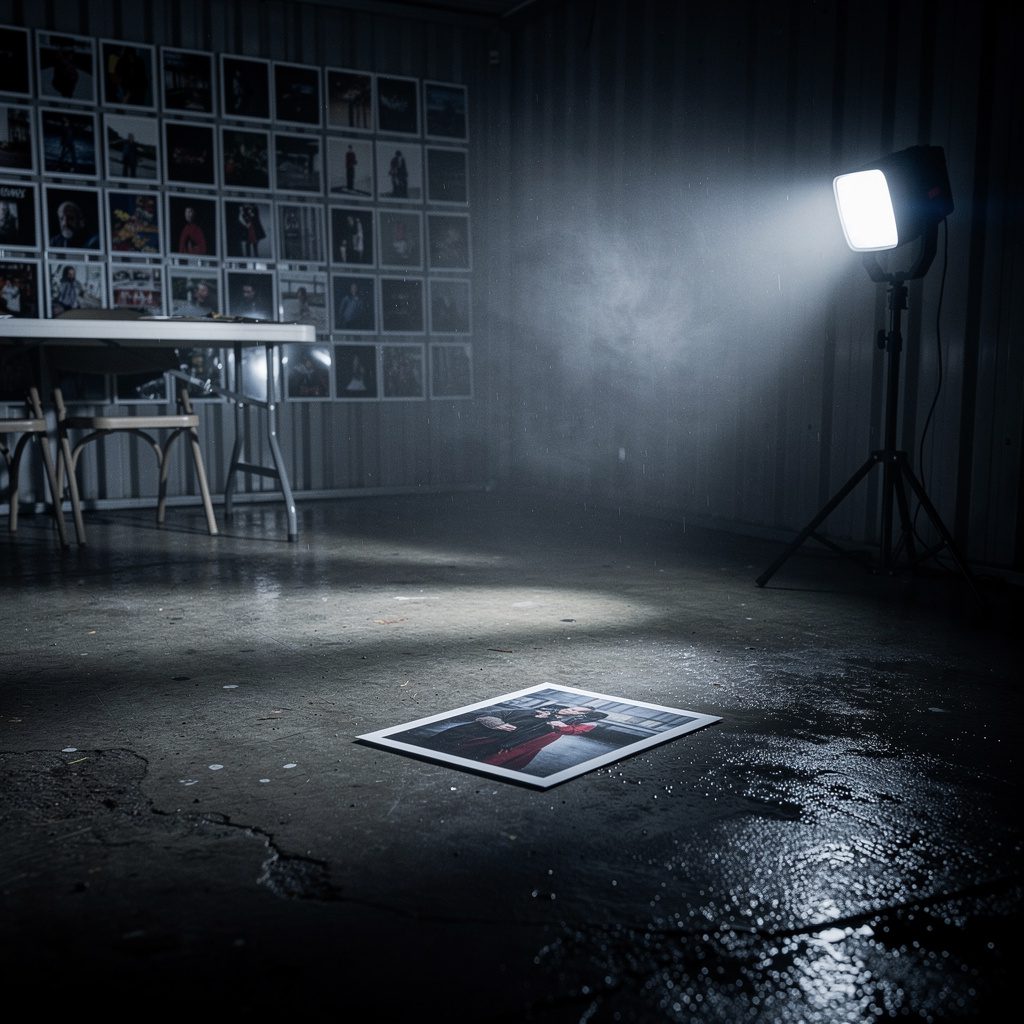
They stood at the edge of the light and looked.
In some of the photographs the fifth man was partially visible. In others he was central, unambiguous, clearly part of the group. In a few he was looking directly at the camera — at Kacey, who had been holding it — with the particular ease of someone who has been photographed many times and has never once been asked to leave the frame. There was one photograph, near the center of the grid, where Kacey herself appeared in it, meaning someone else had taken this one, and in that image Kacey was laughing at something the fifth man had apparently just said, her whole face open with it, completely unguarded.
Kacey looked at this photograph for a long time.
Bartosz found the folder beneath the table — a manila envelope, thick, containing printed records. A lease agreement. A phone plan. A gym membership. All in a name none of them recognized. All at an address in Northeast Portland. All bearing, in the signature line, variations on a signature that was not quite any of theirs but was assembled, somehow, from the components of all of them — Rolf’s capital R, Ilona’s looping L, Bartosz’s compressed B. As though someone had studied them carefully enough to build a ghost from their leftover parts.
The urgency was there now, fully arrived, no longer approaching. Rolf said they needed to call someone — the police, a lawyer, someone. Bartosz, who was the lawyer, said that what they had was a collection of photographs and documents that proved someone had been watching them, but proved nothing about threat or intent in any legally actionable sense, and that this particular gap between what was real and what was provable was one he had spent his career navigating from the other side. Ilona said she didn’t care what was provable. She said she wanted to know who he was.
Kacey said nothing for a long time. Then she said: I think I remember him.
The room went still in the particular way rooms go still when something that has been underground finally surfaces.
She said it slowly, carefully, the way you say something you have been unknowingly holding. She said she thought he had been a neighbor, years ago, in the building where she and Ilona had lived briefly after college — a place in the Sellwood neighborhood, old building, high ceilings, the kind of place that felt temporary even when you were in it. She said she thought his name had been something plain and forgettable. She said he had been quiet. Polite. The kind of neighbor you nod to in the hallway and never quite see.
She said she thought they had all met him once, the four of them, at some kind of building gathering, early spring, before any of them really knew each other well.
And then she said the thing that was actually the revelation, the thing that rearranged all the other things: she said she thought she had been the one who had told him to leave. She couldn’t remember why. She couldn’t remember the specifics. But she had a clear, sudden sense of herself standing in a hallway, speaking firmly, and of a door closing. And a feeling afterward — not guilt, exactly, but something adjacent to it. Something she had filed away under the category of necessary and then forgotten completely.
She looked at the photograph of herself laughing.
She looked at her own open, unguarded face.
And what settled over her then wasn’t fear of the man who had built this archive, who had spent years carefully reconstructing himself into their history. It was something quieter and more personal. It was the recognition that she had done something she could not remember, something consequential enough that someone had structured years around its aftermath, and that the forgetting had not been innocent — it had been easy. It had been so easy. She had filed it under necessary and moved on, and the moving on had felt, at the time, like health.
The rain came through the open door of the storage unit, just barely, misting the edge of the concrete floor.
No one spoke for a while.
I put down my pen. That’s what I do when I’ve gotten what I came for — not a confrontation, not a scene. Just the moment when someone finally looks at themselves clearly. I have found, in my experience, that this is usually enough.

 WhatsApp
 Telegram
 Email







Categories
- AI & Technology
- Contemporary
- Corporate Control
- Creepypasta
- Crime Thriller
- Cyberpunk
- Dark Fantasy
- Enemies to Lovers
- Fairy Tale Retelling
- Fantasy
- First Contact
- Forbidden
- Genetic/Body Horror
- High Fantasy
- Monster Hunter
- Mythic/Folklore
- Paranormal
- Portal/Otherworld
- Post-Apo
- Post-Collapse Society
- Psychological Thriller
- Romances
- SCI-FI
- Second Chance
- Slow Burn
- Space Combat
- Spacepunk
- Surveillance State
- Survival Thriller
- Thrillers
- Time Travel
- Treasure Hunter
- Urban Fantasy
- Witchcraft/Curses
Tags
10min stories atmospheric atmospheric fantasy atmospheric fiction contemporary romance Creepy creepypasta crime thriller dark fantasy debt dystopia emotional fiction enemies to lovers ensemble cast epistolary fantasy first person forbidden romance found text framed narrative high fantasy love story magic Memory mystery Paranormal psychological horror psychological thriller romance sci-fi second chance second chance romance short fiction short story slow burn space station speculative fiction supernatural Survival survival thriller suspense thriller travel romance witchcraft workplace romance
Leave a Reply