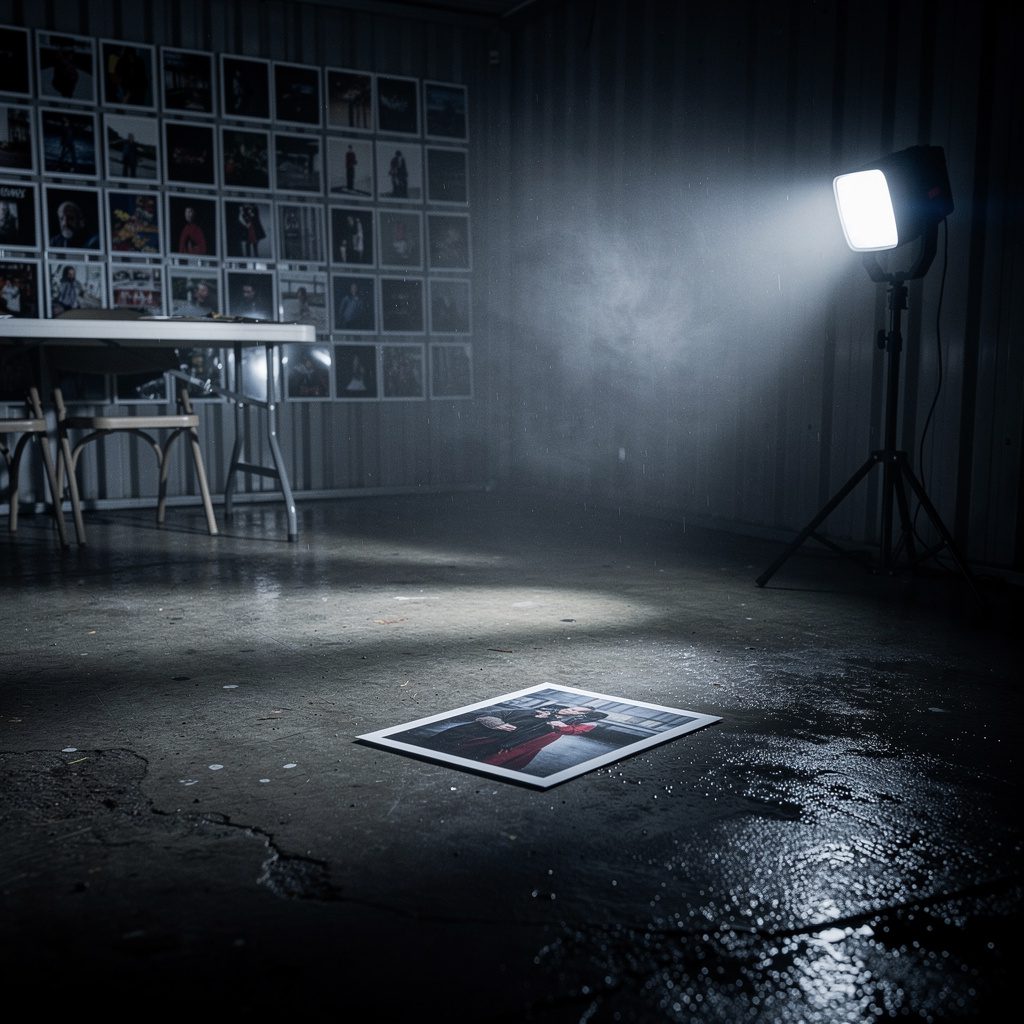
Kacey was the first to speak. She said, quietly, that the barbecue had been six years ago, at a rental property they’d all shared for a long weekend on the Washington coast, and that she had been the one with the camera, and that she remembered taking exactly this shot, and that she had never in her life seen this man before. She said this last part twice, not for emphasis, but because saying it once had not made it feel any more manageable. Bartosz sat down at the kitchen table across from the photograph and put his glasses back on his nose and looked at it the way he used to look at legal briefs — with a kind of exhausted precision, searching for the clause that changed everything.
Fragments, then. Memory coming apart in pieces.
Rolf, three weeks earlier, standing in the parking structure beneath his office building in downtown Portland, finding a handwritten note under his wiper blade. The note had said only: You were there. He had assumed it was for someone else’s car. He had thrown it away.
Ilona, a month before that, receiving a phone call from a number that traced back to a disconnected line. The caller had said nothing for twelve seconds — she had counted — and then had hung up. She had told herself it was a misdial. She had mostly believed this.
Bartosz, going back further still, finding a name written in the margin of a legal pad he kept on his desk at the law firm, a name he didn’t recognize in handwriting that was almost but not quite his own. He had assumed he’d been half-asleep when he wrote it. He had torn the page out and recycled it.
Kacey, the furthest back: a message in her email’s sent folder, addressed to an account she didn’t recognize, containing only a date, a time, and an address in Northeast Portland. She had not sent this message. She was certain of this. She was as certain of this as she had ever been of anything, and the certainty had begun to feel, over the months, like a kind of thin ice she was standing on.
All of this had been building, separately, in each of them, the way water builds behind a dam — silently, without drama, until it isn’t silent anymore.
The second photograph changed the pace of things. It was Bartosz who said they needed to go to the address — the one from Kacey’s sent folder, the one that had appeared in her email like a ghost leaving a forwarding address. He said it the way lawyers say things when they have already decided: not as a suggestion, but as a statement awaiting agreement. Rolf said it was a terrible idea. Kacey said nothing, which was her version of the same thing Bartosz had said. Ilona, who had lived alone in this apartment for four years and who had spent three of those days with the first photograph in her desk drawer unable to throw it away, said they should go tonight, before whoever was doing this sent a third.
The address was a storage facility near the river, the kind of place that operates with minimal staff and maximum anonymity, the orange roll-up doors visible from the elevated train line. They drove in Kacey’s car, the four of them, through rain that had thickened into something closer to mist, the streetlights dissolving into halos above the wet pavement. Nobody talked much. The radio was off. The wipers kept a slow, metronomic time.
I followed at a distance that I have learned, over years, is comfortable for everyone involved.
The unit number had been in the email too — bay 114. It was unlocked. This was, of course, the point. The lock had not been broken; it had been opened and left that way, which meant permission of a kind, or the illusion of it. Rolf pulled the door up and the smell that came out was dry and cool and faintly chemical, the smell of things preserved against their will. Inside: a folding table, a single work light on a battery pack, and on the table, arranged in a grid, forty or fifty photographs. All from the same barbecue. All from the same roll. A progression, a narrative, the kind of careful documentation that takes planning and patience and a very specific relationship to other people’s lives.

 WhatsApp
 Telegram
 Email







Categories
- AI & Technology
- Contemporary
- Corporate Control
- Creepypasta
- Crime Thriller
- Cyberpunk
- Dark Fantasy
- Enemies to Lovers
- Fairy Tale Retelling
- Fantasy
- First Contact
- Forbidden
- Genetic/Body Horror
- High Fantasy
- Monster Hunter
- Mythic/Folklore
- Paranormal
- Portal/Otherworld
- Post-Apo
- Post-Collapse Society
- Psychological Thriller
- Romances
- SCI-FI
- Second Chance
- Slow Burn
- Space Combat
- Spacepunk
- Surveillance State
- Survival Thriller
- Thrillers
- Time Travel
- Treasure Hunter
- Urban Fantasy
- Witchcraft/Curses
Tags
10min stories atmospheric atmospheric fantasy atmospheric fiction contemporary romance Creepy creepypasta crime thriller dark fantasy debt dystopia emotional fiction enemies to lovers ensemble cast epistolary fantasy female protagonist first person forbidden romance framed narrative high fantasy love story magic Memory mystery Paranormal psychological horror psychological thriller romance sci-fi second chance second chance romance short fiction short story slow burn space station speculative fiction supernatural Survival survival thriller suspense thriller travel romance witchcraft workplace romance
Leave a Reply