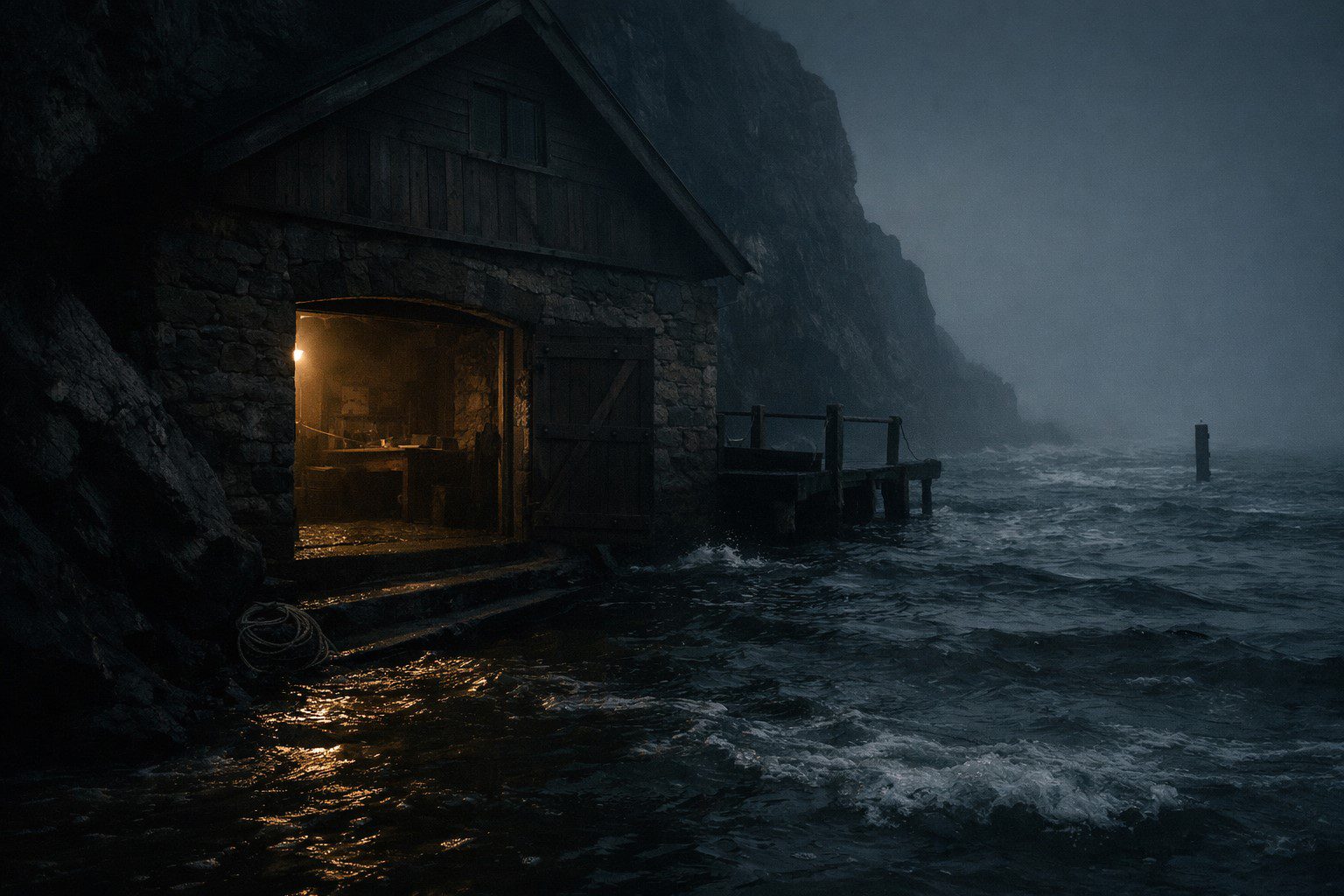
I replied: Loft of stone boathouse, estimated four metres above normal high. Structure appears sound. How long until causeway viable?
The response took six minutes. Causeway likely passable from approximately thirteen hundred. Monitor for structural integrity. If building compromised, signal immediately.
Thirteen hundred. Three hours and fifteen minutes.
I catalogued what I had. The satellite communicator was my lifeline — fully charged, good for twelve hours. The loft had no food beyond my protein bar and no water beyond my half-litre, but three hours was manageable on what I had. The structure around me was my primary concern.
I had been assessing this building for an hour before the water rose. I knew its condition better than anyone. I opened my notebook to the morning’s survey notes and went through them, wall by wall.
The north wall had shown some fracturing at the mortar joints in the lower course — minor, I had noted, consistent with tidal exposure over decades. Under surge conditions, with water pressure against the exterior face, minor became a relative term. I went to the north-facing loft window — a small opening, no glass, original timber frame — and looked down at the waterline on the north wall.
The water was pushing against the wall in a way that normal high tide did not. Not a wave action — a sustained pressure, the weight of abnormal water behind a front that extended further than usual. I could see the mortar lines I had noted this morning. They were holding.
I watched them for twenty minutes. They continued to hold.
At ten-fifteen the water reached its peak. I knew this because the communicator chimed again: Surge maximum reached. Levels should begin receding from ten twenty. Causeway passable from approximately twelve forty-five if conditions hold.
Fifteen minutes earlier than the first estimate. I looked at the water below me. The boathouse floor was invisible beneath what looked like a metre and a half of dark water. The loft floor was dry. The north wall was wet to a height I could see above the water line outside — dark stone, lighter above the surge mark, the clear visual record of how high it had come.
The mortar joints had held. The structure had held.
I sat on the loft floor and ate the protein bar and drank the rest of my water and wrote up the morning’s survey notes by hand, because I was a surveyor and this was what surveyors did.
At twelve fifty I descended the ladder into water that came to my shins, crossed the boathouse floor, and waded to the causeway. The water was cold and the surface underfoot was slippery with weed, but the causeway was visible and solid and I crossed it in fourteen minutes without incident.
On the mainland, a coastguard vehicle was parked at the causeway head. Two officers, both of whom had the expression of people who had been watching a building on a distant island for three hours.
“Mr. Adler,” one of them said.
“The structure held,” I told them. “North wall showed some pressure stress but the mortar joints are intact. I’ll note it in the report.”
They looked at me for a moment.
“Are you all right?” the second officer asked.
“Fine,” I said. “I’d like a cup of tea.”

 WhatsApp
 Telegram
 Email







Leave a Reply