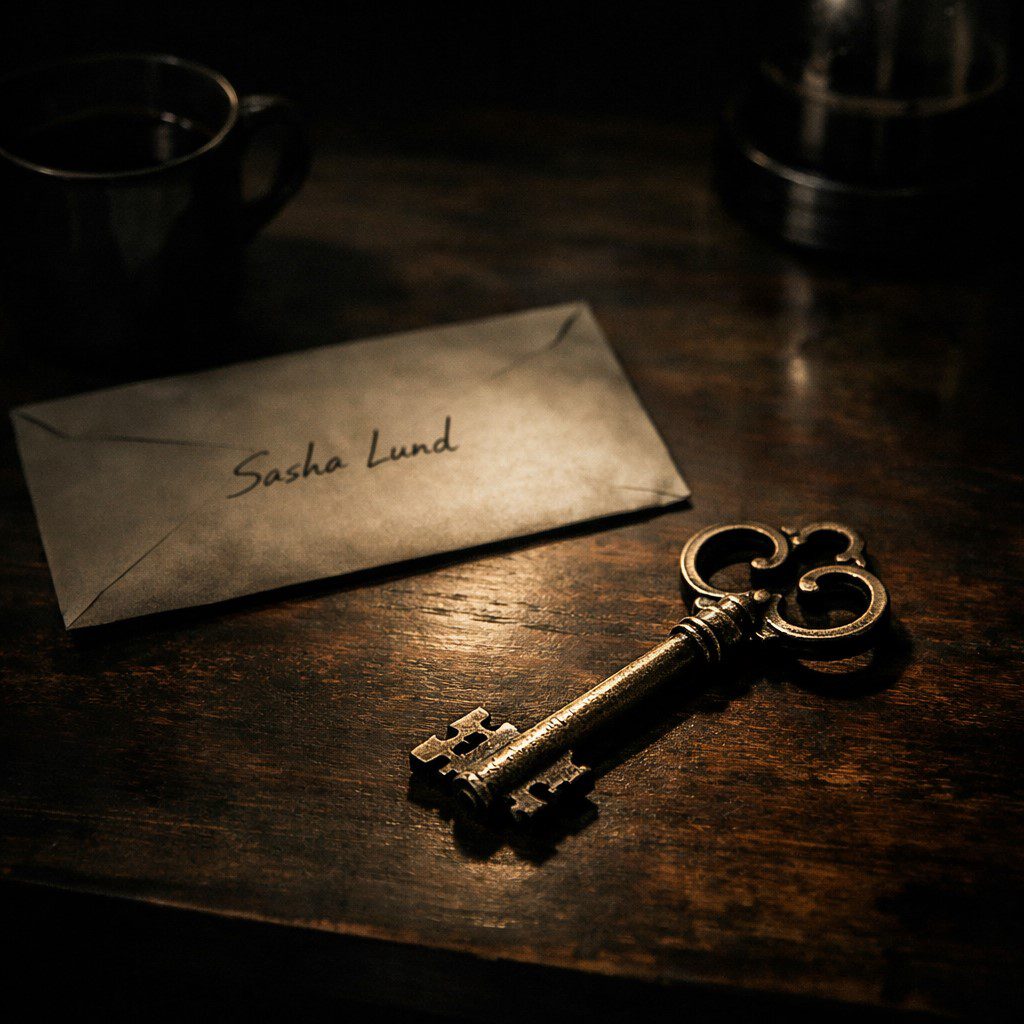
I went on my lunch break the following day. Halkett and Crane, established 1931, a narrow Georgian building on Mercer Lane with a brass plate by the door so old the lettering had softened at the edges. The receptionist was young and efficient and looked at me with polite puzzlement when I explained what I had. I showed her the photograph on my phone.
She went away and came back with a man in his sixties who introduced himself as Mr. Crane — the second generation, he said, not the original — and who looked at the photograph with an expression I could not immediately read.
“Where did you get this?” he asked.
“It came in the post. With my name on the envelope, no return address.”
He looked at the photograph for another moment. Then he looked at me.
“Would you come through?” he said.
He took me to a room at the back of the building that smelled of old paper and the particular dry cold of places that held things for a long time. Three walls were shelved, floor to ceiling, with deed boxes — dark metal, labelled with faded card. He stopped in front of one section and ran his finger along the labels without touching them, reading, until he stopped.
He pointed to a box on the middle shelf. Dark green, older than most of the others, a label so faded I could only read the first letter of what might have been a surname.
“This box,” he said carefully, “has been here since 1987. When it was deposited with us it was accompanied by a sealed letter of instruction. The instruction was that the contents were to be held until a specific set of conditions was met, at which point the box and the key were to be transferred to a named individual.” He paused. “It seems the key has arrived, which means someone determined the conditions were met.”
“What were the conditions?”
“I’m not at liberty to say. The instruction was sealed.”
“Who deposited the box?”
He hesitated. “A client. I can tell you that the client is deceased and has been for some years.”
I looked at the green box on the shelf. “Who is the named individual?”
He looked at me over the top of his glasses with the patient expression of a man who had been managing information carefully for a very long time.
“You are,” he said.
I took the box home. I had to sign three forms and provide two forms of identification, and Mr. Crane made a copy of every document before he let me carry the box out of the building, which told me he was a thorough man who understood that some transactions needed a clear record. I thanked him. He wished me luck with a gravity that made me think luck was the right word.
The box sat on my kitchen table beside the key. I made tea and sat across from both of them and thought about what I knew.
Someone had deposited a box in 1987 with a solicitor, with my name on the instruction and a key that had been — somehow, at some point, by someone — sent to me through the post. I had been born in 1986. The box was older than most of my memories.
Whoever had done this had known my name before I was old enough to have a name worth knowing. Had known my address on Greave Street decades before I chose it.
I picked up the key. I put it in the lock.

 WhatsApp
 Telegram
 Email







Leave a Reply