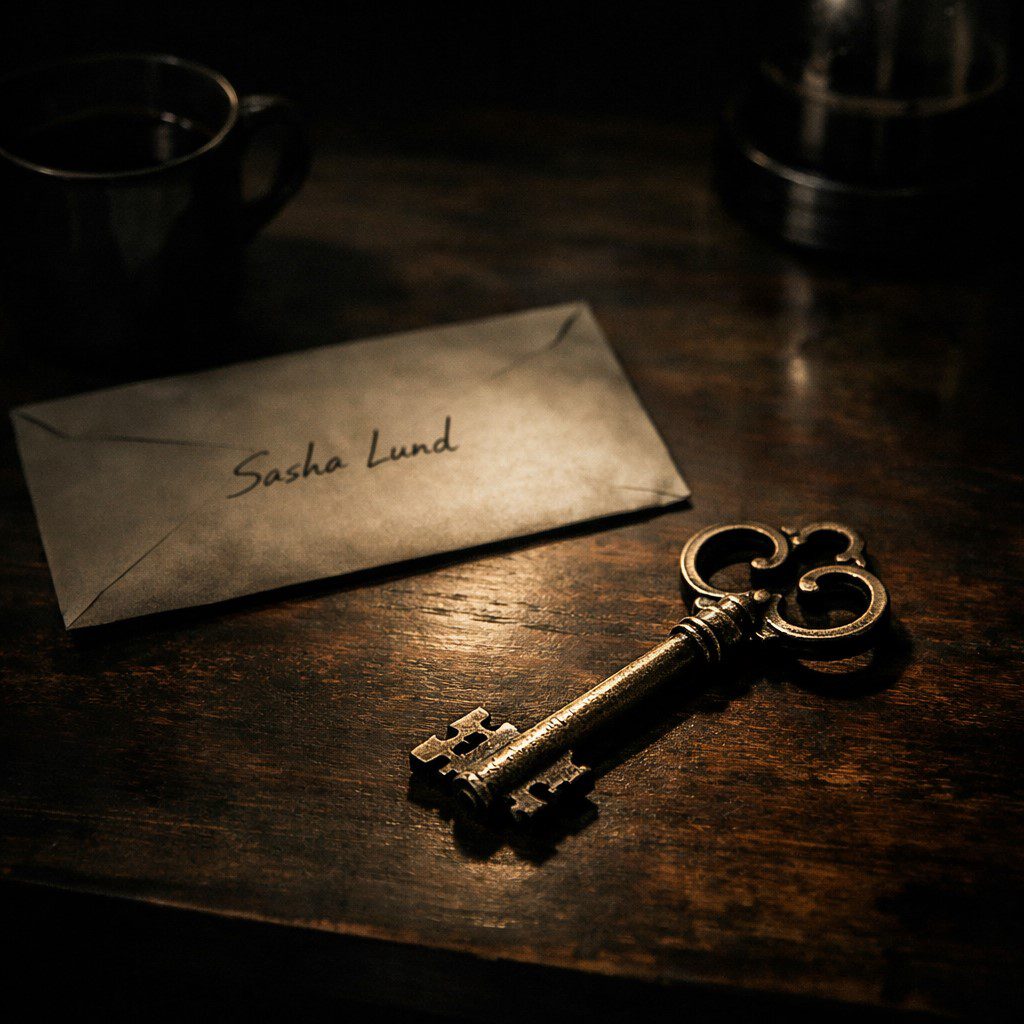
The key arrived in a plain envelope with my name on it and no return address, and when I held it up in the light it was clearly old — brass, hand-cut, the kind that belonged to something serious and locked. My name on the envelope was in a handwriting I did not recognise. My address was correct to the flat number.
I turned it over twice and put it on the kitchen table and made coffee and looked at it for a long time before I admitted to myself that I was already going to find out what it opened.
My name is Sasha Lund. I am thirty-eight, I work as a legal secretary for a firm in the centre of the city, and I have lived in the same flat on Greave Street for six years. I am not a person to whom unusual things happen, or rather I had not been, until the key arrived on a Tuesday in March.
I had no idea what it opened. It was too large for a padlock, too small for a front door. The bow was ornate — an unusual shape, a kind of loop within a loop — and the bit was complex enough that it had been made for something specific, something with a corresponding lock that had been built to the same specification. It was not a common key. Whoever had sent it had sent it to me for a reason, and the reason was the part I could not account for.
I did not know anyone who would send me a key. I did not know anyone who was dead, which was my second thought after my first thought, which was that it was a mistake. My relatives were alive and geographically distant and none of them, to my knowledge, owned anything that would require this key.
I photographed it and sent the photograph to my colleague Petra, who collected antiques as a hobby and had more context for old objects than I did. She replied within twenty minutes: Victorian or Edwardian. Possibly a strong room key or a deed box. Someone’s solicitor’s office, maybe, or a bank vault. Where did you find it?
I told her. She suggested I find a locksmith.
The locksmith was a small shop two streets from my flat, run by a man named Harlan who had been in the trade for forty years and who held the key under a magnifier for three minutes before he said anything.
“This is a Chubb patent,” he said. “Lever lock, probably five or six levers given the bit complexity. Pre-war, I’d say, maybe earlier. Not common anymore. Very good lock when it was made — very difficult to pick.” He turned it over. “Someone looked after this.”
“Do you know what it opens?”
“Could be a deed box. Could be a strong room. Could be a cabinet — there were some very good security cabinets built to the same specification in the early twentieth century.” He handed it back. “Whatever it is, it’ll still be working. These don’t degrade if they’re kept right.”
I asked if he knew of any local businesses or institutions that still used Chubb levers of that vintage.
He thought about it. “There’s a firm of solicitors on Mercer Lane,” he said. “Been there since the thirties. The old partners used to bring me keys from their strong rooms every few years for copies. I’d recognise the pattern.” He looked at the key again. “Actually — yes. That bow design. I’ve cut copies of that before. Not for thirty years, but.”
He wrote down the name of the firm.

 WhatsApp
 Telegram
 Email







Leave a Reply