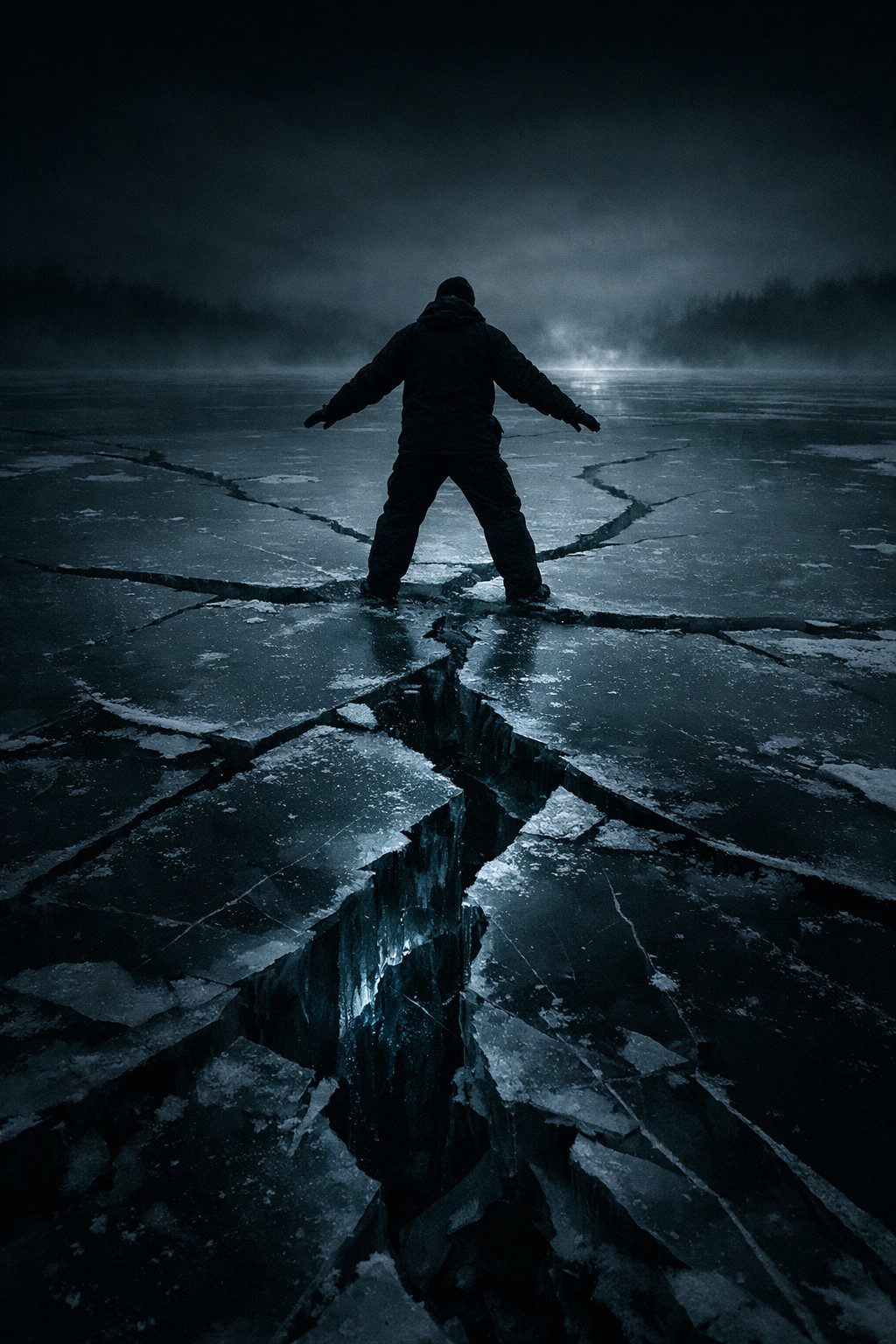
I reached the hole and looked in. Dark water, very cold, moving slightly — the current was real, there was something below. I pulled out my torch and shone it down. Three feet below the surface, pressed against the underside of the ice by the slight current, was a face looking up at me.
Kasper was alive. I could see the movement of his eyes in the torchlight and the small displacement of water around his mouth where he was exhaling into an air pocket between the ice surface and the water, a pocket formed by the slight depression where he had gone through and the re-freeze around the edges. It was perhaps five centimetres deep. It had kept him breathing for — I checked my watch — just over fifteen hours.
Fifteen hours in water at two degrees. Severe hypothermia, certainly. But breathing. Eyes tracking the light. Alive.
I radioed my team — location, situation, one patient, conscious, sub-ice, thermal vent present, bring the ice sled and the warming kit and do not approach via the eastern route, approach from the west where the ice was thick. I kept my voice level because a level voice on the radio was the fastest way to get people moving efficiently. I told them ten minutes. Then I looked down at Kasper’s face in the water and I said, loud enough to carry through the ice: “Kasper. I can see you. I’m going to get you out. Do not move. Do not try to swim. Stay exactly where you are.”
The next ten minutes were the kind of ten minutes that compressed afterward into something you could summarise in a sentence but that at the time contained more decisions per second than most people made in an hour. I enlarged the hole with my ice chisel, carefully, keeping my weight distributed, monitoring the grey ice around me for any change in sound or surface texture. I kept talking to Kasper through the ice — his name, simple instructions, the information that help was coming. I do not know how much of it he could hear. I kept talking anyway.
My team reached me at nine minutes forty seconds. We worked the extraction in the sequence we had trained: sled positioned, rope system established, slow and steady pull, managing the transition from water to ice surface to sled without shock loading the patient’s core temperature further. Kasper came out of the water and onto the sled and into the warming blankets and into my colleague Daria’s hands, and I stepped back and let the protocol do what protocols were designed to do.
He was in hospital four hours later. Hypothermia, frostbite to the extremities, but no cardiac event, no organ failure, no permanent damage that the doctors could find in the first assessment. A fourteen-year-old body that had done something extraordinary: found an air pocket under re-frozen ice and stayed in it for fifteen hours until someone came.
In the debrief, my team lead asked me how I had found the hole. I described the surface assessment, the grey ice, the visual cue. Standard procedure for thermal vent identification, correctly applied.
He nodded and made a note. Then he asked, because he was thorough: “What drew you to that specific area of the lake? The GPS coordinates were a four-hundred-metre radius. You went straight to it.”
I told him about the sound. The low pulse, not quite a crack, not quite a groan, something between them. The pattern that was slow, then fast, then slow. I had taken it as a warning — a sign of ice stress — and followed it to the source.
My team lead looked at me for a moment. Then he pulled up the environmental data from the rescue log — temperature, wind, ice conditions recorded by the sensor buoy at the lake’s centre. He showed me the acoustic readings. The buoy recorded all vibrations in the ice surface. At the time I described hearing the sound, the buoy’s acoustic sensor showed nothing. No pulse, no pattern, no anomalous vibration of any kind.

 WhatsApp
 Telegram
 Email






Leave a Reply