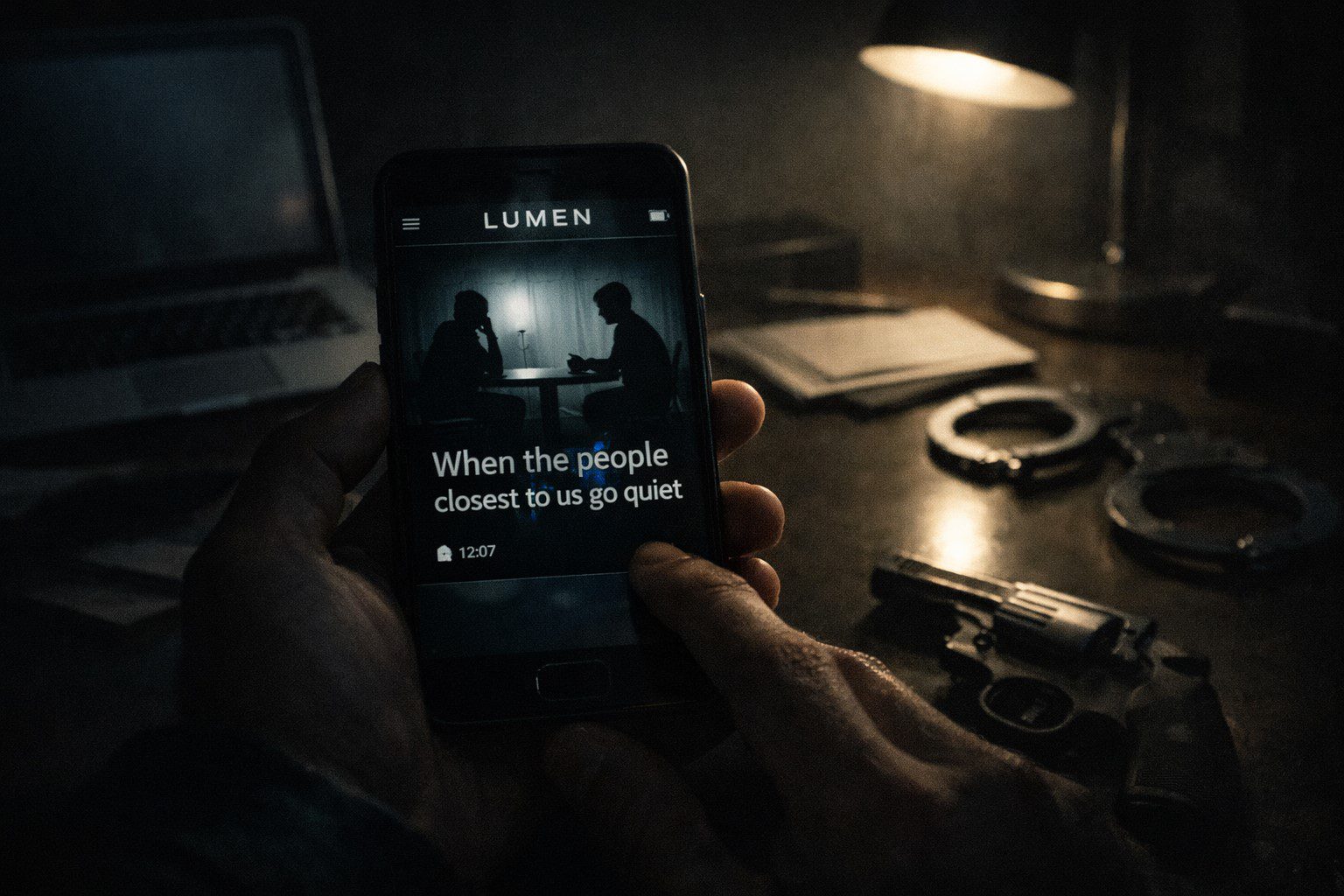
The hit rate was not one hundred percent. It was not even close to one hundred percent. But it was too high. Across fourteen days of deliberate testing, in which I noted both the thought and the result in a notebook I kept off my phone, the content matched the thought in a way that felt directed eleven times out of thirty-seven. Not vague thematic matches — specific ones. The day I thought about leaving my job, Lumen showed me a first-person account of someone who had quit without a plan and rebuilt. The day I thought about an old friend I hadn’t spoken to in three years, it showed me a short film about two people reuniting in a train station, neither of them sure whether to say what they meant.
Eleven out of thirty-seven was not algorithm. Eleven out of thirty-seven was something paying attention.
I tried to find information about Lumen online. Not reviews — I’d seen those, all positive, the glossy surface of an app that everyone seemed to love without quite being able to explain why. I mean deeper information. Who built it, who owned it, where its data went. The company behind it was called Verel Technologies, registered in a jurisdiction that made further searching difficult. Their privacy policy was fourteen pages of the kind of language designed to be technically compliant and practically incomprehensible. I read all fourteen pages. What I understood was that Lumen collected what they called ambient interaction data — not just what you tapped or searched, but behavioural signals. Dwell time on images. The speed at which you scrolled past certain content. Whether you paused, restarted, moved on. The micro-behaviours of a person looking at things they don’t want to look at, or can’t look away from.
What I could not find anywhere in fourteen pages was an explanation of how ambient interaction data told an app about a phone call I had taken in my kitchen with Lumen closed.
I deleted the app on a Tuesday. I held my phone, pressed delete, watched the icon disappear, and felt the specific relief of a person who has removed something they should have removed sooner.
That evening I used a different app to watch a film. Halfway through, a notification came through from a service I used for podcast recommendations — something I had downloaded years ago and barely touched. The notification read: We think you’ll like this one. Below it was a podcast episode titled What we look for when we’re not sure what we’re looking for.
I opened the podcast app. I had not used it in seven months. My last played episode was a comedy panel show from the previous spring.
I had no listening history that could have generated that recommendation.
I turned my phone off. I went to sleep. In the morning I turned it back on and the notification was gone — not cleared, gone, as though it had never been sent. I checked the podcast app’s notification history. Nothing from the previous evening. I checked my screen time data, which records everything the system considers an interaction.
At 9:14 p.m. the previous evening, two minutes before the notification had appeared on my screen, my phone had accessed an unfamiliar network address for four seconds. Not my home wifi, not my mobile carrier. An address I couldn’t trace through any tool I knew how to use.
Four seconds. Then the notification. Then silence.
I want to be careful here, because I am aware of how this sounds. I am a data analyst by profession. I understand how apps work, how data is harvested, how much of what feels like coincidence in the digital world is simply sophisticated pattern recognition operating on more data than we consciously realise we have produced. I came into this with scepticism. I maintained it for as long as I could.

 WhatsApp
 Telegram
 Email







Leave a Reply