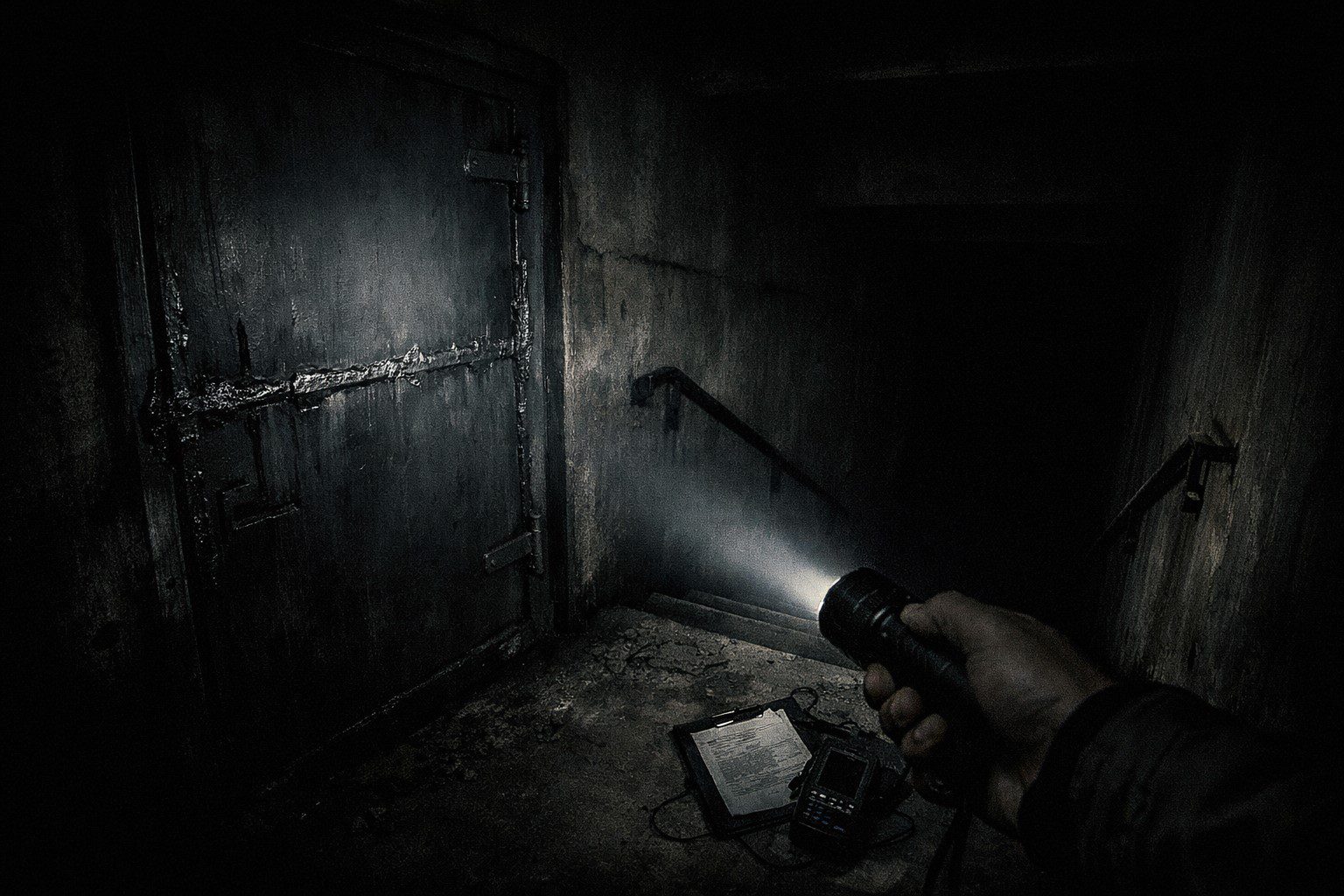
I had forty minutes of assessment notes on my clipboard. I went through them by torchlight.
The upper level was largely open plan — personnel quarters, storage, a communications alcove. I had noted what appeared to be a utility corridor at the north end of the upper level, behind a steel partition wall that was listed in my assignment file as a maintenance access point. I had not yet inspected it when the door sealed.
I went to it. The partition was bolted, not locked — six bolts, standard hex head, my toolkit had the right fitting. I had them off in twelve minutes and the partition swung on hinges that were stiff but functional.
Behind the partition: a narrow corridor, less than a metre wide, extending north for approximately eight metres before turning east. I followed it to the turn and found a ladder set into the wall, vertical, ascending into darkness.
I climbed.
The ladder terminated at a hatch — circular, standard military specification, a wheel lock in the centre. I put both hands on the wheel and turned. Stiff. Very stiff. Decades of disuse and possible corrosion. I braced my feet against the rungs and used my body weight and turned again and felt, incrementally, the wheel begin to move.
Fourteen turns. On the fourteenth the hatch shifted in its frame. On the twentieth it was loose. I pushed upward with my shoulder.
The hatch lifted three centimetres and stopped.
Not locked. Not welded. Stopped by weight — something above it, resting on the external surface, pressing down.
I thought about the force involved. The hatch was rated, according to the specification documents in my file, for emergency egress under pressure — it was designed to be opened from below even under rubble load, up to a specified weight limit. I had not memorised the weight limit. I tried to recall it. Something in the range of two hundred kilograms, if the design was standard.
I pushed again, with everything I had.
Three centimetres became five. Became eight. Became a gap I could see light through — thin, grey, daylight — and I could feel the weight above shifting as whatever was on the surface began to slide.
I did not wait. I turned the wheel to the locked-open position, set my feet, and drove upward with both shoulders.
The hatch opened.
Cold air. November sky. I came up through the floor of what turned out to be a storage outbuilding at the far edge of the Hartfield property — empty, corrugated metal walls, no windows. The hatch had been concealed under a wooden pallet stacked with two large metal toolboxes, which had slid aside as I pushed and now sat half-overturned on the concrete floor.
I stood in the outbuilding and breathed the cold air for approximately thirty seconds. Then I picked up my torch and my kit, which I had carried up the ladder with me, and I walked out of the outbuilding into the grey November morning and took out my satellite communicator.
Three bars. I sent a status update to my office: On surface, Hartfield site, inspection interrupted. Main access door sealed. Possible criminal tampering. Contacting authorities.
I called the police from the edge of the property, standing in the wind, and waited for them with my back against the fence where I could see both the main bunker entrance and the outbuilding.

 WhatsApp
 Telegram
 Email







Leave a Reply