Ros. The name landed and something in me registered it the way you register a word in a foreign language you once spoke and haven’t used in years. Not strange — familiar. Deeply familiar, and completely inaccessible.
Hannah told me carefully, in the way she tells me things when she isn’t sure how I’ll receive them, that Ros had been my closest friend for three years. That she had died four years ago, suddenly, in the spring. That I had been there. That in the weeks and months that followed I had stopped talking about her completely — not gradually but completely, as though a door had been closed and locked. Hannah had tried, gently, more than once. I had deflected, redirected, and eventually she had followed my lead, because sometimes following a person’s lead is the only kind of care that fits.
“I didn’t know you didn’t remember her,” Hannah said quietly. “Clare, I thought you were just — I thought it was how you were coping.”
I sat at the table after the call ended and said the name aloud in the empty kitchen. Ros. It felt like a key that had been in my pocket the whole time.
I went back to Dr. Ellison and told her what Hannah had said. She listened and then she told me what I had come to her with three weeks ago: a creeping sense of missing time, of a self that felt slightly borrowed, of a year that sat behind glass. I had described it, apparently, with a precision and clarity that had suggested I was close to something — close to the edge of a door I had shut so firmly that I had eventually forgotten it was there.
“You knew,” I said. “When I came in this morning saying I didn’t remember making the appointment. You knew what was happening.”
“I had a strong idea,” she said. “But it needed to come from you.”
“What else don’t I know?” I asked. “What else has been on the other side of that door?”
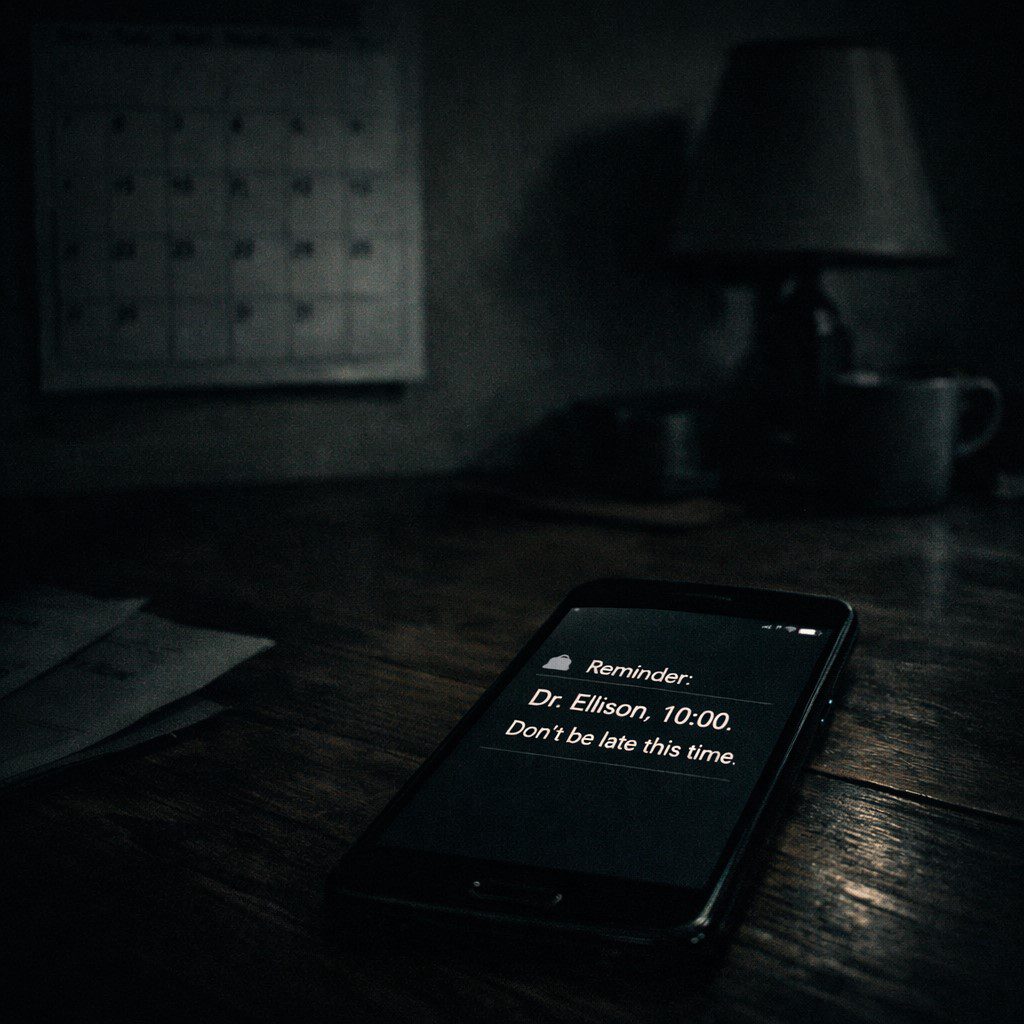
She was quiet for a moment. Then she said: “That’s the work. And Clare — you’re the one who made the appointment. You’re the one who set the reminder. You’re the one who wrote ‘don’t be late this time.’ Some part of you has been trying to open that door for a while. You just needed the rest of you to catch up.”
I think about that a lot. The idea of a self that operates beneath the one you live in daily. That books appointments you won’t remember, searches names in the night, leaves notes in your own handwriting that read like messages from someone who knows you better than you know yourself. It should be frightening. It is frightening, some days.
But there is another way to look at it, and this is the one I come back to most often, lying in the dark in the flat where I live alone and thinking about Ros, whose face I can almost see now, whose laugh I can almost hear.
The version of me that set that reminder — she didn’t want me to stay behind the door. She wanted me to go through it. She was impatient about it, even. She wrote don’t be late this time in the voice I use when I’m talking to myself and I mean it.
I had been keeping a door locked so completely that I forgot it was there. And then quietly, in the part of me that runs deeper than memory, I decided I was ready.
I just had to wait for the rest of myself to get the message.
I am still waiting, some days. But I know the appointment is real now.
And I know I am the one who made it.

 WhatsApp
 Telegram
 Email







Leave a Reply