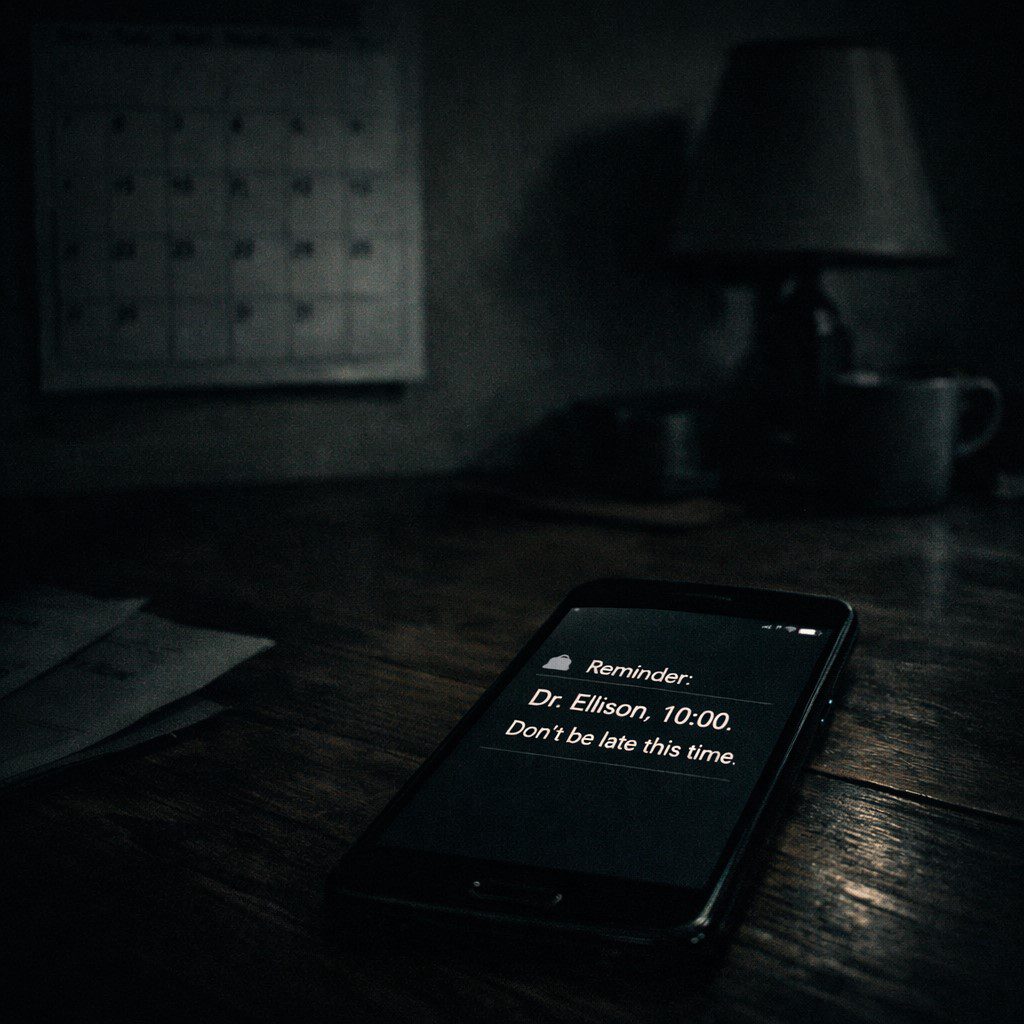
I told her about the reminder. I told her about the search history. I told her about the receptionist confirming an appointment I had no recollection of making. She asked whether I had experienced anything similar before — moments unaccounted for, actions I had taken and then forgotten. I said no, and then I paused, because the honest answer was more complicated than no.
There had been small things. Notes in my handwriting that I didn’t remember writing. A library book returned on my behalf by someone who had given my name, though I had no memory of asking anyone to do it. A conversation my colleague mentioned we’d had, about a policy change I had apparently argued against with some force, that I could not recall at all.
I had dismissed each of them individually. Sitting in Dr. Ellison’s office I felt the weight of them together.
She asked me to come back the following week, and I did. And the week after. Each session she gave me a little more of the shape of things — not the details, not yet, but the outline. I had come to her three weeks ago in a state she described as highly distressed. I had been referred by my GP, whom I had apparently visited twice in the preceding month. I had told Dr. Ellison things about myself that I did not consciously remember experiencing.
“What kind of things?” I asked, in the third session.
“Things from a period about four years ago,” she said carefully. “A time you’ve told me, consistently, that you have no access to.”
Four years ago. I had moved flats four years ago, I knew that. I had started the library job. I had ended a long relationship. In my memory it was a busy and unremarkable year of change and forward motion. Nothing dramatic, nothing unresolved.
But as I sat there and tried to reach into it, tried to find the texture of those months, I found something I hadn’t noticed before. Not gaps exactly. More like distance. Those months existed in my memory the way a film exists — images and events I could name, but with no sense of having lived inside them. No smell, no weight, no emotional temperature. Like a record of something rather than the thing itself.
I told her that. She wrote something down and looked at me steadily.
“That’s new,” she said. “That’s the first time you’ve described it that way.”
I went home and sat at my kitchen table and tried to approach those four years the way you approach something in a dark room — obliquely, from the side, not head-on. I thought about the flat I had lived in then. The street, the smell of the hallway, the particular way the evening light came through the kitchen window. And something moved at the edge of that memory. Something I had not previously noticed the absence of.
There had been another person in that flat.
Not a partner. Not a flatmate. Someone I had been close to, someone whose presence was threaded through that period — at the kitchen table, on the sofa, in the corner of peripheral memories I had always looked past without looking at. A face I couldn’t assemble. A name I couldn’t reach.
I called my oldest friend, Hannah, and asked her, as casually as I could manage, whether she remembered who I had been close to four years ago, outside of the relationship I remembered ending. There was a pause on her end. A particular kind of pause, the kind that has a shape.
“You’re asking about Ros,” she said.

 WhatsApp
 Telegram
 Email







Leave a Reply