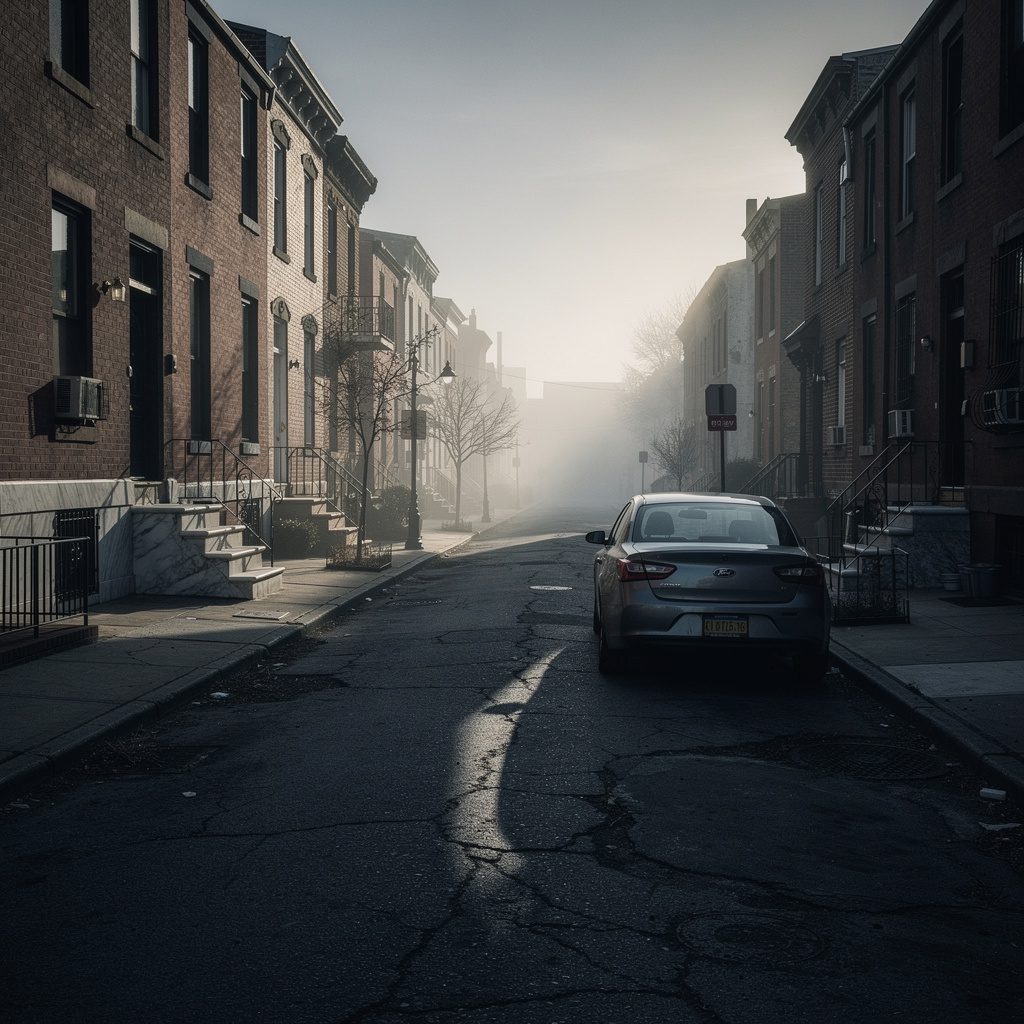
The man was wearing a dark jacket. He had Jabari’s height, Jabari’s build, the same close-cropped hair, the same particular way of standing with his weight slightly forward, as though perpetually about to begin walking. Jabari pressed himself against the wall beside the window and looked again. The man across the street was not looking at the house. He was looking down at his phone, and his face — the angle, the light, the distance — was not quite readable. But the silhouette. The posture. The specific geometry of a body Jabari had seen every morning in his bathroom mirror. It was uncanny in the clinical sense of the word: something familiar occupying the wrong place, dressed in the wrong context, standing on the wrong side of the street.
Jabari did something then that he would later struggle to explain. He did not call the police. He did not take a photograph. He put on his jacket, walked out his front door, and crossed the street.
The man was gone. The car was gone. The street was empty in the thin morning light, a pigeon moving along the gutter, a recycling bin left out two days past collection. Jabari stood on the pavement where the car had been and felt the particular vertigo of a man who has just done something brave and found nothing on the other side of it. He went back inside. He sat at his desk. His hands were not quite steady.
I watched him cross the street. I want you to understand how much that took. Most people do not cross. Most people find a reason not to — a phone call, a sudden need for more coffee, the comfortable inertia of the locked door. Jabari crossed. That mattered.
The week that followed had the quality of a fever. Not dramatic — not the Hollywood version of being watched, with footsteps behind you in dark alleys and threatening notes slid under the door. Nothing so legible as that. It was subtler and therefore worse. His mail had been opened and resealed, or he thought it had — the flap of an electricity bill sitting at an angle that seemed wrong. A window latch on the ground floor that he was certain he had fastened was unfastened one morning. A voicemail from a number he did not recognize: eleven seconds of ambient sound, the low murmur of a room, and then nothing. He reported the car to the police non-emergency line. An officer came, took notes with the practiced patience of someone who has heard many stories like this, and left with the implicit message that there was nothing to be done about a car parked on a public street.
Jabari began researching. This is what careful, methodical people do when the world stops making sense — they try to read it more carefully. He searched his own name and found, on the fourth page of results, a profile on a freelance translation platform he had not created. The photo was his. The name was his. The listed specializations were his. But the contact email was different, and several client reviews described work he had never done — a legal document translated from Mandarin, which he did not speak, a marketing brochure for a shipping company in Rotterdam. He stared at the screen for a long time. Someone had built a version of him and sent it out into the world to do things. Someone was wearing his name the way you wear a borrowed coat.
He found the man on a Wednesday. Not across the street — at the reservoir, three blocks away, on the same path Jabari walked every afternoon at the same time. Because of course. Because if you study a man long enough, you know where he will be. The man was sitting on a bench, facing the water, and from behind he was so precisely Jabari’s double that a woman walking past glanced between them with the startled expression of someone who has encountered a glitch in the world. Jabari sat down on the same bench. He said, quietly, “Who are you.” It was not a question. It was a request for the pretense to end.

 WhatsApp
 Telegram
 Email







Categories
- AI & Technology
- Contemporary
- Corporate Control
- Creepypasta
- Crime Thriller
- Cyberpunk
- Dark Fantasy
- Enemies to Lovers
- Fairy Tale Retelling
- Fantasy
- First Contact
- Forbidden
- Genetic/Body Horror
- High Fantasy
- Monster Hunter
- Mythic/Folklore
- Paranormal
- Portal/Otherworld
- Post-Apo
- Post-Collapse Society
- Psychological Thriller
- Romances
- SCI-FI
- Second Chance
- Slow Burn
- Space Combat
- Spacepunk
- Surveillance State
- Survival Thriller
- Thrillers
- Time Travel
- Treasure Hunter
- Urban Fantasy
- Witchcraft/Curses
Tags
10min stories atmospheric atmospheric fantasy atmospheric fiction contemporary romance Creepy creepypasta crime thriller dark fantasy debt dystopia emotional fiction enemies to lovers ensemble cast epistolary fantasy female protagonist first person forbidden romance framed narrative high fantasy love story magic Memory mystery Paranormal psychological horror psychological thriller romance sci-fi second chance second chance romance short fiction short story slow burn space station speculative fiction supernatural Survival survival thriller suspense thriller travel romance witchcraft workplace romance
Leave a Reply