Wenjie opened the door in her coat — still fully dressed, which Belen registered with a slow, spreading unease. Wenjie looked at her for a moment, and something in her expression shifted from careful composure to something rawer.
“Something called you,” Wenjie said. It was not a question.
Belen stepped inside. The room was identical to hers — same pale walls, same buzzing fixture — but Wenjie had covered the overhead light with a scarf, filling the space with amber shadow. On the bed, a notebook lay open, dense with handwriting. Belen caught fragments before Wenjie closed it: times, room numbers, a phrase repeated in the margin like a note to herself — *the interval narrows*.
“You’ve been tracking something,” Belen said.
“Since Thursday.” Wenjie sat on the edge of the bed. “I received a call two days before we arrived. From a number I didn’t recognize. The voice told me the retreat would go wrong. I dismissed it. Then, last night before I left home, I received a second call. From my own number.” She looked up. “The voice was mine. It told me to watch the intervals between what people said and when they seemed to decide to say it.”
Belen said nothing for a long moment. Outside, the pines shifted in a wind that hadn’t been there an hour ago.
“You’re a trauma researcher,” Belen finally said. “You know what we’d both say to a client who came to us with this.”
“I know exactly what I’d say,” Wenjie replied. “That’s why I’m still here and not already in the car.”
They went to Mervin’s room together. He was awake — they could see the light under the door. He answered on the first knock, and his face, when he saw them, had the particular expression of a man who had been waiting for something and was not entirely relieved that it had arrived.
“You got a call,” he said.
“Belen did,” Wenjie said. “You too?”
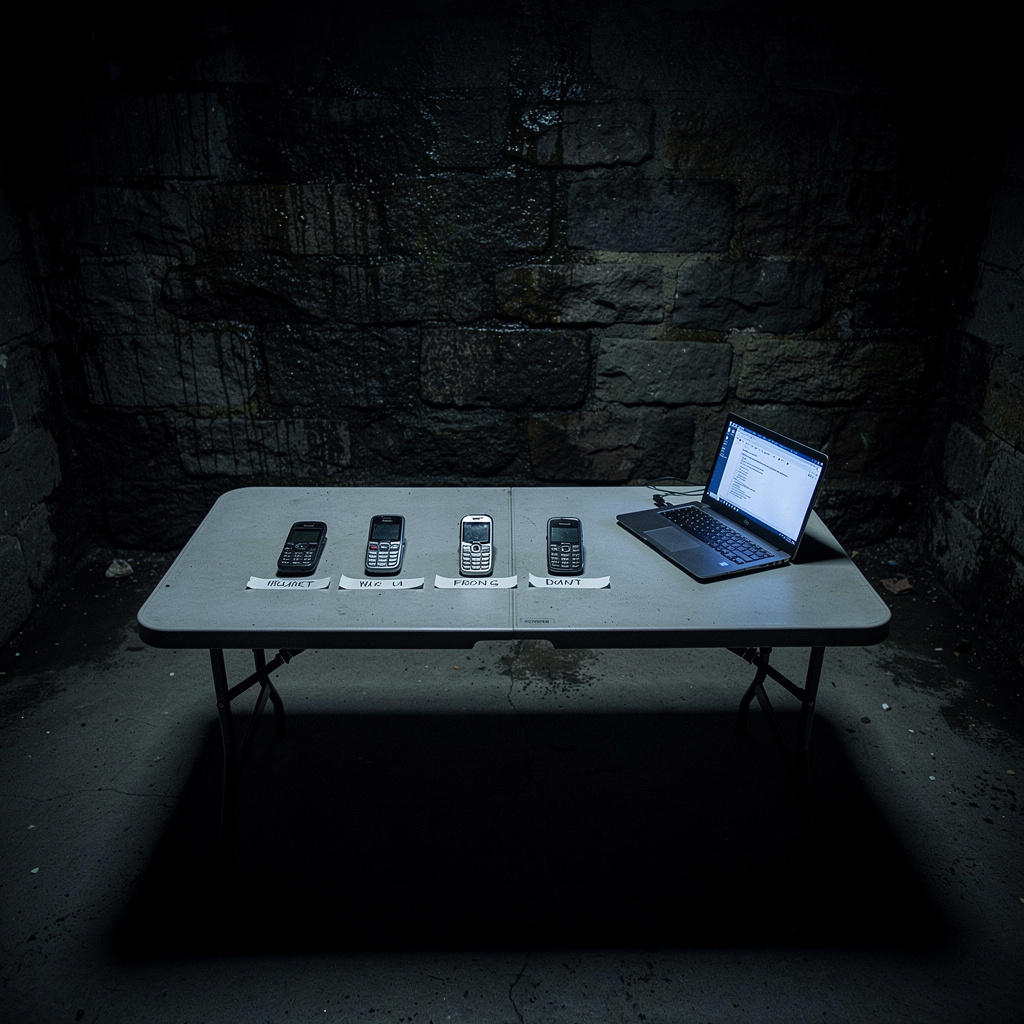
Mervin stepped back from the door. He had his phone in his hand, and he turned the screen toward them. The call log showed a received call, 11:49 PM, two minutes after Belen’s. The number was his own.
“The voice told me,” he said, “that someone in this building is not who they say they are.” He paused. “And that I would know by Sunday morning.”
The three of them stood in the doorway, the buzzing light overhead, the pine-smell coming through the cracked window, and the particular silence of people who study human behavior suddenly finding themselves inside a pattern they cannot name.
They did not sleep.
By 2 AM they had woken Emilio and Petra. Emilio’s phone showed no anomalous calls, and his reaction to theirs moved through skepticism, discomfort, and a fragile intellectual excitement that he kept trying to suppress. Petra listened to everything without interrupting. When they finished, she said: “The voice was your own voice. Each of you. Not a distorted version. Your actual voice.”
“Yes,” Belen said.
“Then whoever is doing this had access to recordings of each of you. High-quality ones. Enough to synthesize speech.” She looked around the room. “Which means this was planned before we arrived. Which means someone in this building, or connected to it, has been studying us.”
The word *studying* landed heavily in a room full of researchers.
“Or,” Emilio said carefully, “one of us is the someone.”
—
Saturday moved like a day underwater. They stayed together in the common room, abandoned the agenda, drank too much coffee, and cycled through every rational explanation with the methodical desperation of people whose entire professional identity depended on rational explanation. Voice synthesis. Social engineering. A prank by a disgruntled colleague. A test — Mervin had run behavioral experiments before; could one of them have arranged this as a kind of field study?
Each theory collapsed under some detail. The calls had come to personal phones, not institute devices. No one outside this group knew the full roster of attendees. Mervin had booked the venue under a personal account.

 WhatsApp
 Telegram
 Email







Categories
- AI & Technology
- Contemporary
- Corporate Control
- Creepypasta
- Crime Thriller
- Cyberpunk
- Dark Fantasy
- Enemies to Lovers
- Fairy Tale Retelling
- Fantasy
- First Contact
- Forbidden
- Genetic/Body Horror
- High Fantasy
- Monster Hunter
- Mythic/Folklore
- Paranormal
- Portal/Otherworld
- Post-Apo
- Post-Collapse Society
- Psychological Thriller
- Romances
- SCI-FI
- Second Chance
- Slow Burn
- Space Combat
- Spacepunk
- Surveillance State
- Survival Thriller
- Thrillers
- Time Travel
- Treasure Hunter
- Urban Fantasy
- Witchcraft/Curses
Tags
10min stories atmospheric atmospheric fantasy atmospheric fiction contemporary romance Creepy creepypasta crime thriller dark fantasy debt dystopia emotional fiction enemies to lovers ensemble cast epistolary fantasy female protagonist first person forbidden romance framed narrative high fantasy love story magic Memory mystery Paranormal psychological horror psychological thriller romance sci-fi second chance second chance romance short fiction short story slow burn space station speculative fiction supernatural Survival survival thriller suspense thriller travel romance witchcraft workplace romance
Leave a Reply