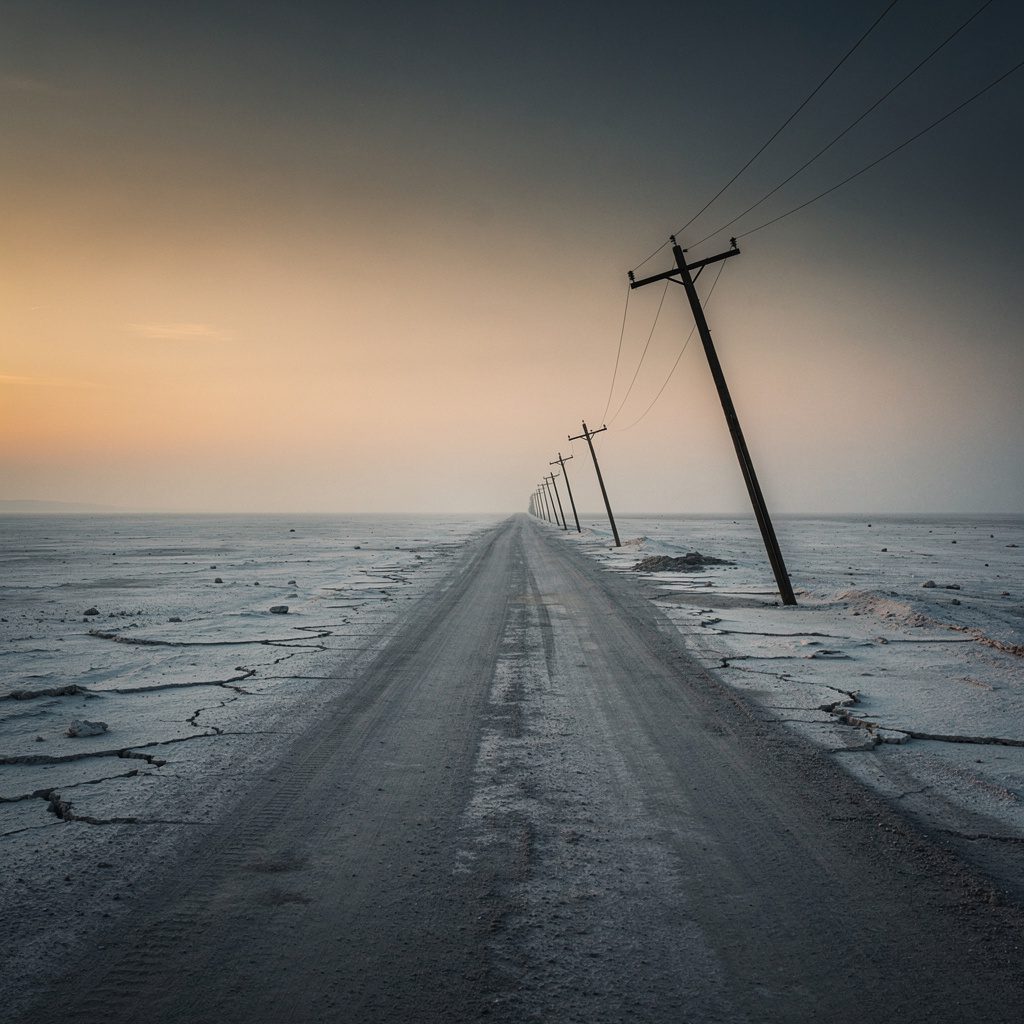
Paloma parked and sat in her car for four minutes — she checked her phone, which had no signal but still displayed the time — before she got out. The air smelled like dust and something underneath the dust, something mineral and faintly sweet, the way certain caves smell when you get deep enough into them that the rock around you is no longer the same rock as the surface. She had been in enough caves to know that smell. It was a smell that meant you had gone somewhere the outside world did not have easy access to.
She pushed open the diner door.
The interior was warm. The counter was set with coffee mugs, turned upside down the way diners do when they are ready to open, not when they have closed. There was a pie under a glass dome on the counter. The pie was fresh — she could tell by the steam still fogging the inside of the dome. Behind the counter, through the service window, she could see the kitchen. The grill was on. A pan was sitting on it.
No one was there.
Gideon found the diner on his first evening, too. He had spent the afternoon walking the streets — all nine of them, he counted — and had found them uniformly empty and uniformly intact. No broken windows. No stripped interiors. No evidence of the kind of slow vandalism that overtakes abandoned places within months of their emptying. The hardware store had screws in the bins, organized by size. The barbershop had a magazine on the chair, open to an article about a road race in 1987. The post office had a corkboard with notices pinned to it: a lost dog, a church fundraiser, a reminder about the water authority meeting on the 14th.
The 14th of what month, in what year, was not specified.
He ate the pie.
He told himself this later, sitting in the diner with a fork in his hand, and the fact of it struck him as both very stupid and completely inevitable. The pie was apple. It was the best apple pie he had ever eaten. He sat at the counter and ate two slices and drank the coffee that had been in the pot, which was hot, which should not have been possible given that no one was there to have made it, and he thought about the architecture of the building around him — the careful proportions of the booths, the particular amber of the pendant lights, the way the counter curved at each end with exactly the radius a good draftsman would specify — and he felt, despite everything, entirely at home.
He spent the night in the camper van, parked in front of the gas station.
Paloma spent the night in the diner, which she would not be able to explain later. She simply hadn’t wanted to leave. She had pushed two booth benches together and slept on them with her jacket as a blanket and woken at what felt like dawn except the light through the windows was wrong — too even, too sourceless, like the light inside a cloud.
She went back to her car.
The road back was gone.
Not blocked. Not washed out. Gone. The alkali flat stretched east in every direction with no evidence that a graded road had ever crossed it. No ruts. No utility poles. She stood at the edge of the pavement where the town ended and the desert began and looked at the unbroken flat and understood, with the quiet precision that her training had given her, that she was looking at something that contradicted every principle she had built her professional life on. A place has coordinates. A place can be found and recorded and returned to. That is what a place is.
This was something else.
She went back inside.

 WhatsApp
 Telegram
 Email







Categories
- AI & Technology
- Contemporary
- Corporate Control
- Creepypasta
- Crime Thriller
- Cyberpunk
- Dark Fantasy
- Enemies to Lovers
- Fairy Tale Retelling
- Fantasy
- First Contact
- Forbidden
- Genetic/Body Horror
- High Fantasy
- Monster Hunter
- Mythic/Folklore
- Paranormal
- Portal/Otherworld
- Post-Apo
- Post-Collapse Society
- Psychological Thriller
- Romances
- SCI-FI
- Second Chance
- Slow Burn
- Space Combat
- Spacepunk
- Surveillance State
- Survival Thriller
- Thrillers
- Time Travel
- Treasure Hunter
- Urban Fantasy
- Witchcraft/Curses
Tags
10min stories atmospheric atmospheric fantasy atmospheric fiction contemporary romance Creepy creepypasta crime thriller dark fantasy debt dystopia emotional fiction enemies to lovers ensemble cast epistolary fantasy female protagonist first person forbidden romance framed narrative high fantasy love story magic Memory mystery Paranormal psychological horror psychological thriller romance sci-fi second chance second chance romance short fiction short story slow burn space station speculative fiction supernatural Survival survival thriller suspense thriller travel romance witchcraft workplace romance
Leave a Reply