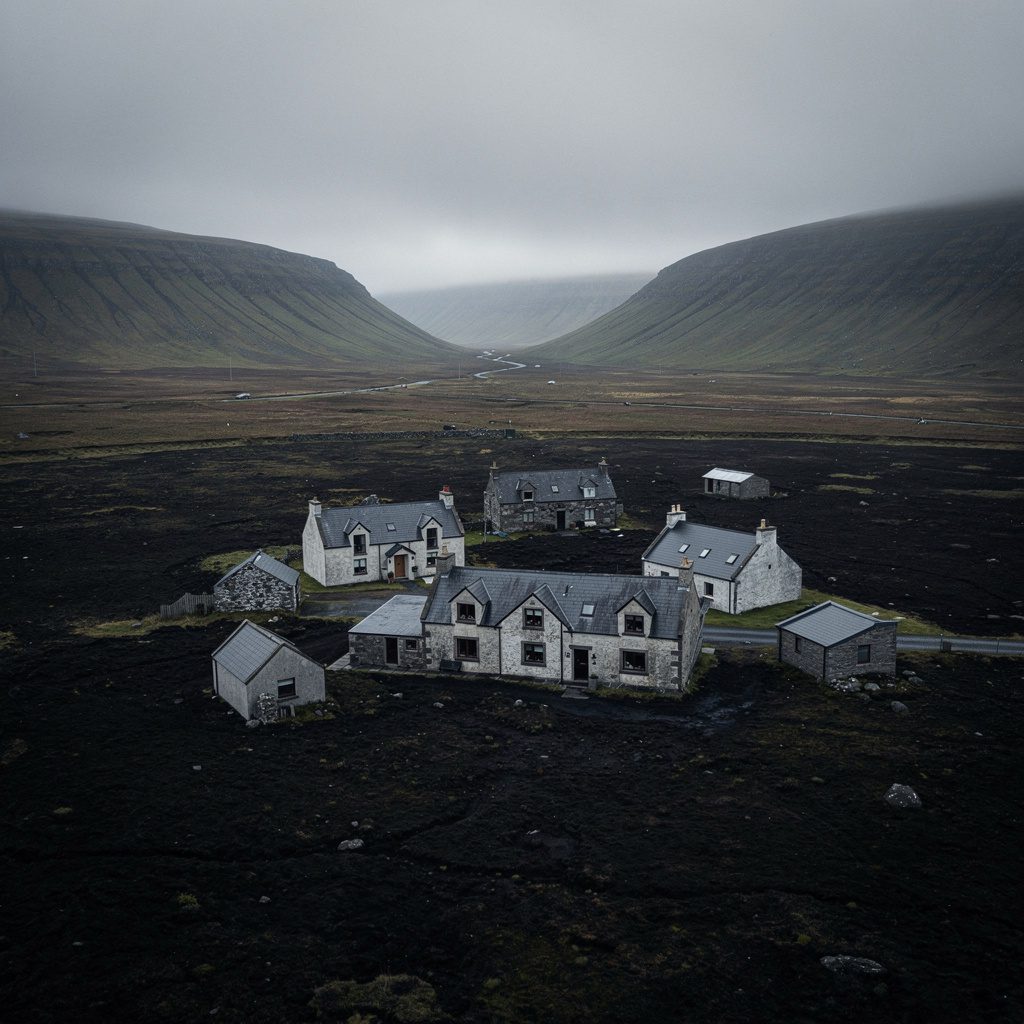
Divya had booked a flight to Knock on the Thursday, telling her team she was visiting a client in Galway. She hadn’t told them about the coordinates. She’d just exported them to her phone and rented a car at the airport and started driving west with the Atlantic somewhere ahead of her, grey and enormous and indifferent.
She’d been to Ireland once before, for a conference in Dublin. This felt nothing like that.
The road narrowed. The verges pressed in. The sky ahead had a flat, heavy quality she associated with weather coming, though her phone showed clear.
Her GPS lost signal twenty minutes from the coast.
She wasn’t surprised. She’d half-expected it.
She navigated by the coordinates she’d written on a Post-it note stuck to the dashboard. The numbers were meaningless without a functioning GPS, she knew that. She was following them anyway, counting distance by her odometer, turning where she thought she should turn.
She turned onto a track between two hills.
—
Maeve saw the car first.
It was parked at the side of the track, hazard lights blinking orange in the grey afternoon. A woman was standing beside it, looking at something in her hand. Tall, dark coat, hair pulled back.
Maeve stopped.
The woman looked up. Her expression was not relieved to see another person. It was something more complicated than that.
“You’re going to Carra Beal,” Maeve said. It wasn’t a question. She didn’t know why she said it that way.
Divya stared at her. “How do you know that name?”
“Note in an atlas. You?”
“Satellite anomaly.”
They stood there for a moment, the wind moving through the grass on either side of the track, the hills holding the silence the way hills do.
“I’m Maeve.”
“Divya.”
Neither of them suggested turning back.
—
They walked the last half-mile because the track became too soft for the cars.
The ground was peat, dark and springy, and their footsteps left no sound. That was the first thing Maeve noticed: the absence of sound. Not silence exactly. Presence without echo. As if the air around them had been lined with something absorbent.
Divya had her phone out, recording. She’d stopped looking at it after the first few minutes. The screen kept showing her the wrong direction.
“The structures in the satellite data,” Maeve said quietly. “How many?”
“Eleven, maybe twelve.”
“Small?”
“Cottage-sized.”
Maeve nodded. It matched what she’d half-constructed in her mind from the 1973 map. A cluster. A settlement.
They came over a low rise and there it was.
Carra Beal.
—
It was small. That was the first thing.
Twelve cottages arranged around a central space that might once have been a green. Stone walls. Slate roofs. Intact windows, though the glass was the thick, wavy kind that hadn’t been manufactured since before the Second World War.
No movement. No lights. No sound.
But not abandoned. That was the second thing, and the worse thing.
The doors were closed, not hanging. The window glass was clean. There was a stack of peat beside the nearest cottage, neatly cut, the edges still sharp. The peat hadn’t softened in rain. It looked as though it had been stacked that morning.
Divya walked toward the central space. Maeve followed.
The ground between the cottages was packed earth, not overgrown. A path had been worn between two of the buildings, the kind of path that forms from years of the same feet taking the same route.
“Someone lives here,” Divya said.
“Or something maintains the impression that they do,” Maeve said.
It was a strange thing to say. She wasn’t sure where it had come from.
—
Divya tried a door.
It opened.
The cottage inside was furnished. A table. Two chairs. A fireplace with cold ash, grey and fine. A shelf with four books on it.
She crossed to the shelf and looked at the titles. Three were in Irish. The fourth was in English: a road atlas, the same edition as the one Maeve had bought at the charity shop in Galway.
Maeve was standing in the doorway. She watched Divya reach for the atlas and open it.
The pages were blank.
Not worn blank. Printed blank. Every page, every sheet, nothing but white paper with the faint ghost of a grid where roads should have been.
Divya set it back on the shelf carefully.
“We should go,” she said.
“Yes,” Maeve agreed.

 WhatsApp
 Telegram
 Email







Categories
- AI & Technology
- Contemporary
- Corporate Control
- Creepypasta
- Crime Thriller
- Cyberpunk
- Dark Fantasy
- Enemies to Lovers
- Fairy Tale Retelling
- Fantasy
- First Contact
- Forbidden
- Genetic/Body Horror
- High Fantasy
- Monster Hunter
- Mythic/Folklore
- Paranormal
- Portal/Otherworld
- Post-Apo
- Post-Collapse Society
- Psychological Thriller
- Romances
- SCI-FI
- Second Chance
- Slow Burn
- Space Combat
- Spacepunk
- Surveillance State
- Survival Thriller
- Thrillers
- Time Travel
- Treasure Hunter
- Urban Fantasy
- Witchcraft/Curses
Tags
10min stories atmospheric atmospheric fantasy atmospheric fiction contemporary romance Creepy creepypasta crime thriller dark fantasy debt dystopia emotional fiction enemies to lovers ensemble cast epistolary fantasy female protagonist first person forbidden romance framed narrative high fantasy love story magic Memory mystery Paranormal psychological horror psychological thriller romance sci-fi second chance second chance romance short fiction short story slow burn space station speculative fiction supernatural Survival survival thriller suspense thriller travel romance witchcraft workplace romance
Leave a Reply