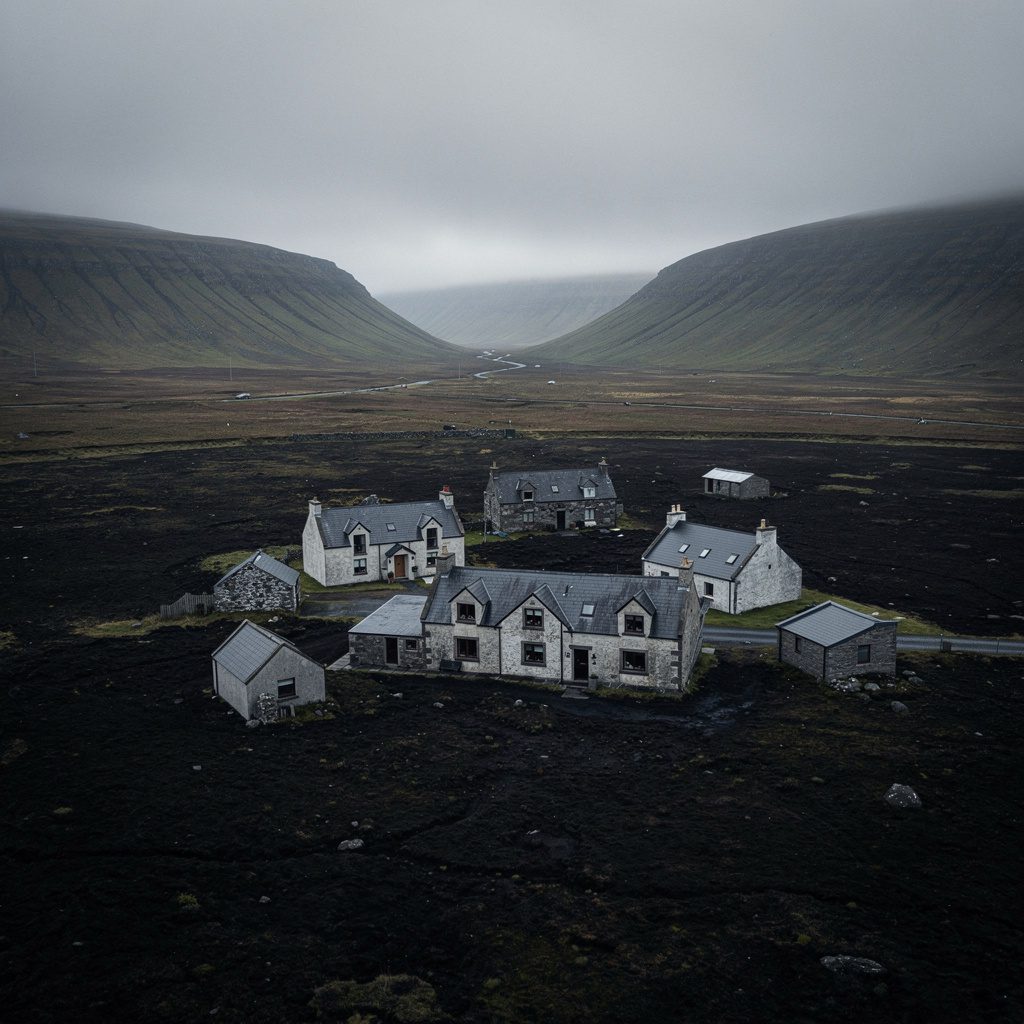
FOUND: Handwritten note, folded inside a road atlas purchased at a charity sale, Galway, Ireland. Date unknown.
“If you find this, don’t go looking for Carra Beal. I know that sounds like the start of a dare. It isn’t. I went looking. I found it. Now every map I own has a blank space where it used to be, and I don’t mean the town is gone. I mean the maps changed. All of them. Even the old ones. Even the ones that were printed before I was born. Don’t go. Just fold this back up and put it in the atlas and pretend you never read it.”
No signature.
—
Maeve Cassidy found the note on a Tuesday in October, when the light over Galway Bay had gone the color of old pewter and the charity shop smelled of damp wool and someone else’s life.
She almost didn’t read it. She almost threw it away.
She didn’t.
She was a cartographer. Had been for eleven years. She worked for a heritage mapping trust, digitizing old Ordnance Survey sheets, cross-referencing townlands that had been absorbed or renamed or simply forgotten. Finding Carra Beal wasn’t a compulsion for Maeve. It was a professional reflex.
She typed the name into three databases that night. Nothing.
She searched the county archives. Nothing.
She pulled up digitized Griffith’s Valuation records from the 1850s, which catalogued nearly every inhabited place on the island. Nothing.
The name didn’t exist. Had never existed. And yet the note was written in the careful, slightly cramped hand of someone who had been there.
—
Five hundred miles east, in a third-floor flat above a Turkish bakery in Sheffield, Divya Kapoor was having a different kind of problem.
She was a software developer for a geospatial analytics firm. Her job was to find errors in mapping data — ghost roads, phantom buildings, coordinates that resolved to the middle of the ocean. Anomalies. She was good at finding them.
The anomaly she’d found three weeks ago was still open in a tab on her second monitor.
A cluster of coordinates on the western coast of Ireland. A tiny polygon — the footprint of maybe a dozen structures, she estimated — that appeared in the raw satellite data layer but resolved to nothing in every named dataset on top of it. No label. No road access. No postal code. No planning records.
Just the shape of a place, sitting there like a held breath.
She’d filed it as a probable data artifact. Then she’d unfiled it.
Then she’d started checking the historical imagery.
The polygon appeared in images going back to 1985, which was as far as the archive reached. It was always the same size. The structures never changed. They didn’t grow, didn’t crumble, didn’t shift. They just sat there, identical across four decades of satellite passes, as though time moved differently inside those coordinates.
Divya had told no one.
She wasn’t sure why.
—
Maeve drove west on the Friday.
She told herself she was doing fieldwork. She told herself it was the kind of thing her job sometimes required — visiting a site in person when the records failed you. She told herself the note meant nothing.
She left the note in the atlas on the passenger seat, just in case.
The road she wanted didn’t appear on her phone’s navigation. She’d expected that. She was using a printed map instead, a 1:50,000 sheet she’d pulled from the trust’s archive, published in 1973. There was a track marked on it, a thin dotted line that left the main coast road and curved inland between two hills.
The track was real. She found it without difficulty.
What she hadn’t expected was that it felt familiar. Not the comfortable familiarity of a place you’ve visited before. The wrong kind. The kind that lives in the back of the neck.
The hills on either side were too symmetrical. The grass was the deep, saturated green of a place that never quite dried out. The track curved exactly where she expected it to curve before she’d looked at the map.
She stopped the car.
Looked at the map. Looked at the track.
Drove on.
—

 WhatsApp
 Telegram
 Email







Categories
- AI & Technology
- Contemporary
- Corporate Control
- Creepypasta
- Crime Thriller
- Cyberpunk
- Dark Fantasy
- Enemies to Lovers
- Fairy Tale Retelling
- Fantasy
- First Contact
- Forbidden
- Genetic/Body Horror
- High Fantasy
- Monster Hunter
- Mythic/Folklore
- Paranormal
- Portal/Otherworld
- Post-Apo
- Post-Collapse Society
- Psychological Thriller
- Romances
- SCI-FI
- Second Chance
- Slow Burn
- Space Combat
- Spacepunk
- Surveillance State
- Survival Thriller
- Thrillers
- Time Travel
- Treasure Hunter
- Urban Fantasy
- Witchcraft/Curses
Tags
10min stories atmospheric atmospheric fantasy atmospheric fiction contemporary romance Creepy creepypasta crime thriller dark fantasy debt dystopia emotional fiction enemies to lovers ensemble cast epistolary fantasy female protagonist first person forbidden romance framed narrative high fantasy love story magic Memory mystery Paranormal psychological horror psychological thriller romance sci-fi second chance second chance romance short fiction short story slow burn space station speculative fiction supernatural Survival survival thriller suspense thriller travel romance witchcraft workplace romance
Leave a Reply