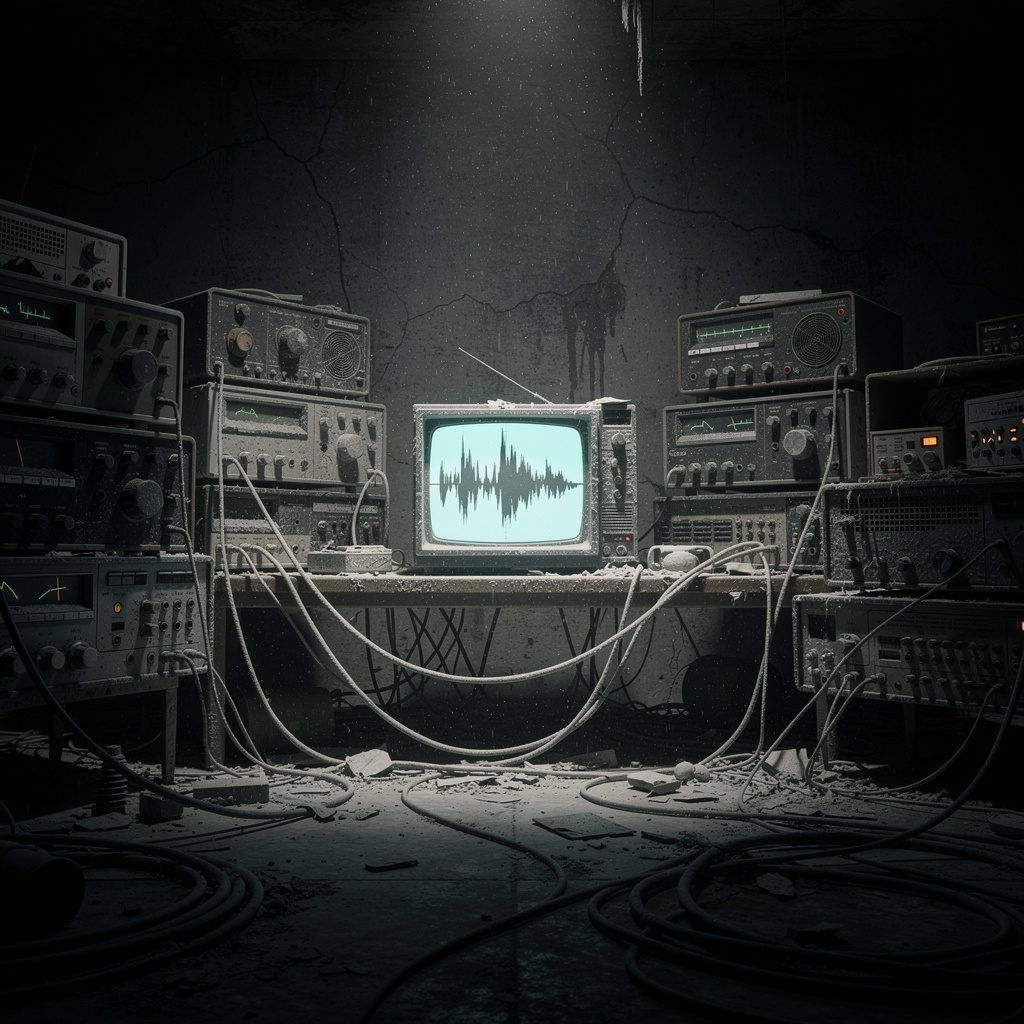
The analysis software rendered the waveform into a visual map. Peaks and valleys, compressed and expanded in ways that Fen had seen in human speech patterns before, years ago, working on a voice-compression project for a telecommunications firm in Lagos.
“It’s speech,” he said.
“You said it wasn’t words.”
“It’s not words I recognize. But the structure is speech. Someone is talking.” He paused. “Or something is generating a pattern that mimics speech.”
“From a receiver that has no transmitting capability, plugged into a wall in a building with no active power grid.”
“Yes.”
“Fen, we need to leave.”
“Five more minutes.”
He ran a frequency-shift analysis. Then a formant extraction. The software worked quietly, the laptop fan the only sound in the room besides the signal itself, still coming through the speaker in its endless, almost-language loop.
Then Fen went still.
“What,” Kunal said. Not a question. A word used as a blunt object.
“The formant pattern.” Fen turned the laptop so Kunal could see the screen. “These are vowel shapes. This is a voice.” He pointed to a cluster of peaks. “And these — these are a name.”
“Whose name?”
Fen looked at him.
“Yours.”
I felt the temperature in the room change. That’s not a metaphor. The building’s HVAC had been dead for years, but the air moved. It moved the way air moves when something shifts in a space — pressure equalizing, like a door opening somewhere below.
Kunal stared at the screen. The peaks were there, undeniable in their structure, rendered in clinical blue and white by software that had no reason to lie.
“That’s a coincidence,” he said.
“Maybe.”
“It’s a coincidence, Fen.”
“You want to run the full decode? I can have it in twenty minutes.”
“No.”
“Kunal —”
“I said no.” He grabbed his jacket from the chair. “Log the data, pack the equipment, and let’s go. We publish the anomaly, we hand it to someone else. We’re hobbyists, not —”
The signal stopped.
Not faded. Not degraded. Stopped. Mid-cycle, mid-syllable-shape, mid-whatever-it-was-trying-to-say.
The silence was worse than the signal.
Fen’s laptop screen flickered. The waveform display froze, then cleared, then displayed a single flat line. Then it displayed something else — a new waveform, different from everything before it. Sharp, deliberate, short.
Fen looked at it for three seconds.
Then he closed the laptop.
“We’re going,” he said.
“What was that last —”
“We’re going now, Kunal.”
They packed fast, working in the dark because Fen turned the work light off and neither of them reached to turn it back on. They moved through the building’s corridor by the glow of Kunal’s phone, down the stairwell, out through the service entrance they’d come in through.
The Baltimore waterfront was cold and damp. A container ship sat motionless on the harbor, its lights reflected in water the color of old iron.
Neither of them spoke until they reached the car.
“What was the last waveform?” Kunal asked.
Fen stared through the windshield.
“A goodbye.”
“You can’t know that.”
“No.” He started the engine. “I can’t.”
I need to tell you something now. Something I held back.
I said I was there. That’s true. I said I noticed the rhythm in the pipes before they did. That’s also true.
What I didn’t say is this: I have no memory of arriving at the Hargrove building. I remember leaving my apartment in Hampden. I remember the drive. But I have no memory of climbing the stairs, no memory of entering the radio room, no memory of the first hour they were there — the hour before the signal changed.
Fen has never mentioned me in any of his accounts of that night. Not once. When I’ve asked him about it directly, he goes quiet in a way that has nothing to do with discretion and everything to do with something he doesn’t want to confirm.
I found the recording on my own phone three days later. I don’t remember making it. It’s forty-seven minutes long and covers exactly the period I can’t recall.
I’ve listened to it twice.
In the recording, there are two voices. Fen’s. And one other.
The other voice is mine.
But in the recording, I am the one who keeps telling them to stay. I am the one who says the signal is harmless. I am the one who insists, in a voice I recognize as my own but with a cadence I have never used in my life, that the last waveform means nothing and Fen should run the full decode.
Kunal, on the recording, is not there at all.
I have spent four months trying to understand what that means.
The closest I’ve come is this: the signal was looking for a way in.
And somewhere between Hampden and the fourth floor of the Hargrove building, it found one.
The receiver was never the source.
I was.

 WhatsApp
 Telegram
 Email







Categories
- AI & Technology
- Contemporary
- Corporate Control
- Creepypasta
- Crime Thriller
- Cyberpunk
- Dark Fantasy
- Enemies to Lovers
- Fairy Tale Retelling
- Fantasy
- First Contact
- Forbidden
- Genetic/Body Horror
- High Fantasy
- Monster Hunter
- Mythic/Folklore
- Paranormal
- Portal/Otherworld
- Post-Apo
- Post-Collapse Society
- Psychological Thriller
- Romances
- SCI-FI
- Second Chance
- Slow Burn
- Space Combat
- Spacepunk
- Surveillance State
- Survival Thriller
- Thrillers
- Time Travel
- Treasure Hunter
- Urban Fantasy
- Witchcraft/Curses
Tags
10min stories atmospheric atmospheric fantasy atmospheric fiction contemporary romance Creepy creepypasta crime thriller dark fantasy debt dystopia emotional fiction enemies to lovers ensemble cast epistolary fantasy female protagonist first person forbidden romance framed narrative high fantasy love story magic Memory mystery Paranormal psychological horror psychological thriller romance sci-fi second chance second chance romance short fiction short story slow burn space station speculative fiction supernatural Survival survival thriller suspense thriller travel romance witchcraft workplace romance
Leave a Reply