I should tell you upfront that I was there. Not at the beginning — nobody was, really — but close enough to the end that I saw what it cost.
“It’s coming from inside the building,” Fen said.
Kunal didn’t look up from the spectrum analyzer. The screen threw pale blue light across his face, making him look hollowed out, a negative of himself.
“That’s not possible.”
“I know it’s not possible. I’m telling you what the equipment says.”
They were in the radio room on the fourth floor of the Hargrove Communications building, an ugly concrete block near the Baltimore waterfront that had been decommissioned in 2019. Kunal had gotten them access through a contact at the city’s historical preservation office. Permits, liability waivers, the full bureaucratic theater. All of it legitimate.
That part matters. I want you to understand they were not trespassers. They were not reckless. They did everything right.
The signal had first appeared six nights ago on a 1625 kHz frequency — a maritime band that nobody legally used anymore, not since the Coast Guard migrated its distress channels years back. Kunal had picked it up from his home setup in Hampden, logged it as an anomaly, cross-referenced it with archived maritime records, and found nothing.
Then he called Fen.
Fen Okoro was an electrical engineer who collected decommissioned radio equipment the way other people collected vintage wine — obsessively, reverently, and with a budget that made his wife quietly furious. He had the tools. He had the knowledge. And he had a particular hunger for signals that shouldn’t exist.
He should have let this one go.
“Play it again,” Kunal said.
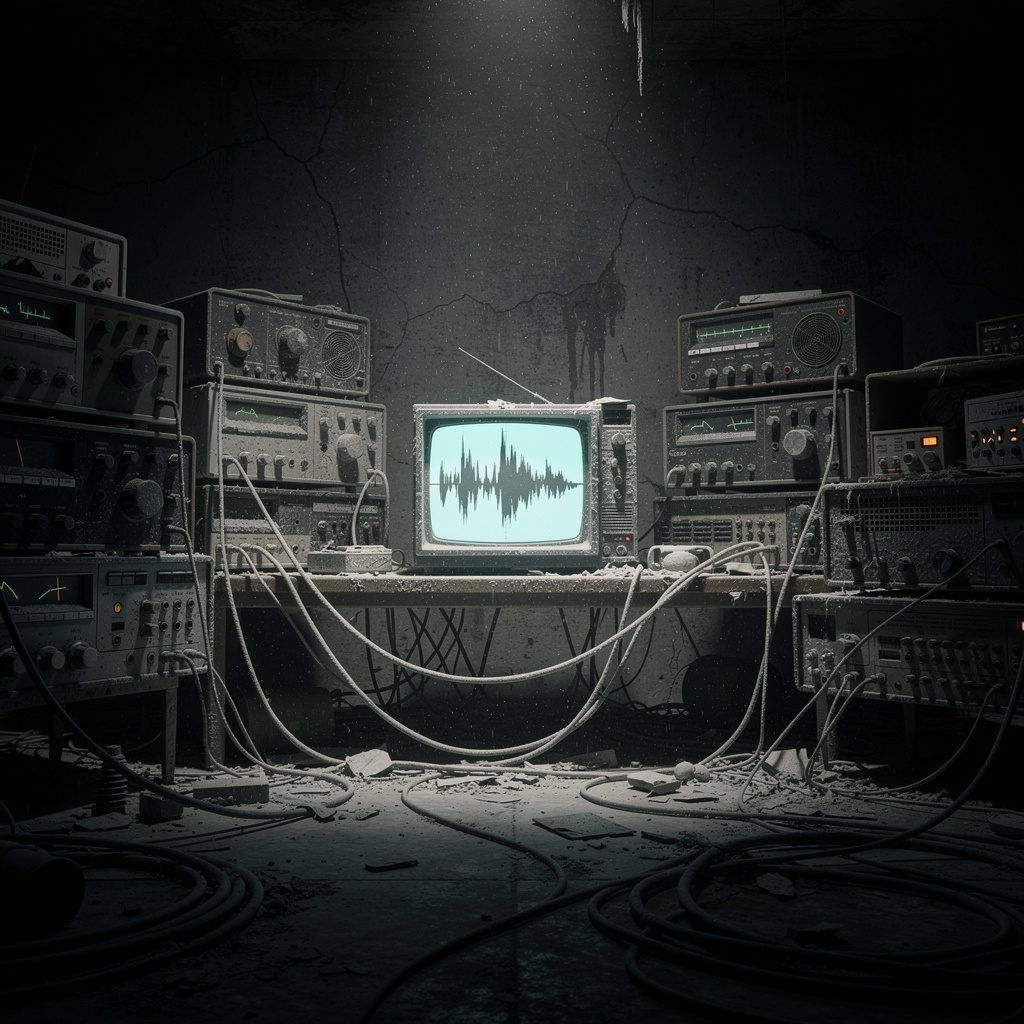
Fen adjusted the directional antenna they’d set up near the window. The building’s old equipment — transmitters, receivers, patch bays in various states of decay — stood around them like museum pieces. Some of it still had power cables running to the wall, though nobody had flipped those breakers in years.
The signal came through the speaker.
It was a voice. Or something shaped like a voice — the cadence was right, the pauses in the right places. But the syllables didn’t resolve into words. They dissolved just before meaning arrived, like a name spoken underwater.
“Directionality is consistent,” Fen said. “It’s originating from this floor. Maybe this room.”
“Nothing in this room is transmitting.”
“Nothing we brought in. The building’s equipment —”
“Is dead.”
“I thought so too.”
Fen walked to the far wall, where a rack of old receivers sat bolted in place. He ran his fingers along the back of the unit on the second shelf, found the power cable, and followed it to the wall. The cable was plugged in. Not jury-rigged, not recently connected — the paint on the outlet plate had yellowed around it. This cable had been here for years.
He picked up his RF meter and held it near the receiver.
The needle swung hard.
“Kunal.”
“I see it.”
Here is what I remember about that moment: the sound of water somewhere in the building. Pipes, probably. Old buildings talk. But it came in a rhythm that night, and the rhythm matched the pauses in the signal, and I noticed that before either of them did.
I didn’t say anything. That’s on me.
Fen pulled a portable oscilloscope from his bag and clipped the probes to the receiver’s output terminals. The waveform that appeared on the screen was clean. Organized. Not the random scatter of interference or the mechanical repetition of a malfunction.
It looked intentional.
“Somebody is transmitting from this receiver,” Fen said. His voice had gone quiet in the way voices do when the brain is still catching up to what the eyes are showing it.
“The receiver can’t transmit. It’s a receiver.”
“I know what it is.”
“Fen.”
“I know.”
Kunal stood up and crossed the room. He looked at the oscilloscope screen for a long moment, then looked at the receiver, then looked at Fen.
“Get a recording of the waveform. Then we’re leaving.”
“We just got here.”
“I know.”
But Fen was already pulling up analysis software on his laptop, already feeding the oscilloscope output in, already doing what Fen always did when something impossible sat in front of him: moving toward it instead of away.
Kunal let him. He told himself it was because the data would be valuable. The truth was simpler — he wanted to know too. He just wasn’t willing to admit it.

 WhatsApp
 Telegram
 Email







Categories
- AI & Technology
- Contemporary
- Corporate Control
- Creepypasta
- Crime Thriller
- Cyberpunk
- Dark Fantasy
- Enemies to Lovers
- Fairy Tale Retelling
- Fantasy
- First Contact
- Forbidden
- Genetic/Body Horror
- High Fantasy
- Monster Hunter
- Mythic/Folklore
- Paranormal
- Portal/Otherworld
- Post-Apo
- Post-Collapse Society
- Psychological Thriller
- Romances
- SCI-FI
- Second Chance
- Slow Burn
- Space Combat
- Spacepunk
- Surveillance State
- Survival Thriller
- Thrillers
- Time Travel
- Treasure Hunter
- Urban Fantasy
- Witchcraft/Curses
Tags
10min stories atmospheric atmospheric fantasy atmospheric fiction contemporary romance Creepy creepypasta crime thriller dark fantasy debt dystopia emotional fiction enemies to lovers ensemble cast epistolary fantasy female protagonist first person forbidden romance framed narrative high fantasy love story magic Memory mystery Paranormal psychological horror psychological thriller romance sci-fi second chance second chance romance short fiction short story slow burn space station speculative fiction supernatural Survival survival thriller suspense thriller travel romance witchcraft workplace romance
Leave a Reply