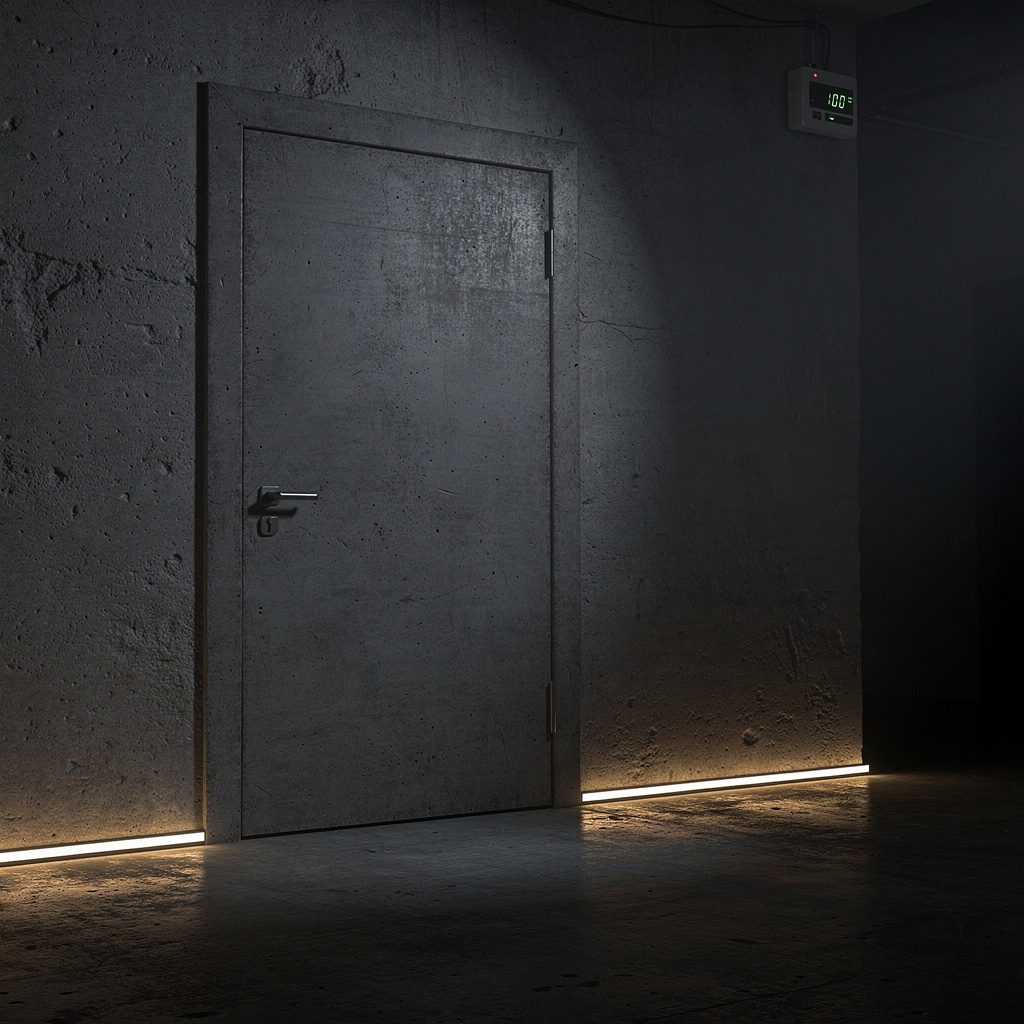
The door had no handle on the inside. He had established this in the first thirty seconds. It was set flush into the wall, with a thin seam around its edges and nothing else. No hinges visible. No panel. No keypad. The room’s other features were: one overhead light, recessed and covered by wire mesh; the oxygen sensor; and three metal shelving units along the far wall, all empty.
No vent. No window. No second door.
This was not an accident.
Kayode understood that clearly now, with the kind of clarity that comes when panic exhausts itself and leaves behind something quieter and more precise. Someone had built this room specifically. Someone had left the anonymous tip, spoofed his keycard access, waited for him to step through the door.
The question was not how to get out. There was clearly no way to get out from inside.
The question was whether anyone knew he was here.
Nine minutes.
Eleni moved through the blind corridor between the loading dock and the service stairs the way she had rehearsed it in her head — quickly, close to the wall, unhurried in her breathing. She had a flashlight, a folding tool kit in her jacket pocket, and a photograph printed from the access log anomaly showing the decommissioned terminal’s ID number. She did not have a phone signal. The sub-basement, she discovered when the freight elevator opened, was a dead zone.
The corridor smelled like old concrete and something else, something faintly metallic and artificial, like a laboratory that had been cleaned too thoroughly.
She saw the door at the end.
It was not ajar. It was sealed — and more than that, it was wrong. Eleni had spent enough time reading building schematics to recognize when something didn’t correspond to a blueprint. This door was not on the sub-basement layout she had pulled from the facility’s archived construction permits. Architecturally, it did not exist.
She approached it.
From inside, Kayode heard a sound. A small sound — the softest friction, like a shoe on concrete. He was on his feet before he registered standing. He pressed both palms flat against the door and said, loudly and evenly, “Someone is in this room. The oxygen sensor reads less than nine minutes. I need you to open this door.”
Silence.
Then, from the other side, a voice — female, careful, unsurprised in a way that itself was surprising: “Is there a locking mechanism on your side?”
“Nothing. No handle. The door is flush.”
A pause that felt much longer than it was. “Step back from the door.”
He stepped back.
Eleni crouched and examined the door’s seam with her flashlight. The fold logic she had found in the access logs came back to her now — the idea that something could appear seamless while concealing a mechanism inside its own structure. She ran her fingertips along the left edge of the frame. Then the bottom. Then the right side, and there — two centimeters above the floor — a slight irregularity in the paint, a small rectangle of texture that didn’t match the surrounding concrete.
She pressed it.
Nothing.
She pressed it and held it.
A soft click, like a thought completing itself. The door eased outward one centimeter.
Kayode pulled it from the inside and it swung fully open and he stepped into the corridor and breathed the recycled air of the sub-basement as though it were ocean wind. He stood there for a moment with his eyes closed. Then he opened them.
The woman crouching in front of him was perhaps forty, with a flashlight in one hand and an expression of controlled assessment — not relief, not alarm, but the particular focus of someone who has found the answer to one question and is already formulating the next.
“You’re the analyst,” she said. It wasn’t a question.
“Kayode Mwangi.”
“Eleni Marino.” She stood. “You were lured here.”
“I know.”
“So was I, I think. Just differently.” She looked past him into the empty room. “Whoever set this up wanted you contained and wanted me looking for you. Which means they expected me to know about the access log anomaly. Which means—”
“They know your monitoring script exists,” Kayode finished.
She looked at him. The flashlight threw half her face in shadow, the other half in amber, and her expression was the expression of a person recalibrating a map.
“We should leave. Now. Separately.”
“Agreed.”

 WhatsApp
 Telegram
 Email







Categories
- AI & Technology
- Contemporary
- Corporate Control
- Creepypasta
- Crime Thriller
- Cyberpunk
- Dark Fantasy
- Enemies to Lovers
- Fairy Tale Retelling
- Fantasy
- First Contact
- Forbidden
- Genetic/Body Horror
- High Fantasy
- Monster Hunter
- Mythic/Folklore
- Paranormal
- Portal/Otherworld
- Post-Apo
- Post-Collapse Society
- Psychological Thriller
- Romances
- SCI-FI
- Second Chance
- Slow Burn
- Space Combat
- Spacepunk
- Surveillance State
- Survival Thriller
- Thrillers
- Time Travel
- Treasure Hunter
- Urban Fantasy
- Witchcraft/Curses
Tags
10min stories atmospheric atmospheric fantasy atmospheric fiction contemporary romance Creepy creepypasta crime thriller dark fantasy debt dystopia emotional fiction enemies to lovers ensemble cast epistolary fantasy first person folklore forbidden romance framed narrative high fantasy love story magic Memory mystery Paranormal psychological horror psychological thriller romance sci-fi second chance second chance romance short fiction short story slow burn space station speculative fiction supernatural Survival survival thriller suspense thriller travel romance witchcraft workplace romance
Leave a Reply