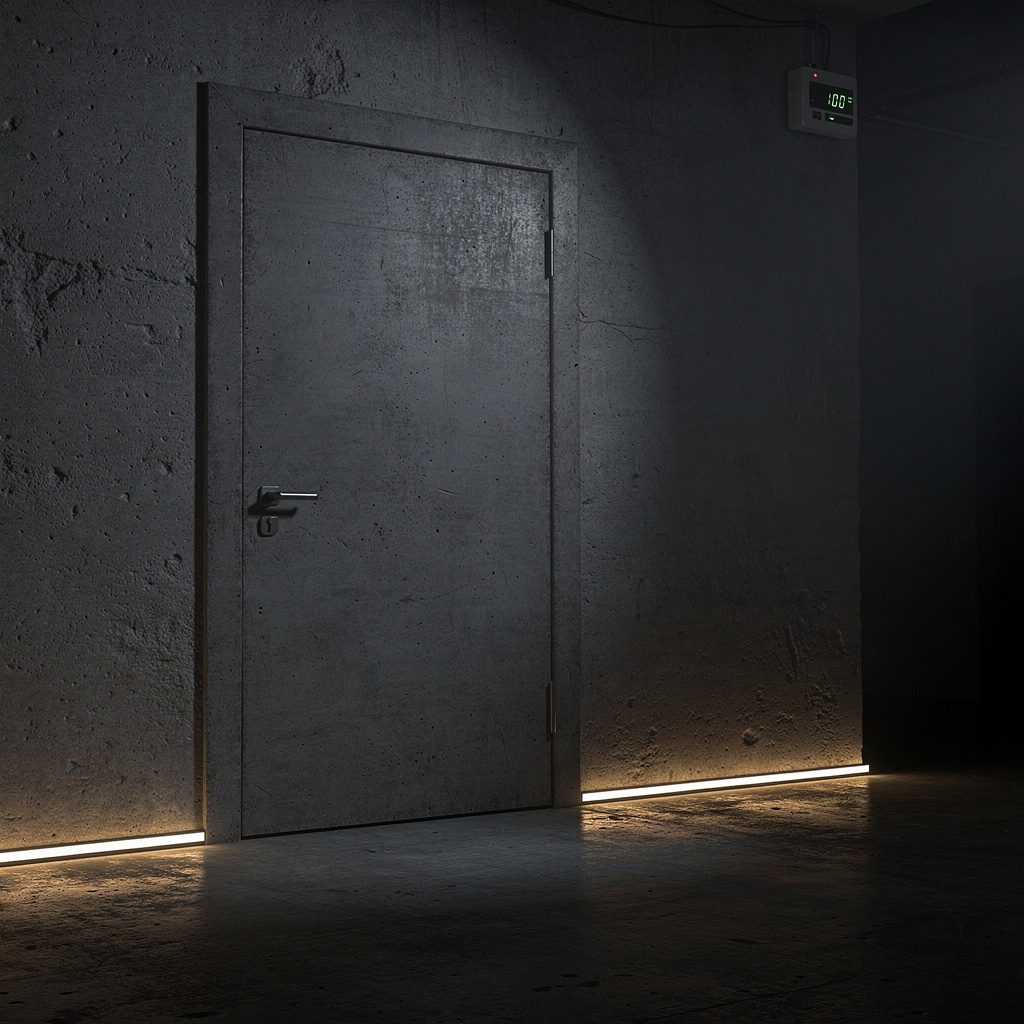
Fourteen minutes.
That was what the oxygen sensor read when Kayode Mwangi finally stopped screaming at the door and turned to look at it — a small rectangular device mounted to the concrete wall, its green digits ticking down with the indifference of a parking meter. He had not noticed it before. He had been too busy throwing himself against the door, then the walls, then the door again, as though the room might change its mind.
It had not.
Now he stood very still in the center of the space, approximately four meters by four meters, and tried to remember how he had arrived here.
The memory came back in pieces, the way memories do after shock rearranges them.
He had been following a lead. That was the first piece. A message left on the community board at the Eastside research complex in Pittsburgh — an anonymous tip about unauthorized access to the sub-basement archive. Kayode was a records analyst, not a security officer, but the tip had mentioned his name specifically. Mentioned that he would want to see what someone had done with three years of his work.
So he had gone. Alone, because that was the kind of decision a person makes at eleven-thirty at night when pride is louder than caution.
The sub-basement was accessible by a single freight elevator, which required a keycard. His had worked — that itself should have been a warning, because his clearance had been downgraded six months ago after the budget restructuring. It had worked anyway. The elevator had descended. The doors had opened into a narrow corridor lit by amber emergency strips. He had walked. A door at the end of the corridor had been ajar, light spilling out from inside.
He had stepped through.
The door had closed.
That was the full inventory of what he knew.
Twelve minutes now.
On the other side of Pittsburgh, twenty-three blocks northeast, Eleni Marino was sitting in her car outside the same research complex, watching the building’s service entrance with the kind of focused patience that looked, from the outside, like boredom.
She had been a contractor for the complex for two years — data verification, mostly, the quiet architecture of making sure one set of numbers matched another. She was good at it. She was also good at noticing when numbers had been made to match rather than naturally matching, which was a different skill entirely, and one that her employers did not know she possessed.
Three weeks ago she had found a discrepancy in the archive access logs. Not a gap — gaps were obvious. This was a fold. A sequence of entries that existed in two places simultaneously, like a page bent back on itself, and if you read it straight you saw nothing wrong, but if you smoothed the fold out, you saw that someone had been accessing a specific set of records every Tuesday night for four months. Always between eleven and midnight. Always from a terminal that the building’s official documentation listed as decommissioned.
She had told no one. She had driven here instead.
Eleni was methodical in the way that made other people uncomfortable, the way that meant she had written down the license plate of every car in the lot, had noted the security guard’s patrol interval at seventeen minutes, had identified the two exterior cameras whose angles left a blind corridor between the loading dock and the service stairs. She was not reckless. She believed in evidence.
What she had not accounted for was the second car she didn’t recognize — a gray sedan, parked at an angle that suggested haste — and the fact that its driver had gone into the building eight minutes before she arrived.
She was still looking at that car when her phone buzzed.
An alert. From a monitoring script she had written herself and attached to the archive access logs six days ago. Someone had triggered it.
She was out of her car before she had consciously decided to move.
Inside the room, Kayode had found a chair. He didn’t remember it being there when he first looked, but here it was — plain metal, the kind that belongs to no particular decade. He sat in it because standing was using oxygen he couldn’t afford. He read once, somewhere, that calm breathing could extend survival time in a low-oxygen environment by several minutes. He breathed slowly and thought about the door.

 WhatsApp
 Telegram
 Email







Categories
- AI & Technology
- Contemporary
- Corporate Control
- Creepypasta
- Crime Thriller
- Cyberpunk
- Dark Fantasy
- Enemies to Lovers
- Fairy Tale Retelling
- Fantasy
- First Contact
- Forbidden
- Genetic/Body Horror
- High Fantasy
- Monster Hunter
- Mythic/Folklore
- Paranormal
- Portal/Otherworld
- Post-Apo
- Post-Collapse Society
- Psychological Thriller
- Romances
- SCI-FI
- Second Chance
- Slow Burn
- Space Combat
- Spacepunk
- Surveillance State
- Survival Thriller
- Thrillers
- Time Travel
- Treasure Hunter
- Urban Fantasy
- Witchcraft/Curses
Tags
10min stories atmospheric atmospheric fantasy atmospheric fiction contemporary romance Creepy creepypasta crime thriller dark fantasy debt dystopia emotional fiction enemies to lovers ensemble cast epistolary fantasy first person forbidden romance found text framed narrative high fantasy love story magic Memory mystery Paranormal psychological horror psychological thriller romance sci-fi second chance second chance romance short fiction short story slow burn space station speculative fiction supernatural Survival survival thriller suspense thriller travel romance witchcraft workplace romance
Leave a Reply