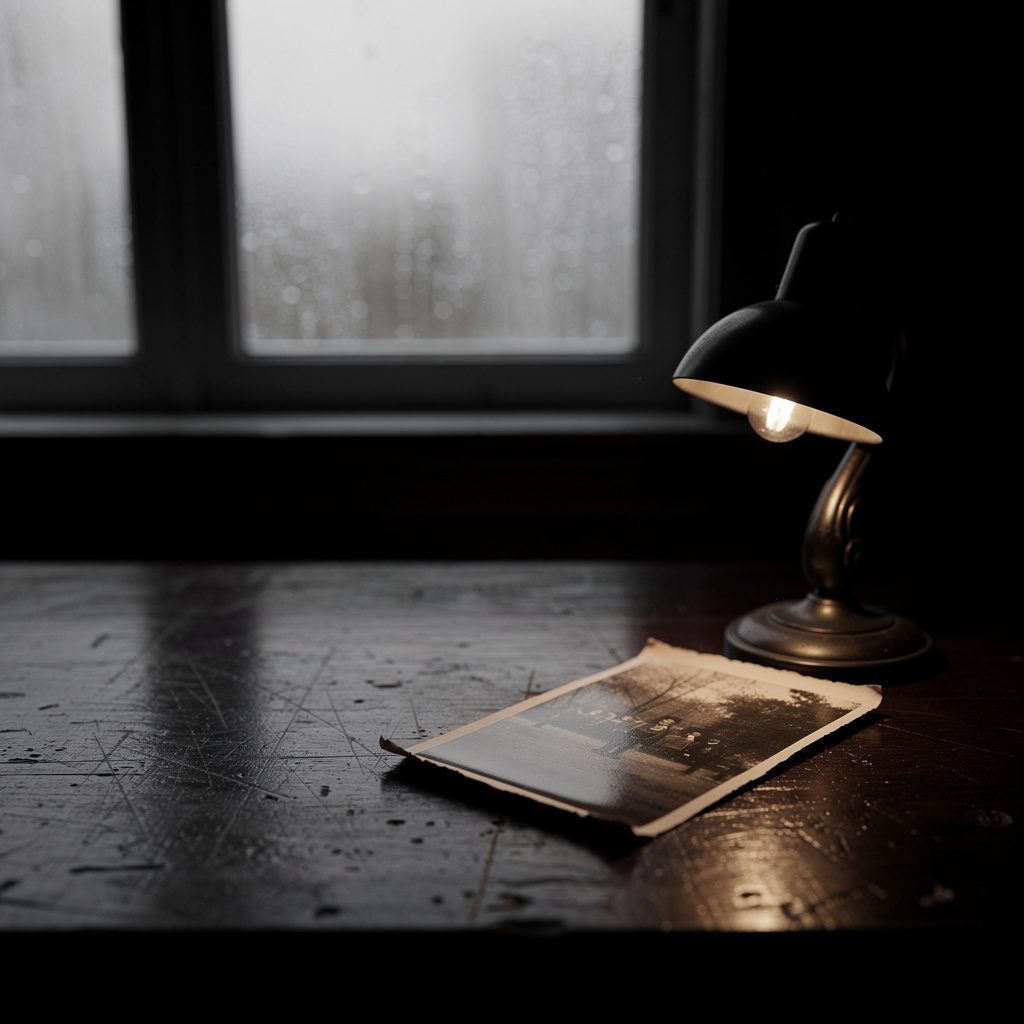
In the days that followed she did what a methodical person does when confronted with an impossibility: she tried to build a rational structure around it.
She scanned the photograph at high resolution and sent it to a friend who worked in photographic archiving — someone who could assess the paper stock, the chemical profile of the developing process, the age of the emulsion. The results came back in four days. Genuine silver gelatin print. Paper stock consistent with the late 1950s to early 1960s. No signs of digital manipulation or composite printing. The image had not been altered.
She pulled every photograph she could find of herself from childhood — school portraits, birthday parties, the awkward documentation of adolescence. She lined them up on her kitchen table and studied her own face evolving across time. The scar. The eyebrow. The particular way her face sharpened when she wasn’t performing ease for a camera.
It was the same face in the 1963 photograph. Fully formed. Adult. Thirty, perhaps thirty-one.
She called her mother in Bergen, where the family had moved when Vibeke was three. The conversation was careful — Vibeke knew how to ask questions without revealing what she was actually looking for. Her mother remembered nothing unusual about Vibeke’s grandmother. No estrangements. No secrets that had surfaced after her death. No relatives Vibeke hadn’t been told about.
“You sound tired,” her mother said near the end of the call.
“I’m fine,” Vibeke said. “Just the estate. It’s taking longer than I expected.”
She was not fine. She was beginning to feel the first tremors of something she had no professional vocabulary for. Cartographers deal in the fixed and the verifiable. She was standing on ground that had stopped being either.
—
Twenty-two hours remaining.
This is where the watcher’s perspective becomes more complicated, and honesty requires acknowledgment of it: by this point, the watcher had begun to understand what was happening to Vibeke Ulvang, and had said nothing. Not from malice. From a kind of paralysis that belongs to those who witness something they cannot interrupt without becoming part of it.
Vibeke had been to the Multnomah County library twice in the preceding week, working through archived Oregon newspapers from the 1960s on microfilm. The watcher had sat three tables away, behind a periodicals shelf, and watched her face in the blue-white light of the reader. She had the concentration of someone defusing something. Unhurried on the surface. Burning underneath.
On the second visit she found it.
A small item in the Astoria Budget, July 1963. A community photograph from a neighborhood Fourth of July gathering. The same porch. The same carved railing. The same group, slightly rearranged — her grandmother, the unrecognized man, the two children. And at the left edge of the frame again, the same face. Same scar. Same eyebrow.
But the caption named her.
V. Strand. Family friend.
Vibeke sat very still for a long time, staring at those two words. Family friend. She was someone’s family friend in 1963, twenty-nine years before she was born. She had a last name in 1963 that was not her last name. Strand. She turned it over in her mind like a stone, checking its weight. Strand. Norwegian word for shore. The edge of land where water begins.
She photographed the microfilm frame with her phone and drove back to the waterfront room.
—
The final hours were quiet ones, which is perhaps not what a person expects from a reckoning.
Vibeke spread everything on the bed: the original photograph, her printed scan, the phone photo of the newspaper clipping, and a map she had drawn herself — not a geographic map, but a timeline, the kind a cartographer makes when the territory is time instead of space. She had marked every date she was certain of: her birth in 1992, her grandmother’s birth in 1921, the estimated date of the photograph, the newspaper date. She had drawn lines between them. She had labeled the anomaly the way she would label an unmapped region on a chart: UNKNOWN.
But she had also, in the last twelve hours, done something she had not done in the first two weeks of this.
She had looked at the fifth figure’s expression.
Not her face. Her expression. The precise quality of what the face was doing in that moment the shutter opened in the summer of 1963.

 WhatsApp
 Telegram
 Email







Categories
- AI & Technology
- Contemporary
- Corporate Control
- Creepypasta
- Crime Thriller
- Cyberpunk
- Dark Fantasy
- Enemies to Lovers
- Fairy Tale Retelling
- Fantasy
- First Contact
- Forbidden
- Genetic/Body Horror
- High Fantasy
- Monster Hunter
- Mythic/Folklore
- Paranormal
- Portal/Otherworld
- Post-Apo
- Post-Collapse Society
- Psychological Thriller
- Romances
- SCI-FI
- Second Chance
- Slow Burn
- Space Combat
- Spacepunk
- Surveillance State
- Survival Thriller
- Thrillers
- Time Travel
- Treasure Hunter
- Urban Fantasy
- Witchcraft/Curses
Tags
10min stories atmospheric atmospheric fantasy atmospheric fiction contemporary romance Creepy creepypasta crime thriller dark fantasy debt dystopia emotional fiction enemies to lovers ensemble cast epistolary fantasy first contact first person forbidden romance framed narrative high fantasy love story magic Memory mystery Paranormal psychological horror psychological thriller romance sci-fi second chance second chance romance short fiction short story slow burn space station speculative fiction supernatural Survival survival thriller suspense thriller travel romance witchcraft workplace romance
Leave a Reply