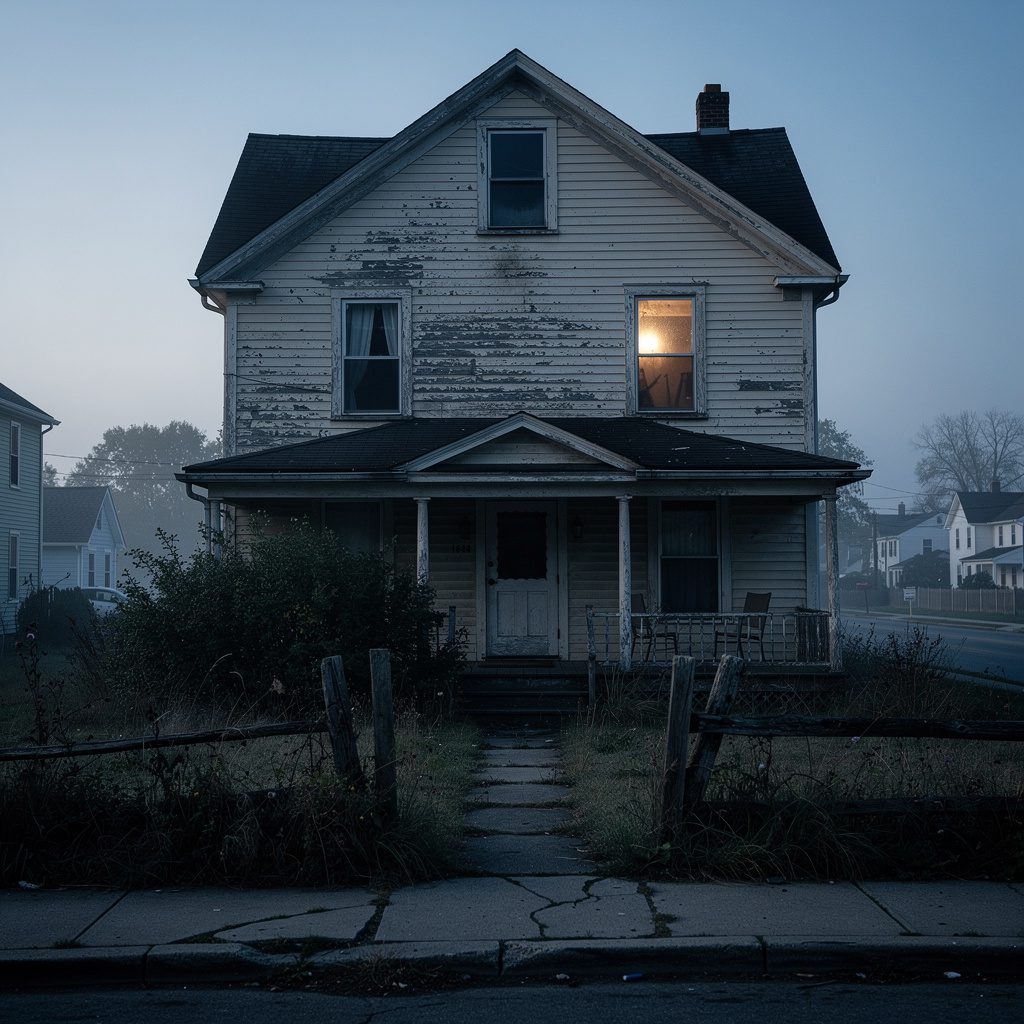
She had not owned the green jacket fourteen months ago. She had bought it eight months ago from a shop in Cranston.
The floor behind her creaked.
She spun around.
A man stood in the kitchen doorway. Fifties, maybe older, wearing a canvas work jacket over a flannel shirt, a knit cap pulled low. His face was lean and deeply lined, the face of someone who had spent years outside, and his eyes were very still in a way that had nothing to do with calm. He was holding a flashlight, not turned on. His other hand was empty.
“You shouldn’t be in here,” he said. His voice was flat, regionless, the accent of someone who had lived in too many places to carry just one.
“I could say the same,” Livia said. Her thumb was on her phone screen. She could feel her own heartbeat in her ears.
He looked at her for a moment without expression. Then he looked past her at the window, and something moved across his face — not surprise, not recognition, but something older and harder to name. Wariness, maybe. The wariness of a man who has confirmed what he already suspected.
“How long have you been coming here?” he asked.
“I haven’t been. This is my first time inside.”
He almost smiled. Not warmly. “That’s what they all think.”
He stepped into the kitchen and she stepped back, putting the counter between them, and he stopped as if he’d expected that and didn’t intend to push it. He looked around the room slowly, the way a doctor looks at a chart — reading something invisible to her.
“This house,” he said, “has a way of pulling people in before they realize they’ve been here. Not the building. Something in the record of it. The paperwork. The history. You start following the trail and the trail starts following you. I’ve seen it four times now.”
“That’s not possible,” Livia said, though her voice came out smaller than she meant it to.
“The man before you — Osei — he was a contractor. He came to assess the foundation and he ended up sleeping on the floor for three nights pulling up old documents from underneath the subfloor. Deeds. Letters. Things that had been hidden there since the sixties. He thought he was chasing a story.” He paused. “He hasn’t been found.”
The pipes ticked. Outside, a cloud moved across the afternoon sun and the kitchen dimmed by a shade.
“Who are you?” Livia asked.
“Someone who got out early enough.” He turned the flashlight over in his hands, not switching it on. “I came here two years ago. Journalist. Property fraud angle — there were patterns in the ownership transfers, money moving through the title in ways that didn’t make sense. Same as you, probably. Whatever you were looking for.”
“I was looking for a paper trail in a civil case.”
“And you found something that didn’t fit, and you couldn’t leave it alone, and now you’re standing in the kitchen at five in the afternoon with no backup and the front door open.” He said it without judgment, only with the exhaustion of someone repeating something they have said before, to people who didn’t listen. “The house doesn’t haunt people. I want to be clear about that. I don’t believe in that. What it does is — it accumulates. Every person who’s been through it leaves something in the record. A filing, a photograph, a report. And those records connect to other records, and the connections pull the next person in, and that person leaves more records, and so on. It’s a machine. A paper machine. And the question I have never been able to answer is whether it was designed that way or whether it just grew.”
Livia thought about the photograph. The green jacket. The counter where she was standing right now.
“The photograph in the deed transfer,” she said slowly. “The woman at the counter.”
He looked at her sharply. “What deed transfer?”
“The one filed fourteen months ago. There’s a photograph embedded in the scan. A woman in this kitchen.”
For the first time, something crossed his face that looked like genuine unease. “I’ve been through every document attached to this property going back forty years. There is no embedded photograph in that filing.”
Silence.
The kind that presses against you.
“I have it on my laptop,” Livia said. “I can show you.”

 WhatsApp
 Telegram
 Email






Categories
- AI & Technology
- Contemporary
- Corporate Control
- Creepypasta
- Crime Thriller
- Cyberpunk
- Dark Fantasy
- Enemies to Lovers
- Fairy Tale Retelling
- Fantasy
- First Contact
- Forbidden
- Genetic/Body Horror
- High Fantasy
- Monster Hunter
- Mythic/Folklore
- Paranormal
- Portal/Otherworld
- Post-Apo
- Post-Collapse Society
- Psychological Thriller
- Romances
- SCI-FI
- Second Chance
- Slow Burn
- Space Combat
- Spacepunk
- Surveillance State
- Survival Thriller
- Thrillers
- Time Travel
- Treasure Hunter
- Urban Fantasy
- Witchcraft/Curses
Tags
10min stories atmospheric atmospheric fantasy atmospheric fiction contemporary romance Creepy creepypasta crime thriller dark fantasy debt dystopia emotional fiction enemies to lovers ensemble cast epistolary fantasy first person forbidden romance found text framed narrative high fantasy love story magic Memory mystery Paranormal psychological horror psychological thriller romance sci-fi second chance second chance romance short fiction short story slow burn space station speculative fiction supernatural Survival survival thriller suspense thriller travel romance witchcraft workplace romance
Leave a Reply