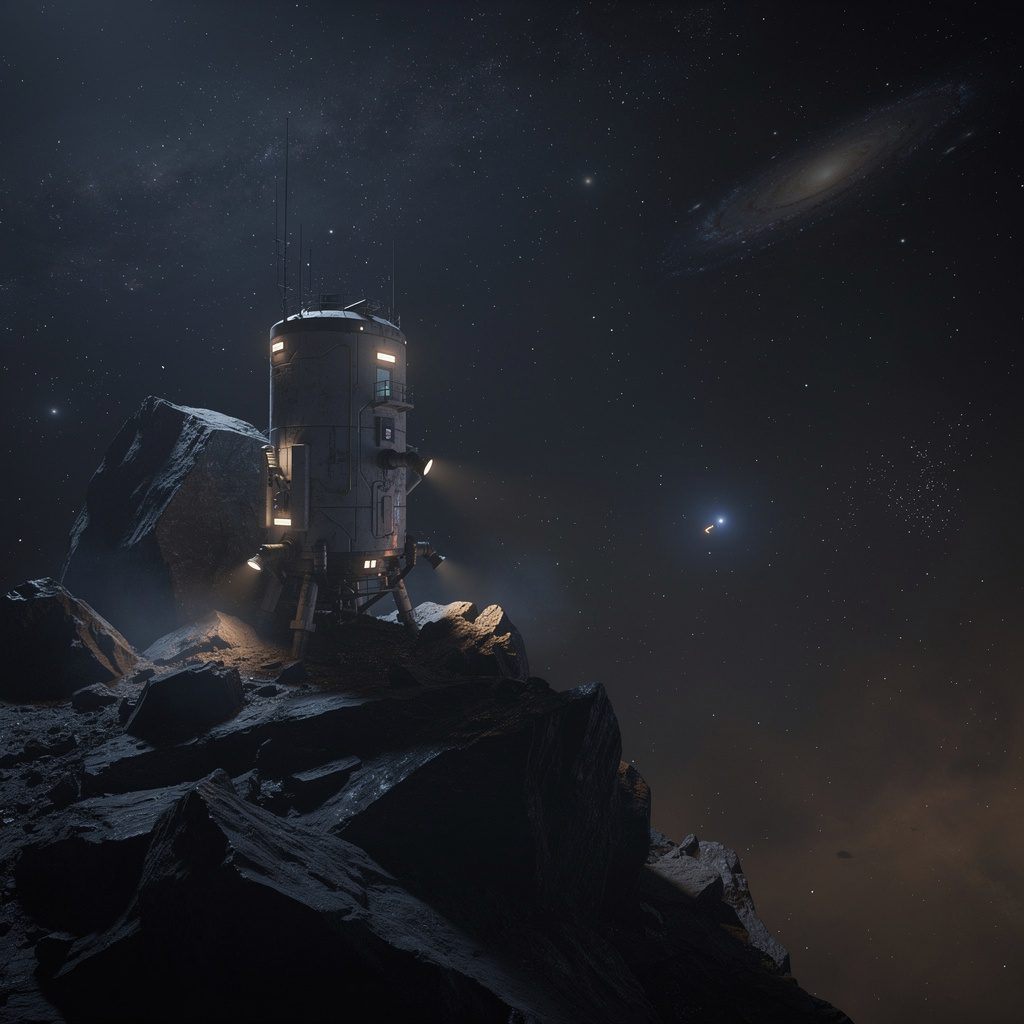
Luca was alone at the arrays at 0200 when the signal changed. He had been watching it for hours — watching was perhaps the wrong word, sitting with it was more accurate, the way you sit with something you do not yet understand but feel compelled to stay near. The pulse pattern shifted, and then, over the course of about forty minutes, it changed again, and then again, and what emerged from the variation was a structure: not language, not in any sense he could consciously decode, but pattern with internal logic, repetition with variation, the unmistakable architecture of something that was trying to be understood. He recorded everything. His hands were steady. He was, he would realize later, less afraid than he had expected to be, and more moved — moved in the specific way of someone who has spent a long time in a small, forgettable place doing a small, forgettable job, and has just been shown that the universe had been paying attention to that place all along.
He woke the others. All of them came quickly, Gael still holding his book by reflex, Shreya already pulling her hair back into its working knot before she had fully cleared the doorway, Manoj in the calm and unhurried manner of someone who had prepared himself for this possibility the moment the anomaly first appeared. They listened to the recording together. Shreya ran a structural analysis of the pattern. Gael, whose hobby was historical linguistics and whose books were not all fiction, said quietly that the repetition structure had properties consistent with what early communication theorists had called foundational bridging — a way of establishing shared logical ground before attempting meaning. He said it tentatively, because he was not an expert and knew it. But the others listened, because he was right in the way that people are sometimes right when they are paying careful attention to something no one else thought to look at.
Markov sent a full-priority transmission to the hub at 0400, breaking protocol in three different ways to ensure it would not be filtered by the duty queue. The response, when it came, was not from Ashkiel Pran. It was from a level of the Compact’s administrative structure that Luca had never directly interacted with, and it arrived with a series of instructions that were clear and specific and that the four of them began following immediately — not because they were ordered to, but because the instructions made sense, and because following them meant continuing to do the thing they were already doing: listening.
The object — they still called it that, by habit or by choice — did not approach the station. Over the following eighteen hours, as the Compact mobilized a response team that would take days to arrive, it simply remained at its adjusted bearing and continued to transmit its structured, patient signal. Luca worked through two full shifts without sleeping, cross-referencing Gael’s pattern analysis with Shreya’s material data, building a picture of something that had traveled a distance none of them could calculate from a point of origin none of them could name, and had found this particular unremarkable drum of pressurized metal bolted to an iron-colored rock, and had chosen to speak to it.
On the second evening, Luca stepped away from the arrays and stood at the observation port for a long time, looking out at the asteroid and the stars and the darkness where the object waited. He thought about the eleven months he had spent here, the rust-coffee and the maintenance bulletins and the sense of being quietly kept in place, and he understood — not with resentment but with something that felt like relief, like a knot releasing — that he had not been overlooked. He had been exactly where he needed to be, doing exactly what he was built to do: watching, carefully, for the thing that didn’t match. The anomaly had not found Verada-9 by accident. The signal’s structural analysis, when Gael finished it the next morning, would show that the transmission had been narrowly, precisely directed — aimed at the station with an accuracy that implied long observation, patient waiting, a knowledge of where the careful ones were stationed.
Something had been watching Luca Ferrante watch the corridor for a very long time. And when it finally decided to speak, it had known exactly who would listen.

 WhatsApp
 Telegram
 Email







Categories
- AI & Technology
- Contemporary
- Corporate Control
- Creepypasta
- Crime Thriller
- Cyberpunk
- Dark Fantasy
- Enemies to Lovers
- Fairy Tale Retelling
- Fantasy
- First Contact
- Forbidden
- Genetic/Body Horror
- High Fantasy
- Monster Hunter
- Mythic/Folklore
- Paranormal
- Portal/Otherworld
- Post-Apo
- Post-Collapse Society
- Psychological Thriller
- Romances
- SCI-FI
- Second Chance
- Slow Burn
- Space Combat
- Spacepunk
- Surveillance State
- Survival Thriller
- Thrillers
- Time Travel
- Treasure Hunter
- Urban Fantasy
- Witchcraft/Curses
Tags
10min stories atmospheric atmospheric fantasy atmospheric fiction contemporary romance Creepy creepypasta crime thriller dark fantasy debt dystopia emotional fiction enemies to lovers ensemble cast epistolary fantasy female protagonist first person forbidden romance framed narrative high fantasy love story magic Memory mystery Paranormal psychological horror psychological thriller romance sci-fi second chance second chance romance short fiction short story slow burn space station speculative fiction supernatural Survival survival thriller suspense thriller travel romance witchcraft workplace romance
Leave a Reply