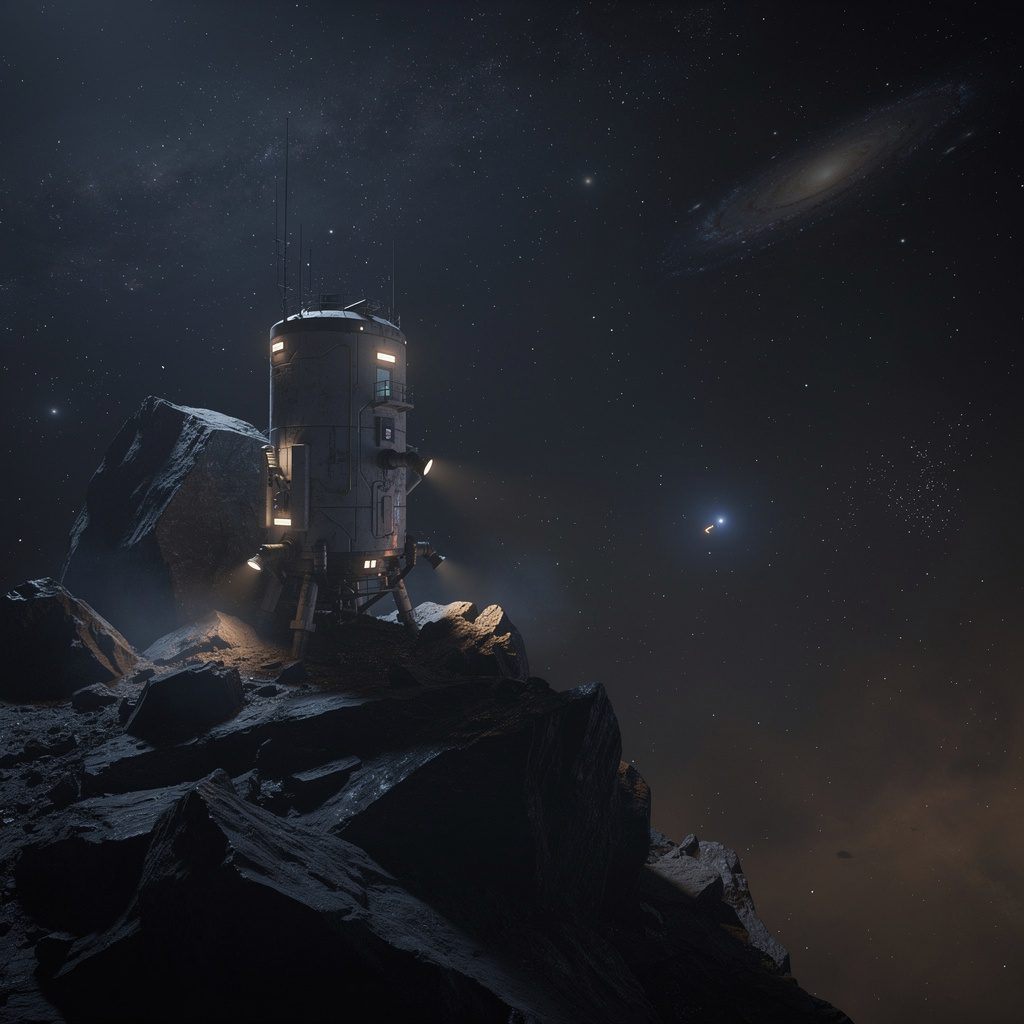
He marked it. He ran the automatic cross-check. The system returned no match. He ran it again manually, pulling up the full sector registry himself, checking not just the active flight plans but the historical record going back eighteen months. Nothing. He sat with this for a long moment, the coffee cooling beside his hand, the observation port behind him framing the same iron-colored asteroid it always framed, and felt the particular sensation of a familiar world beginning, very slightly, to tilt.
He brought it to Manoj at 0730, presenting the data without interpretation, which was how Manoj preferred things. The commander studied the readout for longer than Luca expected, his broad face still, his reading glasses — actual corrective lenses, a personal affectation — perched on his nose. Shreya was there too, having come in for her morning systems check, and she leaned over Manoj’s shoulder with the unselfconscious directness she brought to all technical problems. She said nothing for a while. Then she said that the pulse interval was irregular in a way that was not consistent with any drive system she had documentation for, and that the signature’s spectral profile was strange — not wrong, exactly, but strange, like a chord played in a tuning she hadn’t encountered before. Gael, who had wandered in with a book tucked under his arm, listened from the doorway and did not offer a technical opinion but watched the others’ faces with the attentive quiet of someone cataloguing something important.
For two days, nothing escalated. This was, in retrospect, the most disorienting part — the way the anomaly simply persisted without demanding anything, drifting at the same bearing, pulsing in the same irregular pattern, neither approaching nor retreating. Luca filed a report to the hub and received an automated acknowledgment. He filed a second report flagging the anomaly as potentially non-standard and received a response from a duty officer named Ashkiel Pran who told him, in the polite and slightly condescending language of someone managing a large volume of routine queries, that sensor artifacts in the outer belt were common and that he should recalibrate his passive arrays and resubmit if the reading persisted. Luca recalibrated the arrays. The reading persisted. He resubmitted. He did not hear back.
On the third day, the signature moved. Not toward the station — not exactly — but it shifted bearing in a way that was precise and deliberate, a small correction that brought it from 227 to 231, and then held there. Shreya ran the movement through her trajectory modeling and reported, in the flat tone she used when she found something she could not immediately explain, that the object — she had started calling it an object — had made a micro-adjustment consistent with active navigation rather than passive drift. Active navigation meant propulsion. Propulsion meant control. Control meant intention.
The four of them stood in the operations bay that evening, the station’s ambient hum a constant low presence beneath everything, the stars outside motionless and indifferent, and the word that none of them had yet said aloud sat in the room with them like a fifth person. Manoj was the one who finally said it, calmly and without theater, because he was constitutionally incapable of theater: that if this was a vessel of some kind, and if it had active navigation, and if it was not registered with any authority in the Compact’s records, then they needed to consider the full range of possibilities, including the ones they had no protocol for. Gael set his book down very carefully on the console beside him. Shreya pulled up the arrays and began running a new kind of scan, one she had not been asked to run, because she had already thought ahead to what they would need next.
What the new scan returned — and it took Shreya four hours to be certain enough to share the results, cross-checking against every reference archive the station carried — was a material composition reading that did not match any alloy, polymer, or composite in the Compact’s engineering registry. Not an unknown variant of a known material. Not a degraded or contaminated sample that might confuse the sensors. Something structurally coherent and internally consistent that simply had no analogue in any catalog compiled by human hands. The station was very quiet when she presented this. Outside the observation ports, the asteroid’s shadow was exactly where it always was at this hour.

 WhatsApp
 Telegram
 Email







Categories
- AI & Technology
- Contemporary
- Corporate Control
- Creepypasta
- Crime Thriller
- Cyberpunk
- Dark Fantasy
- Enemies to Lovers
- Fairy Tale Retelling
- Fantasy
- First Contact
- Forbidden
- Genetic/Body Horror
- High Fantasy
- Monster Hunter
- Mythic/Folklore
- Paranormal
- Portal/Otherworld
- Post-Apo
- Post-Collapse Society
- Psychological Thriller
- Romances
- SCI-FI
- Second Chance
- Slow Burn
- Space Combat
- Spacepunk
- Surveillance State
- Survival Thriller
- Thrillers
- Time Travel
- Treasure Hunter
- Urban Fantasy
- Witchcraft/Curses
Tags
10min stories atmospheric atmospheric fantasy atmospheric fiction contemporary romance Creepy creepypasta crime thriller dark fantasy debt dystopia emotional fiction enemies to lovers ensemble cast epistolary fantasy first person forbidden romance found text framed narrative high fantasy love story magic Memory mystery Paranormal psychological horror psychological thriller romance sci-fi second chance second chance romance short fiction short story slow burn space station speculative fiction supernatural Survival survival thriller suspense thriller travel romance witchcraft workplace romance
Leave a Reply