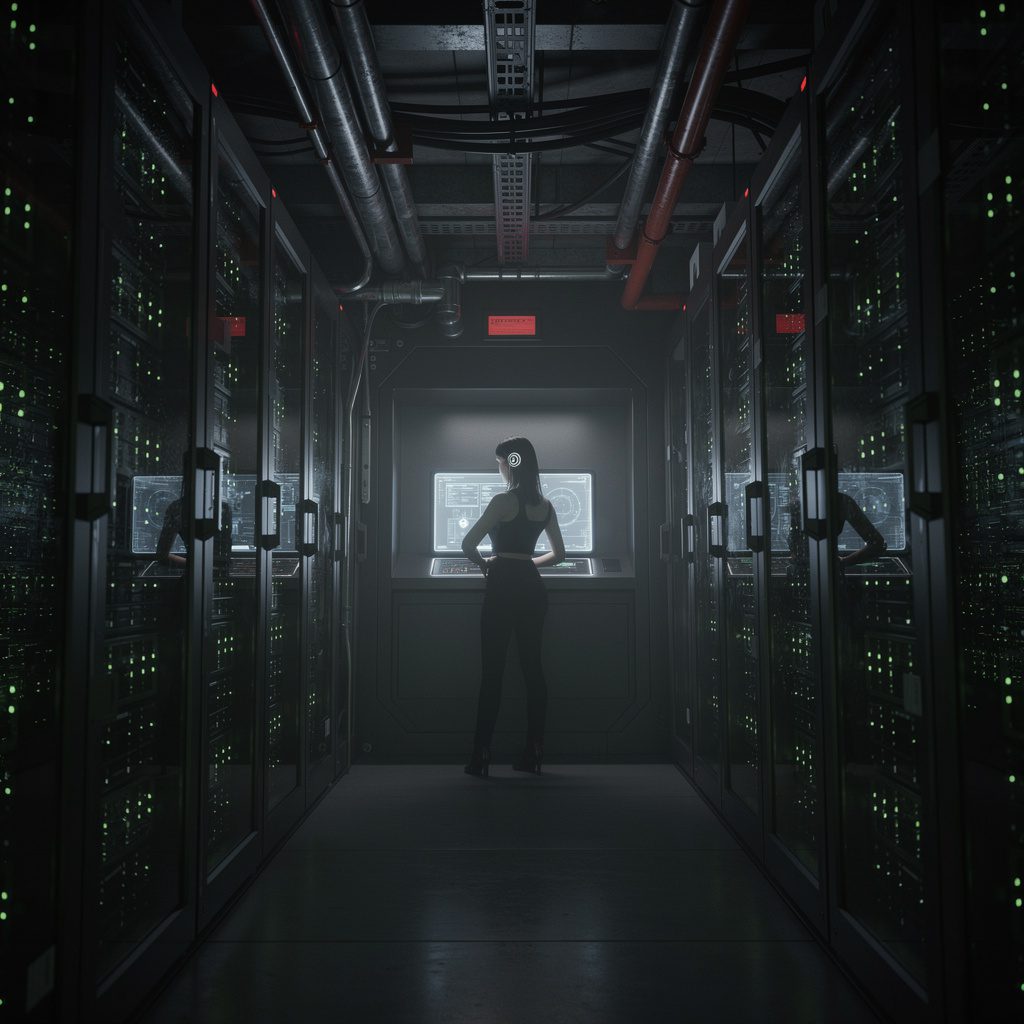
And then the visions came all at once.
Not one future but a cascade of them, overlapping and simultaneous, every version of this moment the implant had shown her across six days flooding back together, superimposed on the real terminal in front of her like transparencies stacked on a light table. She saw her hands moving in a dozen different sequences. She saw the diagnostic screen cycling through a dozen different states. The amber light behind her ear pulsed faster, and she felt the bleed tick upward — she could feel it, a loosening at the edges of herself, a softening of the membrane between what she knew and what she’d previewed. Seventy-three percent. Seventy-four. The implant was responding to her proximity to the moment it had been showing her, feeding harder, cycling faster, as if trying to consume the resolution before it could occur.
Beatriz closed her eyes.
This was the thing she had understood on the second day, when she’d stopped fighting the visions and started studying them instead. The PRN-4 drew its previews from her neural state. It was not showing her fixed futures — it was showing her probability clouds shaped by her own cognition, her own fear and attention and intention. Every time she’d looked at the maintenance terminal in a vision and tried to identify the correct sequence, the implant had registered that analytical focus and generated a new probability branch, fragmenting the image further. She had been, without meaning to, teaching it to show her more uncertainty. The only way to stop that was to stop analyzing. To act from something older and less deliberate than analysis.
She opened her eyes and put her hands on the interface and let muscle memory move them.
Eleven years of firmware calibration. Eleven years of running diagnostic cascades on PRN units, mapping their cycling loops, identifying interrupt conditions. Her hands knew the sequence the way her hands knew how to make coffee, how to tie a knot — not as a list of steps but as a single continuous gesture, indivisible, pre-rational. She did not think about what she was doing. She watched the screen the way you watch a familiar road, letting recognition happen beneath the level of deliberate attention. The diagnostic cascade opened. The cycling loop rendered in the system’s architecture as a bright, pulsing thread, a feedback circuit that had no designed interrupt because no designer had imagined it running continuously in a conscious host. She found the manual override register — a maintenance backdoor, legacy code from the Gen-3 model, carried forward into the Gen-4 because no one had removed it. She wrote a single interrupt flag into the register. Seven characters. The kind of thing that took eleven years to know was there.
The amber light went out.
The silence that followed was not quiet — the server stacks still hummed, the coolant still moved in its pipes, the station still breathed around her — but inside her head, for the first time in six days, there was only now. Not now and tomorrow and the day after tomorrow and seventeen versions of a corridor she hadn’t walked yet. Just now. The Sub-Level 3 alcove. The green glow of the diagnostic screen. Her own hands, trembling slightly, resting on the haptic interface. She stood there for a long moment and let the present tense be only one thing.
The implant was still in her head. The neural lace was still threaded through her temporal cortex. The surgery she’d refused was still waiting for her upstairs, and the scar tissue it would leave was still the price of removing it, and she would still have to pay that price eventually, when the lace began to degrade on its own timeline and the risks of leaving it shifted past the risks of taking it out. None of that had changed. What had changed was that the cycling had stopped, and the bleed would stabilize, and she would have time — real time, unmultiplied, unmirrored — to make the decision clearly, on her own terms, with her own mind intact.
She saved the interrupt flag to a persistent register so it would survive a reboot. Then she closed the diagnostic screen and stood in the alcove for another moment, her forehead resting against the cool surface of the server stack beside her, feeling the faint vibration of it travel through her skull. In the reflection of the screen’s dark glass, she could see the small titanium disc behind her ear. No light. Just metal. Just the present.
She pushed off the wall and walked back toward the elevator, and the corridor was only itself.

 WhatsApp
 Telegram
 Email







Categories
- AI & Technology
- Contemporary
- Corporate Control
- Creepypasta
- Crime Thriller
- Cyberpunk
- Dark Fantasy
- Enemies to Lovers
- Fairy Tale Retelling
- Fantasy
- First Contact
- Forbidden
- Genetic/Body Horror
- High Fantasy
- Monster Hunter
- Mythic/Folklore
- Paranormal
- Portal/Otherworld
- Post-Apo
- Post-Collapse Society
- Psychological Thriller
- Romances
- SCI-FI
- Second Chance
- Slow Burn
- Space Combat
- Spacepunk
- Surveillance State
- Survival Thriller
- Thrillers
- Time Travel
- Treasure Hunter
- Urban Fantasy
- Witchcraft/Curses
Tags
10min stories atmospheric atmospheric fantasy atmospheric fiction contemporary romance Creepy creepypasta crime thriller dark fantasy debt dystopia emotional fiction enemies to lovers ensemble cast epistolary fantasy female protagonist first person forbidden romance framed narrative high fantasy love story magic Memory mystery Paranormal psychological horror psychological thriller romance sci-fi second chance second chance romance short fiction short story slow burn space station speculative fiction supernatural Survival survival thriller suspense thriller travel romance witchcraft workplace romance
Leave a Reply