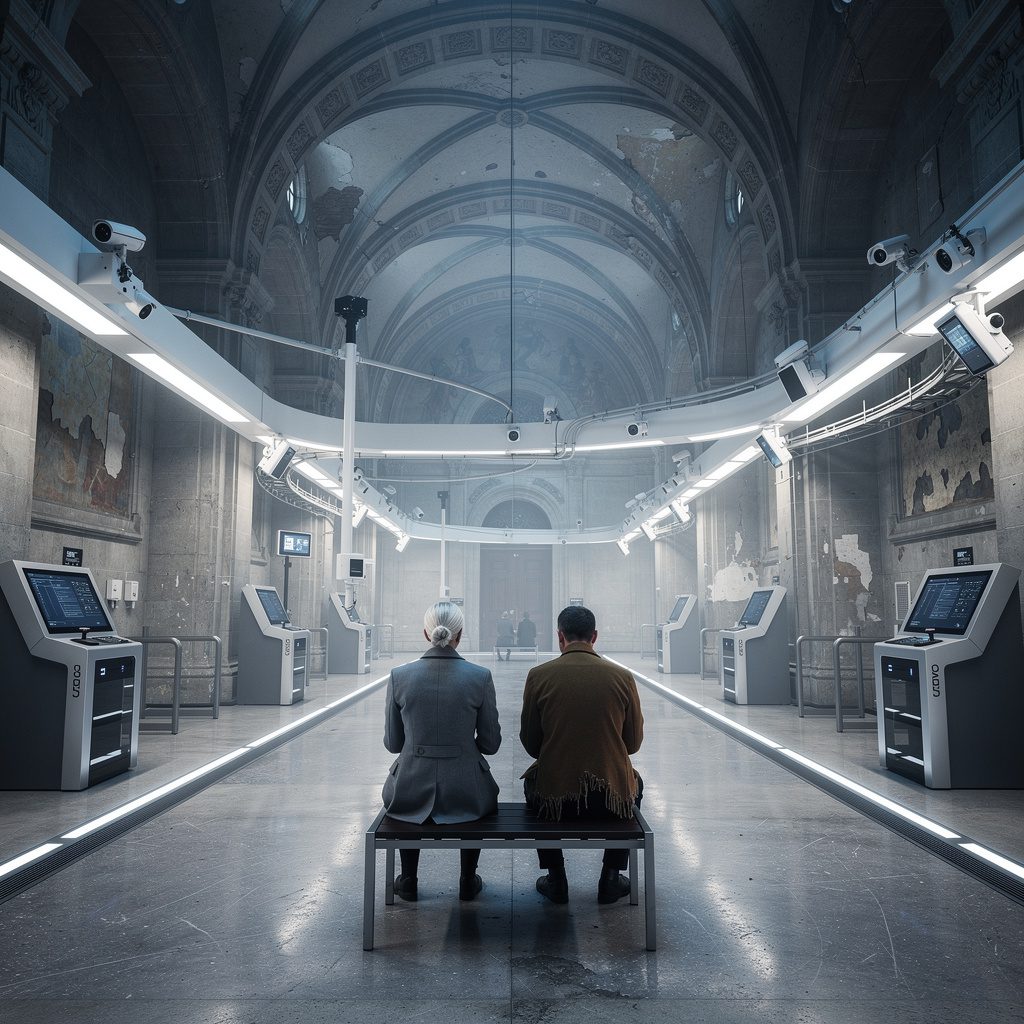
On the fourth day, I return to Gate Seven.
Theodora is already there, beside the dead terminal, and she looks at me with the expression of someone watching a proof complete itself.
I tell her the coordinates quietly, in the two-second blind spot at the eastern corner, during the primary array’s rotation away from the gate. I have timed this with the precision of two years’ careful observation. My voice is steady. The numbers leave me like something I’ve been holding too long.
She presses the data wafer from her coat lining into my palm — warm, thin as a fingernail — and closes my fingers around it. “The Archive’s record of what you said matches exactly,” she tells me. “To the word.” Her voice carries no triumph. Only that same grief, clarified now, like water after the sediment settles. “They’ll know you helped me when I access the core. The behavioral log will show the conversation here. They’ll re-score you.”
I know this. I have known it since the third night, when the coordinates surfaced and I understood that I was already inside the loop, that the choice had in some sense already been made by a version of me who had thought it through to its end and decided yes. The Directorate’s systems will flag today’s interaction. My rating will drop. Red-band, most likely — restricted movement, mandatory reassessment, the full architecture of their attention turned toward me. It is not a small cost. It is, in the language of the life I have built inside their parameters, everything.
But the data wafer in my hand contains eleven years of buried research. Evidence of the temporal echo phenomenon the Directorate discovered and then sealed away — not because it was a modeling artifact, but because it was real, and because a government that has built its power on predicting citizen behavior cannot afford for its citizens to know that prediction runs in both directions. That the future leaves traces. That the observed, if they know how to look, can read the architecture of what is coming just as clearly as the watchers believe they can.
Theodora turns to go. I watch her move through the corridor — steady, unhurried, the grey coat carrying its hidden data, her silver hair catching the flat institutional light. She does not look back.
I press my palm to the reader at Gate Seven one last time. I breathe into the biometric column. I wait for the chime.
Green light.
For now.

 WhatsApp
 Telegram
 Email







Categories
- AI & Technology
- Contemporary
- Corporate Control
- Creepypasta
- Crime Thriller
- Cyberpunk
- Dark Fantasy
- Enemies to Lovers
- Fairy Tale Retelling
- Fantasy
- First Contact
- Forbidden
- Genetic/Body Horror
- High Fantasy
- Monster Hunter
- Mythic/Folklore
- Paranormal
- Portal/Otherworld
- Post-Apo
- Post-Collapse Society
- Psychological Thriller
- Romances
- SCI-FI
- Second Chance
- Slow Burn
- Space Combat
- Spacepunk
- Surveillance State
- Survival Thriller
- Thrillers
- Time Travel
- Treasure Hunter
- Urban Fantasy
- Witchcraft/Curses
Tags
10min stories atmospheric atmospheric fantasy atmospheric fiction contemporary romance Creepy creepypasta crime thriller dark fantasy debt dystopia emotional fiction enemies to lovers ensemble cast epistolary fantasy female protagonist first person forbidden romance framed narrative high fantasy love story magic Memory mystery Paranormal psychological horror psychological thriller romance sci-fi second chance second chance romance short fiction short story slow burn space station speculative fiction supernatural Survival survival thriller suspense thriller travel romance witchcraft workplace romance
Leave a Reply