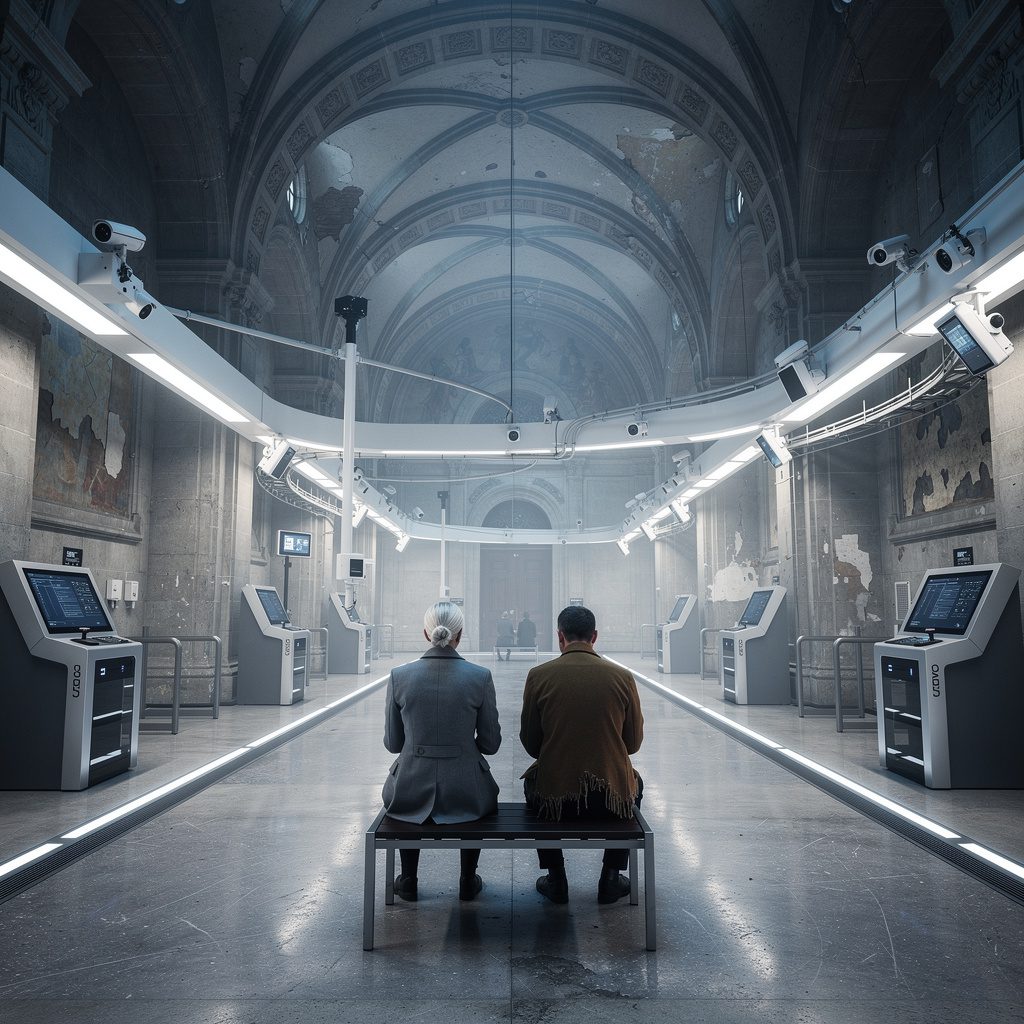
What she tells me is this: she came from a research installation called the Vethara Deep Archive, a sub-basement facility beneath the old university district that the Directorate officially closed eleven years ago. Unofficially, she says, it was converted. The Archive had been studying what the Directorate’s own scientists called “temporally displaced behavioral echoes” — a phenomenon their surveillance systems had begun detecting in the data streams. Patterns of behavior that appeared in the compliance logs before the behavior actually occurred. Micro-predictions, they called them at first. Then the predictions grew longer. Days ahead. Then weeks. The Directorate had assumed it was a modeling artifact, a flaw in the predictive algorithms they used to pre-score citizen behavior. They had been wrong. Theodora had been one of the researchers assigned to understand why. What she found — what she is still carrying, in a data wafer pressed into the lining of her transit coat — is the record of a conversation. A conversation between her and a woman named Elspeth Donnelly, logged in the Archive’s internal system with a timestamp forty-eight hours in the future.
I sit with this for a moment.
The transit corridor hums around us. A compliance officer passes at the far end, her uniform the flat charcoal of Directorate authority, her own sensor relay clipped to her shoulder and broadcasting continuously. I watch the officer’s path. I watch the sweep of the arrays. I am always watching. This is what two years of yellow-band living does to a person — it makes you a student of surveillance, an archaeologist of the observed world, reading the landscape of control the way an explorer reads terrain.
“What does the conversation say?” I ask.
Theodora’s expression shifts — something between relief and sorrow. “You tell me where the Archive’s primary data core is buried. The physical location. The Directorate moved it before they shut the facility down. They buried it under the reclamation plant district. You tell me the exact coordinates.” She pauses. “And then you tell me to find you here, four days before that conversation is scheduled to happen. So that I can give you the time to figure out how you know.”
This is the moment the dread becomes something else. Not urgency yet — not quite — but the sensation of standing at the edge of a very long drop and understanding, for the first time, that the drop is real.
I spend the next three days doing what I have always done in the face of an unmapped space: I explore it methodically. I cannot access restricted Directorate databases — my compliance terminal has yellow-band limitations, monitored and throttled — but I can access the public urban planning records, the geological surveys, the licensed construction permits from eleven years ago. I do this in small increments, never more than a few queries per session, never a pattern the monitoring systems would flag as purposeful research. I sleep badly. I eat at the correct times, in the correct quantities, because deviation in biometric baselines is logged. I think about Theodora’s face — the grief in it, the specific grief of someone who has seen a thing that cannot be unseen and has been carrying it alone.
On the third night, I find it. Not the coordinates themselves, but the shape of an absence: a construction permit from eleven years ago for a “soil remediation project” in the reclamation district, filed under a subsidiary name that doesn’t appear in any other Directorate record before or after. A single permit. A single company. A footprint so careful it is almost invisible — which is to say, it is exactly the kind of footprint left by people who know how surveillance works, because they built it. I triangulate from the permit boundaries, from the geological survey lines, from the old university district maps I’ve been quietly assembling in my head for three days. And when I have the coordinates — six digits, precise to within four meters — I understand something that makes the air go strange around me.
I have always known these coordinates.
Not consciously. Not as information I possessed. But when I write them down, they feel like a word I’ve been trying to remember, finally surfacing. The sensation is disorienting in a way I can’t fully describe — like finding a room in your own home that you’ve somehow never opened, and discovering it is full of your own handwriting.

 WhatsApp
 Telegram
 Email







Categories
- AI & Technology
- Contemporary
- Corporate Control
- Creepypasta
- Crime Thriller
- Cyberpunk
- Dark Fantasy
- Enemies to Lovers
- Fairy Tale Retelling
- Fantasy
- First Contact
- Forbidden
- Genetic/Body Horror
- High Fantasy
- Monster Hunter
- Mythic/Folklore
- Paranormal
- Portal/Otherworld
- Post-Apo
- Post-Collapse Society
- Psychological Thriller
- Romances
- SCI-FI
- Second Chance
- Slow Burn
- Space Combat
- Spacepunk
- Surveillance State
- Survival Thriller
- Thrillers
- Time Travel
- Treasure Hunter
- Urban Fantasy
- Witchcraft/Curses
Tags
10min stories atmospheric atmospheric fantasy atmospheric fiction contemporary romance Creepy creepypasta crime thriller dark fantasy debt dystopia emotional fiction enemies to lovers ensemble cast epistolary fantasy female protagonist first person forbidden romance framed narrative high fantasy love story magic Memory mystery Paranormal psychological horror psychological thriller romance sci-fi second chance second chance romance short fiction short story slow burn space station speculative fiction supernatural Survival survival thriller suspense thriller travel romance witchcraft workplace romance
Leave a Reply