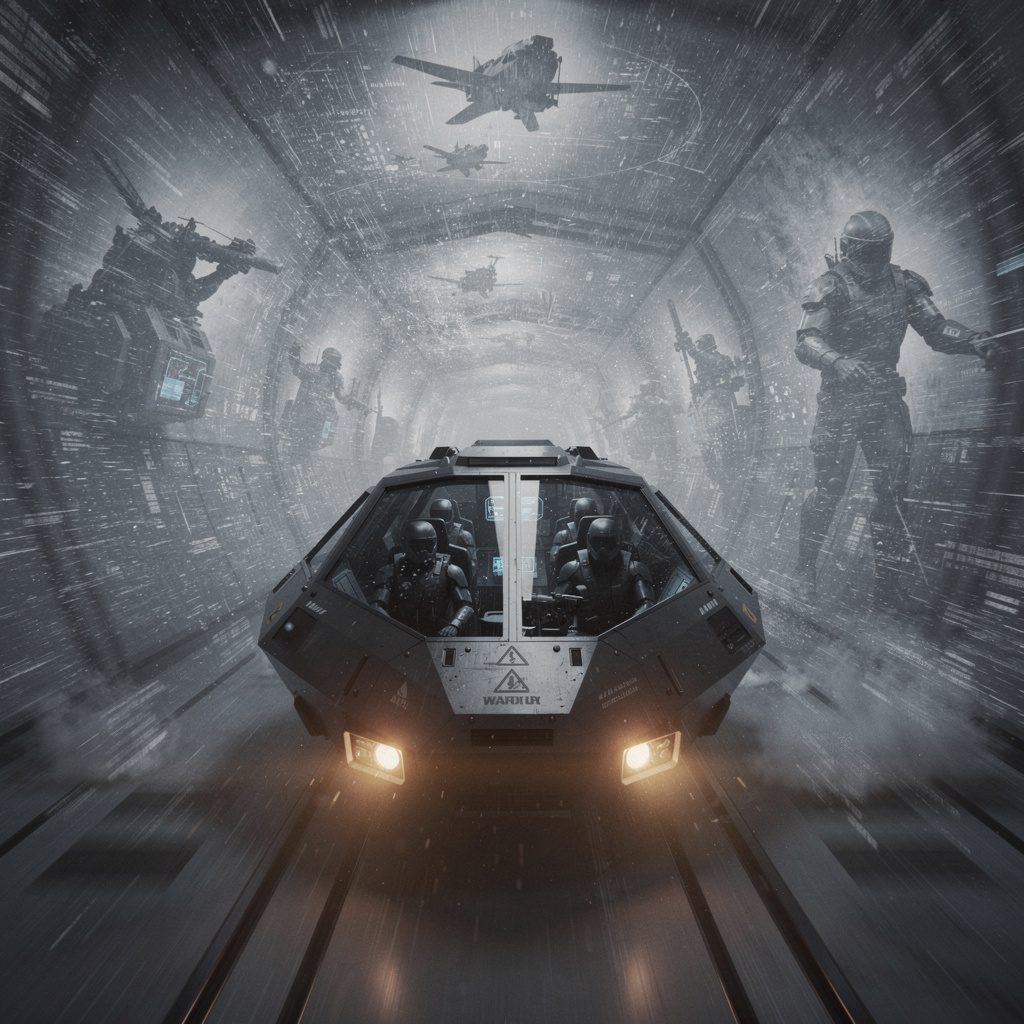
Thornbury stood. He moved to the command console beside Rudenko and pulled up the mission file — the full package, not the abbreviated field brief. He scrolled fast. Rudenko watched him read. She’d read it herself, twice, before deployment. She knew what was in it.
What she hadn’t noticed — what none of them had noticed, because it was buried in the technical appendix under Corridor stability projections — was a single annotation, flagged by a junior analyst and apparently ignored by everyone above her in the review chain.
Thornbury found it. He read it aloud, slow and deliberate.
“Corridor anchor degradation at Havel’s last known position is consistent with deliberate interference, not natural decay. Probability structures surrounding the anchor show signs of external compression. Someone is collapsing the window from the inside.”
Two minutes.
Rudenko made the call. “We go.”
“That’s a direct violation of a confirmed TOA abort,” Pruitt said. Not an argument. A fact. He was already moving to his deployment harness.
“Havel said don’t let them close it,” she said. “Someone just tried to make sure we do exactly that. I want to know why.”
Thornbury was already locked in. Winterbourne had her kit sealed and secured. Pruitt clipped his harness in four seconds flat.
The anchor point materialized ahead of them — a fixed disc of stabilized spacetime, glowing faint amber at the edges, pulsing with the effort of holding itself open against whatever was compressing it from within. It was smaller than the mission file had projected. Much smaller. The degradation was accelerating.
They hit the anchor at full insertion speed.
The transition was brutal — always was, but this one more than usual. The Corridor spat them out into a maintenance sub-level of what had once been a TOA relay station, circa 2089, two years before the Armistice. The air tasted of burnt insulation and recycled oxygen. Emergency lighting painted everything a deep, arterial red.
Havel was there. He was seated against the far wall, a field terminal across his lap, his face drawn and pale with the particular exhaustion of someone who has been living in fractured time too long. He looked up when they entered. He did not look surprised.
He looked relieved.
And then Lesia Rudenko saw what was on his terminal screen — a full system map of the Corridor relay network, with one node highlighted and actively transmitting — and she understood everything. All of it. At once.
The node was Meridian Station. The compression signal collapsing the anchor from the inside was originating from TOA command itself. And the timestamp on the compression order matched, exactly, the timestamp on the abort transmission they’d received in the pod.
The same command. The same moment. Two signals sent simultaneously: one to abort the extraction, one to collapse the anchor and strand Havel permanently inside the Corridor.
Havel hadn’t gone dark by accident. He’d found something. And someone at Meridian had decided the cleanest solution was to seal him inside a degrading probability tunnel and send his team home before they could pull him out.
Winterbourne was already working on him — scanning, stabilizing, prepping the return harness with practiced efficiency. Pruitt had the anchor re-lock sequence running, buying them minutes. Thornbury stood at the entrance to the sub-level, watching the corridor beyond, rifle in hand, saying nothing.
Rudenko crouched in front of Havel.
“What did you find?”
He handed her a data chip. Small. Black. Warm from being held so long.
“The Armistice wasn’t negotiated,” he said. “It was installed. Someone came back and wrote it into the timeline. TOA senior command has known for eleven years. The war didn’t end. It was edited.”
The anchor pulsed. Pruitt called out thirty seconds.
Rudenko pocketed the chip. She stood. She looked at her team — Thornbury at the door, Winterbourne lifting Havel to his feet, Pruitt counting down with his eyes on the screen.
None of them had been told what they were walking into. The order to stand down had made no sense until it was already too late to obey it.
That, she realized now, had been the point.
They went through the anchor together, all five of them, and the Corridor sealed shut behind them like a wound closing over something that would not stay buried.

 WhatsApp
 Telegram
 Email







Categories
- AI & Technology
- Contemporary
- Corporate Control
- Creepypasta
- Crime Thriller
- Cyberpunk
- Dark Fantasy
- Enemies to Lovers
- Fairy Tale Retelling
- Fantasy
- First Contact
- Forbidden
- Genetic/Body Horror
- High Fantasy
- Monster Hunter
- Mythic/Folklore
- Paranormal
- Portal/Otherworld
- Post-Apo
- Post-Collapse Society
- Psychological Thriller
- Romances
- SCI-FI
- Second Chance
- Slow Burn
- Space Combat
- Spacepunk
- Surveillance State
- Survival Thriller
- Thrillers
- Time Travel
- Treasure Hunter
- Urban Fantasy
- Witchcraft/Curses
Tags
10min stories atmospheric atmospheric fantasy atmospheric fiction contemporary romance Creepy creepypasta crime thriller dark fantasy debt dystopia emotional fiction enemies to lovers ensemble cast epistolary fantasy first person forbidden romance found text framed narrative high fantasy love story magic Memory mystery Paranormal psychological horror psychological thriller romance sci-fi second chance second chance romance short fiction short story slow burn space station speculative fiction supernatural Survival survival thriller suspense thriller travel romance witchcraft workplace romance
Leave a Reply